2020issue C1025
Constructing late-trend longs with a price channel, gap breakout, and trailing stop
After at least two weeks of defined uptrend action, recent highs and lows can be marked as a price channel. A small upside gap that clears that channel starts a written plan: wait for an advance of at least 0.50 dollars above the breakout day's high, then bind the long with an initial day-low stop and a two-dollar trailing stop.
- After an uptrend of at least two weeks, recent highs and lows can be marked as a price channel that contains later trading until a breakout appears.
- A small upside gap that clears that preexisting channel is classified as a continuation breakout, not as ordinary in-range movement.
- The constructed entry waits until price has advanced at least 0.50 dollars above the high of the breakout day, then places an initial stop one dollar below the entry day's low and a two-dollar trailing stop.
- The same channel-plus-gap signal may open a new long or add to a long already held. Price still inside the channel is treated as noise.
Start with a defined uptrend channel
Setup work starts by scanning for charts with two or more weeks of defined uptrend action and holding those symbols on a watchlist until the small upside gap-breakout appears.
After an uptrend lasting at least two weeks, recent highs and lows can be marked as a price channel that contains subsequent trading. That price channel is a visually marked band of those highs and lows. It contains ordinary range movement until a breakout appears.
Price action that remains inside the current channel is treated as noise. The written plan begins only when the channel-breakout signal appears.
Treat the small upside gap as the breakout
A small upside gap that clears that preexisting channel is classified as a continuation breakout rather than ordinary in-range movement. The breakout is treated as confirmation that renewed buying has started, not as in-range noise.
Gap-continuation names the same event more narrowly: a modest upside opening gap that appears inside an established uptrend and extends the prior channel rather than reversing it.
Write the entry offset before opening or adding
The constructed entry waits until price has advanced at least 0.50 dollars above the high of the day on which the channel breakout is observed. That entry-offset is the minimum advance required before the long is opened or added to.
The same channel-plus-gap signal may open a new long or add to a long already held.
Bind the idea with an initial stop and a trailing stop
The initial stop is placed one dollar below the low of the day the position is entered.
After that initial stop is set, risk is further bounded with a two-dollar trailing stop. The trailing stop is a follow-along exit that stays a fixed two-dollar distance from price after the initial stop has already been placed one dollar below the entry day's low.
OSTK daily closes around the July 2020 price-channel breakout
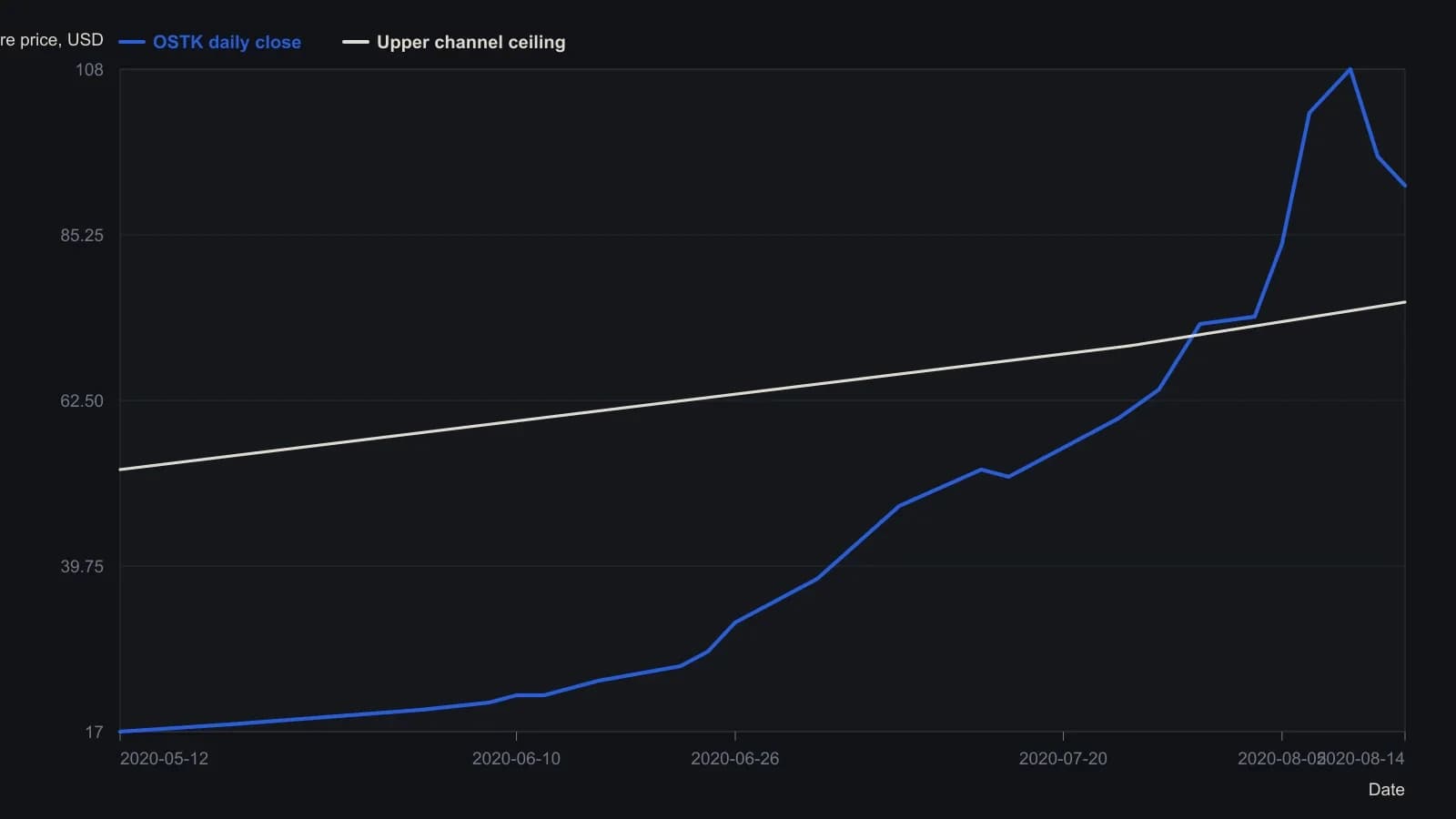
Digitized from the daily candle raster and rounded to whole dollars. The article’s 0.50-dollar entry offset, 1-dollar initial stop, and 2-dollar trailing stop are rules, not plotted series.
All readings on this track · 55 readings
- 1988Constructing price channels from trendlines
- 1988Three-point curved trend channel construction
- 1988Least-squares construction of channel trendlines
- 1988Three-zone price channel from quadratic smoothing
- 1989A variable-sensitivity stochastic built on three-sigma bounds
- 1989Close-minus-average oscillator for channel extremes
- 1989The six-stage hunt as a critique of one-click heroics
- 1990Fair-value gaps and a copper moving-average channel
- 1990Diversify markets, not systems, to cut trend-system variance
- 1991Constructing trendlines, price channels, and close-based breakouts
- 1991Constructing seasonal-cycle overlays with channel confirmation
- 1993Lag-compensated exponential trend channel construction
- 1993Constructing a lead-lag filter and price channel as one stack
- 1993Three stochastic warnings still need price-channel confirmation
- 1993Lead-lag smoothing for weekly trend-channel construction
- 1993Constructing zero-net-lag price channels
- 1995From a downtrend-line break to a regression channel
- 1995Validated trendline and price channel construction
- 1995Constructing price envelopes from averages, volatility, and regression
- 1996Constructing trendlines and channels from explicit swings
- 1998Fifty percent retracement as a channel regime test
- 1998Close-based channel rails as daily scenario maps
- 1999Constructing support, resistance, trendlines, and price channels
- 2001Cycle composites, price channels, and two-sided signals
- 2001Testing horizontal price channels with stops and scale
- 2002A two-stage momentum-shift and price-channel process
- 2002Wave-by-wave channel construction for Elliott counts
- 2002Affine channels as reusable trade hypotheses
- 2004Stress-test seasonal windows across regimes, then add channels
- 2004Regime permission from trendlines, channels, and range edges
- 2004Weekly-average and price-channel states on sector depositary baskets
- 2005Oil services catch-up after channel resistance breaks
- 2005Constructing a volatility-normalized cycle index
- 2005How a Darvas channel becomes a complete entry and exit procedure
- 2005Clustered Fibonacci and channel levels in news-driven forex
- 2005Treat a consolidating currency market as a time-frame problem
- 2005Channel walls that flip roles or recapture price
- 2006Stacking candlesticks, crossovers, and price channels
- 2006Failed uptrend channel breakout left the euro rangebound
- 2006Constructing a Wilson relative price channel from a range-bound strength index
- 2007Range bars change when a Bollinger squeeze counts as a breakout
- 2009One testable SPY procedure for a price channel, a trend rule, and a seasonal overlay
- 2010A gold-miner channel plan from value to false breakouts
- 2010A multi-timeframe channel from value to an overvalued zone
- 2010Asymmetric price channel construction for congested markets
- 2011Phasing many cycles at once with nested envelopes
- 2012Constructing adaptive horizontal price channels
- 2014Confirming support with trendlines, channels, and retracements
- 2015News-sentiment confirmation for support, channel, and volume tests
- 2015A three-layer permission stack: moving averages, a price channel, and weekly levels
- 2016Entropy-diff as a regime switch between trend following and a price channel
- 2017Competing rulers on a pound chart after Brexit
- 2017Test consolidation channel breakouts as one procedure
- 2020Constructing late-trend longs with a price channel, gap breakout, and trailing stop
- 2025Using IBM's multi-year price channel as a breakout teaching case