2001issue C151-2
Cycle composites, price channels, and two-sided signals
Archive notes describe a rule-based model that issued buy and sell signals, joined three cycle readings into one composite-cycle, and applied entry, exit, and abstention rules as a complete procedure. Editorial: TradersWeek teaches that stack as a three-layer classroom test.
- A market timer combined minor, intermediate, and major cycle readings into one composite-cycle so a trend change could be inspected as a single forecast object.
- Action charts placed that reading beside a price-channel and a volume-flow line, with a market-timer-histogram supplying the buy and sell arrows.
- Buy, sell, and abstention marks belonged to one published mechanical-trading-system, not to a one-sided recommendation.
- Weekly up-down-ranking output from the composite-cycle was used to add or remove names from a model portfolio, and the same chart treatment could be built for names outside that book.
What the archive described
The service under review was framed as a quantitative, rule-based model. It issued both buy and sell signals rather than one-sided recommendations.
The same cycle-and-signal treatment was applied beyond equities to commodities, currencies, credit markets, indices, and industry groups.
The review located the work on a position-horizon mechanical-trading-system. The stated entry, exit, and abstention rules had to be applied as one complete procedure.
Joining three cycles into one forecast
A market timer read trend conditions on minor, intermediate, and major cycles. It then combined those readings into one composite-cycle, described as more responsive to trend changes.
Editorial vocabulary: a dominant-cycle is a measured oscillation in ordered price, volume, or breadth. It is treated as a forecast over a defined sampling interval and lookback, then checked against a later result.
A composite-cycle is one series formed by joining the minor, intermediate, and major readings so a change in trend can be inspected as a single object.
Channels, volume-flow, and the timer pane
Action charts for a currency continuous contract showed the minor cycle together with buy and sell marks, price channels, and a cumulative volume-flow line.
A histogram pane representing the market timer was the component that placed the buy and sell arrows on the price chart. In classroom terms, the market-timer-histogram is the subchart that converts the composite-cycle state into those marks.
Editorial vocabulary: a price-channel is an envelope drawn from OHLC structure and chart scale so a repeatable price condition can be stated as a hypothesis from an intradaily bar through several weeks. Volume-flow is a cumulative volume series plotted with price so participation can be read beside the channel and the cycle marks.
British pound continuous futures through the minor cycle
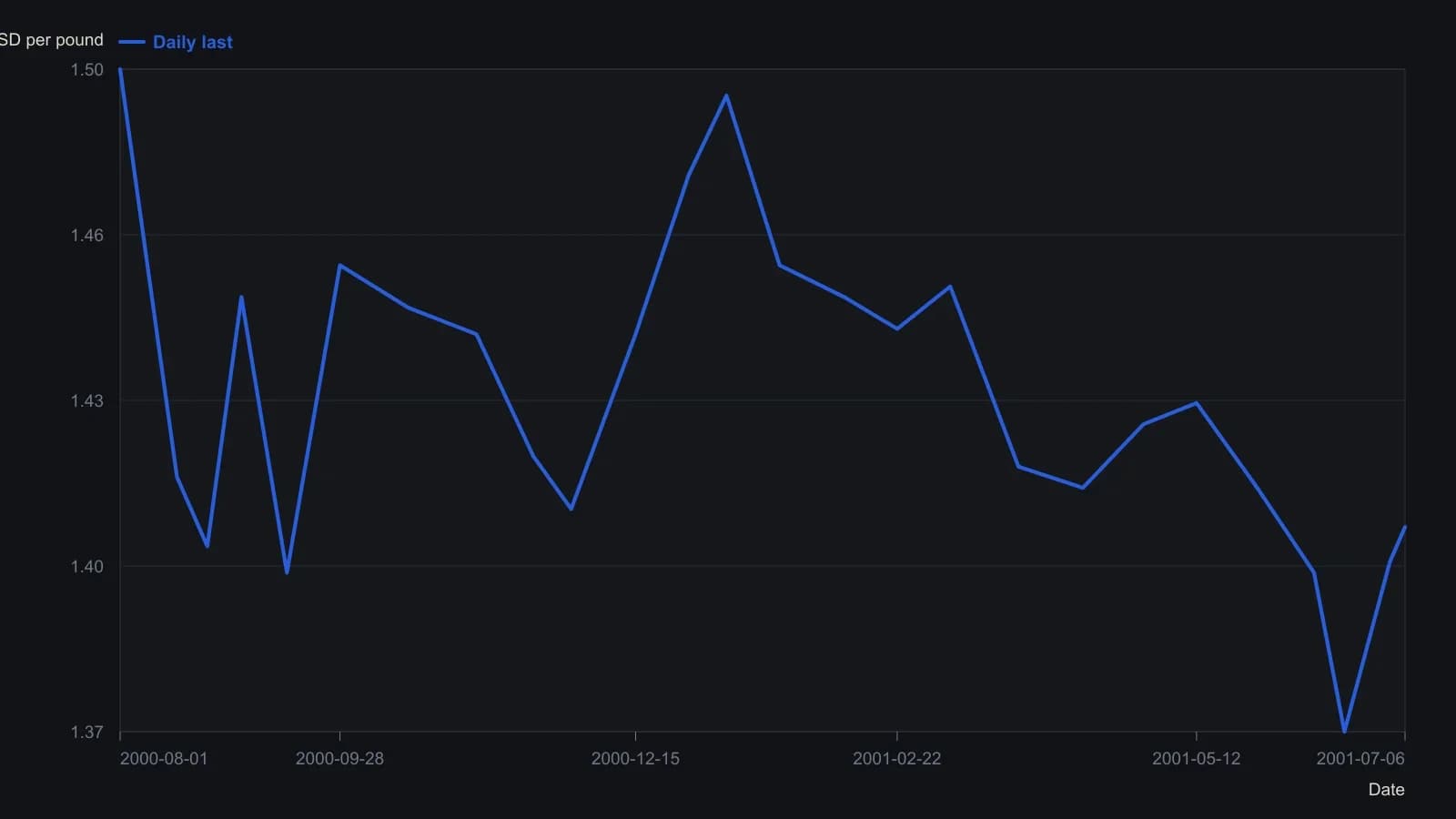
OHLC bars were reduced to last price at visible swings. Volume, cumulative volume, and the WSR timer histogram use other scales and were not traced. Dates are taken from the month axis (August 2000–July 2001); swing timing is approximate to about one week.
Inspectable rules and the model book
Rules for the timer components were published so the mechanical procedure could be inspected. The same action-chart treatment could be generated for securities outside the model portfolio.
The composite-cycle output fed weekly up-down-ranking lists. Those ordered lists were used to add or remove names from a model portfolio.
Editorial vocabulary: a mechanical-trading-system is a complete rule set that turns market state and execution constraints into entry, exit, and abstention marks over one holding period and can be applied as a single procedure. An up-down-ranking is an ordered list derived from the composite-cycle and used to add or remove names from a model book.
All readings on this track · 55 readings
- 1988Constructing price channels from trendlines
- 1988Three-point curved trend channel construction
- 1988Least-squares construction of channel trendlines
- 1988Three-zone price channel from quadratic smoothing
- 1989A variable-sensitivity stochastic built on three-sigma bounds
- 1989Close-minus-average oscillator for channel extremes
- 1989The six-stage hunt as a critique of one-click heroics
- 1990Fair-value gaps and a copper moving-average channel
- 1990Diversify markets, not systems, to cut trend-system variance
- 1991Constructing trendlines, price channels, and close-based breakouts
- 1991Constructing seasonal-cycle overlays with channel confirmation
- 1993Lag-compensated exponential trend channel construction
- 1993Constructing a lead-lag filter and price channel as one stack
- 1993Three stochastic warnings still need price-channel confirmation
- 1993Lead-lag smoothing for weekly trend-channel construction
- 1993Constructing zero-net-lag price channels
- 1995From a downtrend-line break to a regression channel
- 1995Validated trendline and price channel construction
- 1995Constructing price envelopes from averages, volatility, and regression
- 1996Constructing trendlines and channels from explicit swings
- 1998Fifty percent retracement as a channel regime test
- 1998Close-based channel rails as daily scenario maps
- 1999Constructing support, resistance, trendlines, and price channels
- 2001Cycle composites, price channels, and two-sided signals
- 2001Testing horizontal price channels with stops and scale
- 2002A two-stage momentum-shift and price-channel process
- 2002Wave-by-wave channel construction for Elliott counts
- 2002Affine channels as reusable trade hypotheses
- 2004Stress-test seasonal windows across regimes, then add channels
- 2004Regime permission from trendlines, channels, and range edges
- 2004Weekly-average and price-channel states on sector depositary baskets
- 2005Oil services catch-up after channel resistance breaks
- 2005Constructing a volatility-normalized cycle index
- 2005How a Darvas channel becomes a complete entry and exit procedure
- 2005Clustered Fibonacci and channel levels in news-driven forex
- 2005Treat a consolidating currency market as a time-frame problem
- 2005Channel walls that flip roles or recapture price
- 2006Stacking candlesticks, crossovers, and price channels
- 2006Failed uptrend channel breakout left the euro rangebound
- 2006Constructing a Wilson relative price channel from a range-bound strength index
- 2007Range bars change when a Bollinger squeeze counts as a breakout
- 2009One testable SPY procedure for a price channel, a trend rule, and a seasonal overlay
- 2010A gold-miner channel plan from value to false breakouts
- 2010A multi-timeframe channel from value to an overvalued zone
- 2010Asymmetric price channel construction for congested markets
- 2011Phasing many cycles at once with nested envelopes
- 2012Constructing adaptive horizontal price channels
- 2014Confirming support with trendlines, channels, and retracements
- 2015News-sentiment confirmation for support, channel, and volume tests
- 2015A three-layer permission stack: moving averages, a price channel, and weekly levels
- 2016Entropy-diff as a regime switch between trend following and a price channel
- 2017Competing rulers on a pound chart after Brexit
- 2017Test consolidation channel breakouts as one procedure
- 2020Constructing late-trend longs with a price channel, gap breakout, and trailing stop
- 2025Using IBM's multi-year price channel as a breakout teaching case