1995issue C031-3
Validated trendline and price channel construction
A trendline is drawn from two valid extremes that do not cut through intervening bars. It stays a tentative-trendline until a third untouched retest treats it as established. A parallel return-line then completes a price-channel, so slope, age, incomplete traverses, and a chosen break-and-stop rule can be checked on the same construction.
- A tentative-trendline uses at least two valid extremes and must not cut through any intervening price bars.
- A third untouched retest is what treats the line as an established-trendline, which is then extended as far to the right as the chart allows.
- A price-channel is the band between the primary trendline and a parallel return-line; an incomplete traverse is read as fading momentum.
- A trendline-break has several cited confirmation standards, and one stop convention sits just beyond the high or low of the session that first crossed the line.
A construction checklist
Editorial: treat trend work as a construction checklist rather than a line adjusted after the fact. Two valid extremes, a no-cut-through rule, a third untouched retest, and a parallel return-line let slope, age, incomplete channel traverses, and a predefined break-and-stop rule be checked against the same bars.
Two valid extremes and a no-cut-through rule
A trendline is drawn from at least two points: an extreme high or low and a later opposite swing extreme. The line must not cut through any intervening price bars. Until price comes back, that segment is a tentative-trendline.
The third untouched test
A two-point line stays tentative until price returns to touch it without penetrating it. A third untouched test is what treats the line as an established-trendline.
The same two-point rules are meant to keep construction simple and consistent and to stop the line being bent to fit a preferred outcome. The finished line is then extended as far to the right as the chart allows.
Slope, age, and repeated touches
Price is described as trending up, down, or sideways. Steeper lines are more easily pierced by a brief consolidation, while lines nearer horizontal are treated as weaker and more breakable.
A line is treated as stronger the more often it is touched without a break. A line that has held for several months is treated as more significant than one that has existed only days or weeks.
The return-line and the price-channel
A price-channel is constructed by adding a second line parallel to the primary trendline along the opposite extremes. That second line is the return-line. The pair may slope up, down, or sideways.
December 1993 T-bond futures in an upward price channel
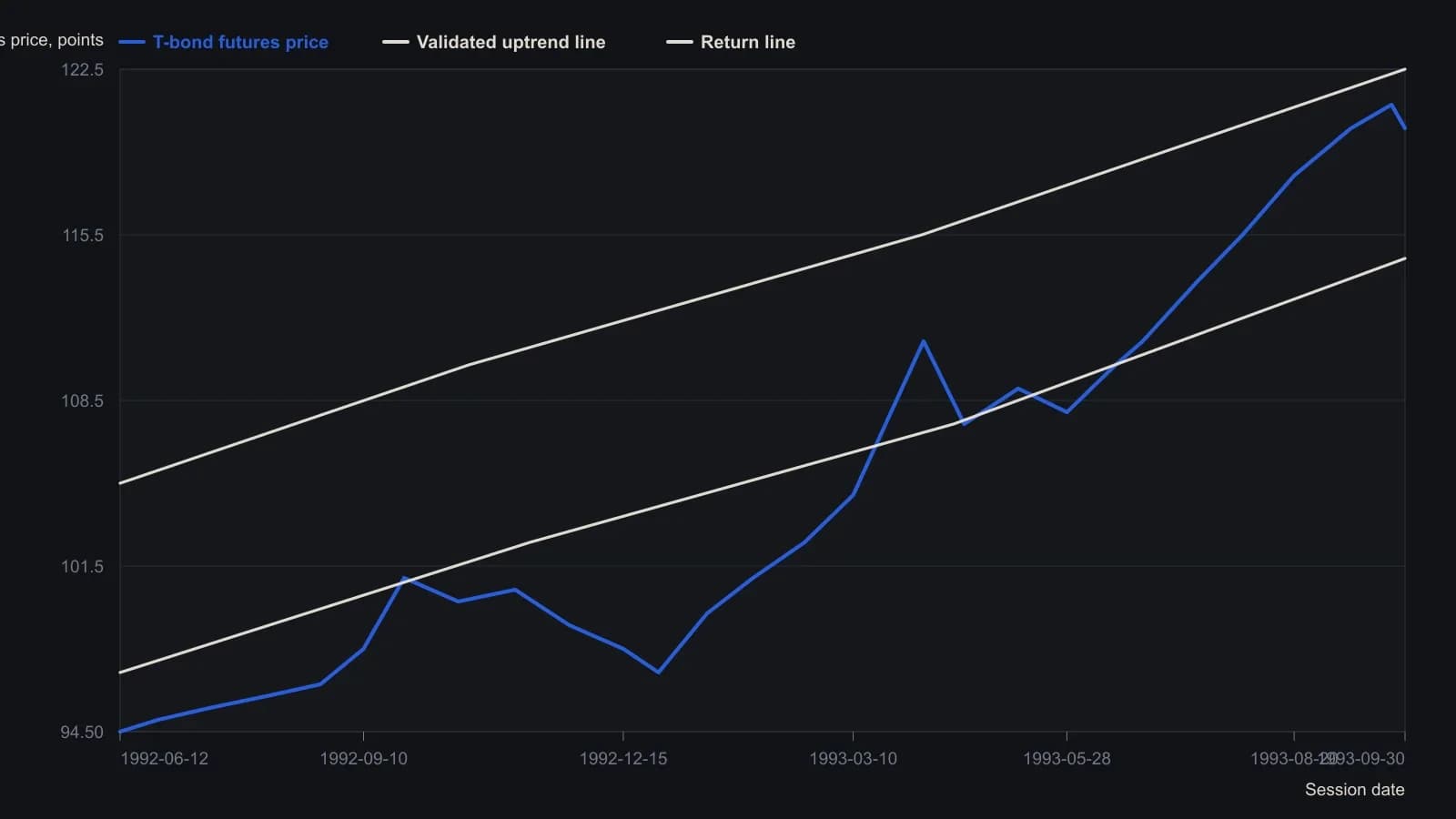
Sampled from the Technical Tools daily-bar raster. T-bond futures quote in 32nds of a point, but the print only supports about half-point accuracy; sessions are thinned, not every bar.
Disputed tests for a trendline-break
What counts as a trendline-break is disputed. Cited standards include an intraday pierce, a close beyond the line, a close 3 percent beyond the line, or two consecutive closes outside it.
A stop beyond the first crossing session
After a trending channel is broken, one stop convention places the protective order just beyond the high or low of the session that first crossed the line, in case the break later fails.
Shorter trendlines can form inside a larger move. Where those minor lines meet the dominant line is treated as a location where shorter-horizon orders are often placed or removed.
All readings on this track · 55 readings
- 1988Constructing price channels from trendlines
- 1988Three-point curved trend channel construction
- 1988Least-squares construction of channel trendlines
- 1988Three-zone price channel from quadratic smoothing
- 1989A variable-sensitivity stochastic built on three-sigma bounds
- 1989Close-minus-average oscillator for channel extremes
- 1989The six-stage hunt as a critique of one-click heroics
- 1990Fair-value gaps and a copper moving-average channel
- 1990Diversify markets, not systems, to cut trend-system variance
- 1991Constructing trendlines, price channels, and close-based breakouts
- 1991Constructing seasonal-cycle overlays with channel confirmation
- 1993Lag-compensated exponential trend channel construction
- 1993Constructing a lead-lag filter and price channel as one stack
- 1993Three stochastic warnings still need price-channel confirmation
- 1993Lead-lag smoothing for weekly trend-channel construction
- 1993Constructing zero-net-lag price channels
- 1995From a downtrend-line break to a regression channel
- 1995Validated trendline and price channel construction
- 1995Constructing price envelopes from averages, volatility, and regression
- 1996Constructing trendlines and channels from explicit swings
- 1998Fifty percent retracement as a channel regime test
- 1998Close-based channel rails as daily scenario maps
- 1999Constructing support, resistance, trendlines, and price channels
- 2001Cycle composites, price channels, and two-sided signals
- 2001Testing horizontal price channels with stops and scale
- 2002A two-stage momentum-shift and price-channel process
- 2002Wave-by-wave channel construction for Elliott counts
- 2002Affine channels as reusable trade hypotheses
- 2004Stress-test seasonal windows across regimes, then add channels
- 2004Regime permission from trendlines, channels, and range edges
- 2004Weekly-average and price-channel states on sector depositary baskets
- 2005Oil services catch-up after channel resistance breaks
- 2005Constructing a volatility-normalized cycle index
- 2005How a Darvas channel becomes a complete entry and exit procedure
- 2005Clustered Fibonacci and channel levels in news-driven forex
- 2005Treat a consolidating currency market as a time-frame problem
- 2005Channel walls that flip roles or recapture price
- 2006Stacking candlesticks, crossovers, and price channels
- 2006Failed uptrend channel breakout left the euro rangebound
- 2006Constructing a Wilson relative price channel from a range-bound strength index
- 2007Range bars change when a Bollinger squeeze counts as a breakout
- 2009One testable SPY procedure for a price channel, a trend rule, and a seasonal overlay
- 2010A gold-miner channel plan from value to false breakouts
- 2010A multi-timeframe channel from value to an overvalued zone
- 2010Asymmetric price channel construction for congested markets
- 2011Phasing many cycles at once with nested envelopes
- 2012Constructing adaptive horizontal price channels
- 2014Confirming support with trendlines, channels, and retracements
- 2015News-sentiment confirmation for support, channel, and volume tests
- 2015A three-layer permission stack: moving averages, a price channel, and weekly levels
- 2016Entropy-diff as a regime switch between trend following and a price channel
- 2017Competing rulers on a pound chart after Brexit
- 2017Test consolidation channel breakouts as one procedure
- 2020Constructing late-trend longs with a price channel, gap breakout, and trailing stop
- 2025Using IBM's multi-year price channel as a breakout teaching case