1993issue C031-13
Lead-lag smoothing for weekly trend-channel construction
Weekly trend channels can be built from a data-filter whose filter-lag is cancelled before width is measured. The rails then come from a lead-lag center line plus or minus a scaled modified-sigma, and the lower rail is compared with a longer exponential trend filter.
- Filters used to build a trend channel are judged by two opposing properties: how much they damp short-term noise and how many bars they lag the input series.
- A lead-lag filter applies a first-order correction after exponential smoothing so net lag can be cancelled while the same alpha still sets the smoothness.
- A weekly modified-sigma width averages five squared deviations from the lead-lag series and then averages those variances over 13 observations.
- Suggested weekly construction uses a lead/lag length of 6 to 8, a width multiplier of 2.3 to 2.6, and a longer exponential average as the trend filter compared with the lower rail.
Noise damping versus filter-lag
Filters used to build a trend channel are judged by two opposing properties: how much they damp short-term noise and how many bars they lag the input series. Filter-lag is that bar count when the smoother is plotted on the latest close. A data-filter is the rule that turns an ordered price series into the smoother used as a center line or as input to a width measure.
Matching simple and exponential lag
A simple moving average of length N lags the input by (N-1)/2 bars, so a seven-bar average is three bars late when plotted on the current close. Exponential smoothing is a recursive average that updates by a fraction alpha of the gap between the latest observation and the prior average. An exponential moving average lags by (1/alpha)-1, and setting alpha equal to 2/(N+1) matches the lag of an N-bar simple average.
A lead-lag filter for the center line
Applying a first-order correction with gamma equal to 2(alpha-1) after an exponential smoother yields a lead-lag filter whose net lag can be cancelled while the same alpha still sets the smoothing. The lead-lag filter is that correction: net delay can be driven toward zero while the original alpha still sets smoothness. Lengthening the lead/lag window increases smoothness but also increases overshoot and slows the response when the input slope changes, as a seven-point filter does less of both than an 11-point filter on a ramp-and-hold series.
Modified-sigma after the shift
Volatility measured against an uncentered seven-week average spikes after breakouts, while shifting that average forward by three weeks narrows the reading but postpones the calculation until later closes exist. A weekly modified-sigma width can be built by averaging five squared deviations from the lead/lag series and then averaging those variances over 13 observations. Modified-sigma is that two-stage width, averaged again so the envelope does not jump with every bar.
Rails, slope, and the trend filter
Upper and lower channel lines are the modified lead/lag series plus or minus j times modified sigma, with the scale factor j set at or above 2.0. Those rails are the price channel: a scaled modified-sigma width added to and subtracted from the low-lag center line. Suggested weekly construction ranges are a lead/lag length of 6 to 8 and a width multiplier of 2.3 to 2.6, with a separate longer exponential average used as the trend filter compared with the lower channel rail. The trend filter is that longer exponential average, used as the baseline that the lower channel rail is compared with to mark a timing hypothesis.
A three-week exponential prefilter that is shifted for zero net lag needs the next close, so the finished channel ends one bar before the latest print and can be extended with the channel slope.
S&P 500 weekly lead-lag channel versus the trend filter
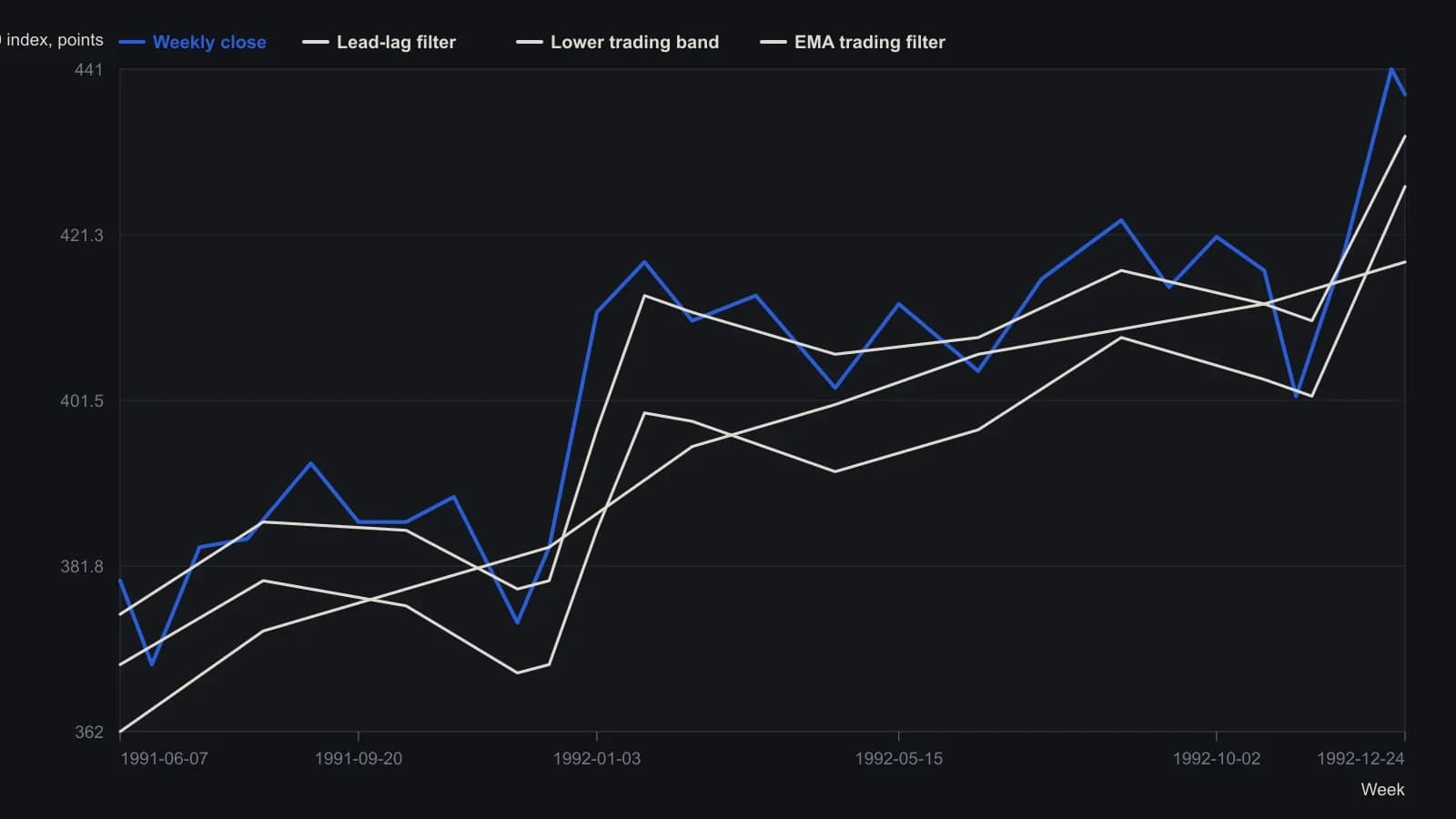
Warren built the center with a seven-week lead-lag after a three-week EMA prefilter, scaled modified-sigma by about 2.5 for the rails, and used a roughly 29-week EMA as the trading filter. Raster readings are only good to about two index points.
All readings on this track · 55 readings
- 1988Constructing price channels from trendlines
- 1988Three-point curved trend channel construction
- 1988Least-squares construction of channel trendlines
- 1988Three-zone price channel from quadratic smoothing
- 1989A variable-sensitivity stochastic built on three-sigma bounds
- 1989Close-minus-average oscillator for channel extremes
- 1989The six-stage hunt as a critique of one-click heroics
- 1990Fair-value gaps and a copper moving-average channel
- 1990Diversify markets, not systems, to cut trend-system variance
- 1991Constructing trendlines, price channels, and close-based breakouts
- 1991Constructing seasonal-cycle overlays with channel confirmation
- 1993Lag-compensated exponential trend channel construction
- 1993Constructing a lead-lag filter and price channel as one stack
- 1993Three stochastic warnings still need price-channel confirmation
- 1993Lead-lag smoothing for weekly trend-channel construction
- 1993Constructing zero-net-lag price channels
- 1995From a downtrend-line break to a regression channel
- 1995Validated trendline and price channel construction
- 1995Constructing price envelopes from averages, volatility, and regression
- 1996Constructing trendlines and channels from explicit swings
- 1998Fifty percent retracement as a channel regime test
- 1998Close-based channel rails as daily scenario maps
- 1999Constructing support, resistance, trendlines, and price channels
- 2001Cycle composites, price channels, and two-sided signals
- 2001Testing horizontal price channels with stops and scale
- 2002A two-stage momentum-shift and price-channel process
- 2002Wave-by-wave channel construction for Elliott counts
- 2002Affine channels as reusable trade hypotheses
- 2004Stress-test seasonal windows across regimes, then add channels
- 2004Regime permission from trendlines, channels, and range edges
- 2004Weekly-average and price-channel states on sector depositary baskets
- 2005Oil services catch-up after channel resistance breaks
- 2005Constructing a volatility-normalized cycle index
- 2005How a Darvas channel becomes a complete entry and exit procedure
- 2005Clustered Fibonacci and channel levels in news-driven forex
- 2005Treat a consolidating currency market as a time-frame problem
- 2005Channel walls that flip roles or recapture price
- 2006Stacking candlesticks, crossovers, and price channels
- 2006Failed uptrend channel breakout left the euro rangebound
- 2006Constructing a Wilson relative price channel from a range-bound strength index
- 2007Range bars change when a Bollinger squeeze counts as a breakout
- 2009One testable SPY procedure for a price channel, a trend rule, and a seasonal overlay
- 2010A gold-miner channel plan from value to false breakouts
- 2010A multi-timeframe channel from value to an overvalued zone
- 2010Asymmetric price channel construction for congested markets
- 2011Phasing many cycles at once with nested envelopes
- 2012Constructing adaptive horizontal price channels
- 2014Confirming support with trendlines, channels, and retracements
- 2015News-sentiment confirmation for support, channel, and volume tests
- 2015A three-layer permission stack: moving averages, a price channel, and weekly levels
- 2016Entropy-diff as a regime switch between trend following and a price channel
- 2017Competing rulers on a pound chart after Brexit
- 2017Test consolidation channel breakouts as one procedure
- 2020Constructing late-trend longs with a price channel, gap breakout, and trailing stop
- 2025Using IBM's multi-year price channel as a breakout teaching case