1999issue C091-6
Index-fund positions as a majority-vote committee
Editorial reading: treat an index-fund vehicle as a committee decision. Each simple rule casts one long or abstain ballot, and a purchase is contemplated only when a pre-agreed majority of independent checks agree.
- The procedure trades an index-fund vehicle that tracks the S&P 500 rather than a basket of individual stocks.
- Component systems from market-breadth, price momentum, market sentiment, and interest-rate proxies are mixed instead of used in isolation.
- A majority-vote-entry contemplates a purchase when six of as many as nine reviewed indicators are simultaneously long.
- The design prefers simpler rules and longer-frame confirmation of shorter-frame signals so entry, exit, and reduced exposure remain one testable procedure.
A committee of simple rules
Editorial interpretation: TradersWeek reads this archive workflow as a way to treat an index-fund position as a committee vote. Each simple rule casts one long or abstain ballot. Capital is committed only when a pre-agreed majority of independent checks agree.
A mechanical trading system is a prewritten procedure that turns market observations into a long, short, or stand-aside action without discretionary rewrite at the moment of trade. The archive procedure applies that idea to an index-fund vehicle, a mutual fund designed to track a broad equity index so a trader can apply system signals without selecting individual stocks. The fund in this workflow is designed to track the S&P 500 rather than a basket of individual stocks.
Mix the ballots
Component systems are drawn from market-breadth measures, price momentum, market sentiment, and interest-rate proxies, then mixed instead of used in isolation. A majority-vote-entry is a scoring rule that adds one point for each bullish component and buys only when a stated number of those points is reached. In this workflow a purchase is contemplated when six of as many as nine reviewed indicators are simultaneously long.
Market-breadth scores
Market-breadth is a count of how many issues participate in an advance or decline, typically via new highs, new lows, advancing issues, and declining issues.
One breadth rule takes daily new yearly highs divided by the sum of new yearly highs and new yearly lows, smooths that ratio with a 10-day exponential average, and scores +1 when the average exceeds 70. A simpler breadth ratio of new highs to the sum of new highs and new lows issues a buy when the ratio is above 0.5.
Sentiment and an interest-rate proxy
A contrary-sentiment-check is a crowd-expectation reading treated as a warning when bullish consensus is extreme and as support when it is subdued. Weekly bullish-consensus readings above 70 are treated as a possible negative, while readings near 35 are treated as a possible constructive extreme. A contrary sentiment score of +1 is assigned whenever weekly bullish consensus stays below 70.
A moving-average is a lookback average of ordered prices used to mark trend direction when a faster average crosses a slower one or when price sits above or below the average. One interest-rate proxy applies a weekly 10-period and 20-period moving-average crossover to the utility average, with tabulated signals from April 23, 1993 through January 15, 1999.
Confirm the shorter signal
Index confirmation is treated as present when the S&P 500 and either the Dow industrials or the transports sit above a 39-week moving average. Multi-timeframe-confirm is a requirement that a longer sampling interval, such as a weekly close, agree with a shorter daily signal before size is increased.
The design prefers simpler rules, multiple daily and weekly frames, and longer-frame confirmation of shorter-frame signals so that entry, exit, and reduced exposure remain one testable procedure.
S&P 500 daily closes, late 1996 to 2 July 1999
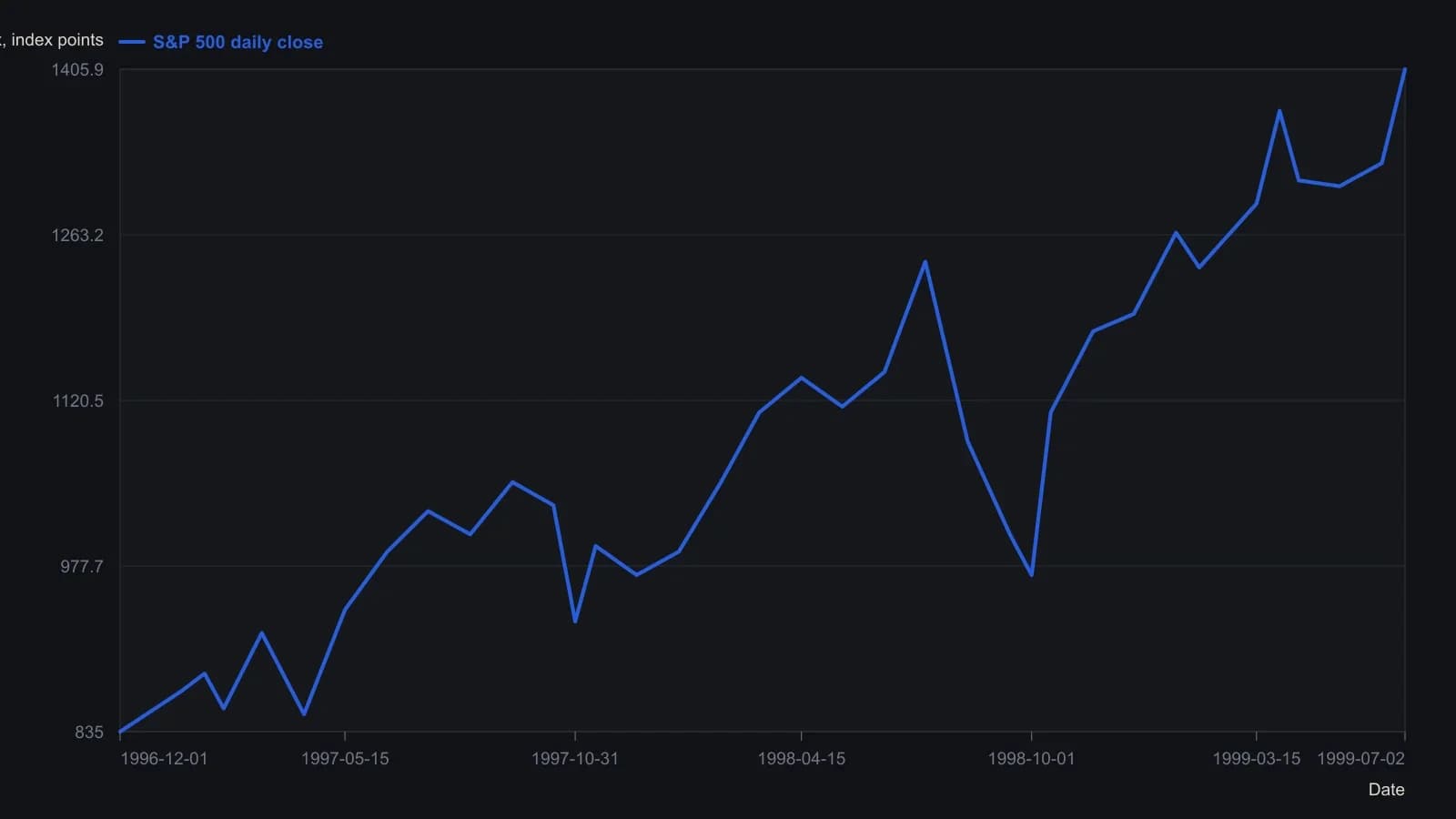
Read from a daily line chart with a 50-point price grid. Dates are month-scale anchors except the header date of 2 July 1999. Interior closes are approximate to about 10 index points and are not exchange official prints.
All readings on this track · 71 readings
- 1987How a failed rebound, weak breadth, and cycle dates broke the 1987 bull case
- 1988Diagnosing market bottoms with breadth, divergence and averages
- 1988Diagnosing index tops with breadth divergences
- 1988Record highs versus seven-day breadth and divergence
- 1989Constructing a percentage-scaled internals composite
- 1989Constructing a weekly block-tick breadth z-score
- 1989Constructing a dual-rate advance-decline oscillator
- 1989Normalize advance-decline series for a common-scale comparison
- 1990Unchanged-issue share as a narrow-breadth case study
- 1990Evaluating daily and weekly unsigned plurality breadth
- 1990Constructing paired new-high and new-low breadth indicators
- 1990Ten-day HI/LO extremes as a long-horizon breadth signal
- 1990Confirming index cycles with breadth, volume, and waves
- 1990Index cycle gates from breadth and volume
- 1990Constructing advance-decline breadth indicators
- 1990Weekly advance-decline oscillator: weight map, extremes, and spike cycle
- 1990Price-weighted construction distorts breadth, support, and trend
- 1991A peak-sequence test from the new-highs-to-advances-ratio
- 1991Fuzzy rules that turn daily market-breadth into a session consensus
- 1991From daily breadth tallies to a weighted consensus signal
- 1991Retesting market-breadth when market structure changes
- 1991Constructing TRIN as a breadth-volume ratio
- 1991Build the market clock before you read a price bar
- 1991A construction audit of the long-horizon trading index
- 1991Independent formula timers kept as a testable combination
- 1992When identical TRIN prints come from different pairings
- 1992Grade closing tick before a next-session breadth hypothesis
- 1992Noncumulative advance-decline swing confirmation
- 1992Five-day sum construction of the trading index
- 1992Daily closing-trin extremes and next-day direction
- 1992A three-layer audit: regime, breadth, and group RSI
- 1992Constructing a nine-state trend, momentum, and breadth score
- 1993Constructing a market-volume-impact rating from nested averages
- 1993When advance-decline confirmation counts the wrong universe
- 1993Constructing breadth momentum from advance-decline smoothing
- 1993Constructing a cumulative market-thrust line
- 1994Three-horizon construction of the Haurlan index
- 1994Checklist-gated session entry in 1993 index futures
- 1994Read one advance-decline pair through three windows
- 1994Constructing calibrated market-breadth summation indexes
- 1994Constructing a two-speed advance-decline oscillator and a calibrated summation
- 1995NYSE tick extremes and candlestick reversal entries
- 1995Assembling range, breadth, and a stored stop into one procedure
- 1995Restating market breadth timing rules as ratios
- 1995Constructing breadth ratio gates after lookback drawdowns
- 1995Building a short-range breadth and price oscillator
- 1996Constructing a smoothed advance-decline trend filter
- 1996Smoothed advance-decline alerts at the 1987 and 1990 turning points
- 1996Constructing breadth, RSI, and stochastic range filters
- 1996New-high and new-low counts as a breadth construction
- 1996Constructing the four-input breadth-volume ratio
- 1996Constructing the McClellan oscillator and a calibrated summation index
- 1996Declare the oscillator seed, then calibrate only the summation index
- 1997Three-gate centered strength in market-breadth construction
- 1997Daily advance-decline and new-high new-low breadth signals
- 1999Index-fund positions as a majority-vote committee
- 2000Tick, tiki and TRIN as a three-layer session confirmation stack
- 2000Constructing an advance-decline oscillator from one listed tape
- 2001Market breadth, beta, and volume-price confirmation
- 2001Regime context from relative venue volume, breadth, and intermarket spreads
- 2002When NYSE breadth misreads operating-stock participation
- 2003Two-gate breadth divergence and a trend filter for rally tops
- 2003Market internals confirm or diverge from the index
- 2004Constructing the McClellan oscillator and summation index
- 2005Intraday index-futures divergence as a three-part session hypothesis
- 2005Breadth summation levels as a short-term signal filter
- 2005Checking trend versus range with breadth and divergence
- 2011Constructing a Nasdaq hi-lo index from highs, lows, and issues traded
- 2013Cumulative advance-decline versus a one-year average
- 2013A one-year breadth average as a participation gate
- 2015Falsifying a healthy correction with breadth and support