2003issue C011-2
Four sleeves on one regime board: gold miners, REITs, bills, and equities
A single market sleeve is an incomplete context. The 2000 to 2002 archive path places an unhedged gold-miner basket, listed equity REITs, short Treasury bills, and the total U.S. equity market on one board. An editorial reading treats disagreement among those sleeves as the lesson, not a search for a winner.
- The unhedged gold-equity basket holds mining and production shares that keep gold largely unhedged beyond about 11 to 12 years, so it is meant to track bullion more closely than a broader gold-and-silver equity index.
- That gold basket spent most of 2000 below its 50- and 200-period moving averages, turned higher in early 2001, and was described as breaking out in the first half of 2002, while listed equity REITs rose above both averages in the first half of 2000 and lost both in the summer of 2002 after a spring peak.
- Short-term rates rose in 1999 and into 2000, then yields fell sharply in 2001 after the policy rate was cut from 6% in January to 1.75% by December, and the total U.S. equity market printed three major troughs in spring 2001, autumn 2001, and summer through autumn 2002.
- Read together, those years show four sleeves in different regimes at once. An editorial reading keeps them on one intermarket dashboard so the disagreement is the context, not a contest.
One sleeve is not a regime board
An editorial starting point is that any one sleeve is incomplete until four series sit on the same intermarket dashboard: an unhedged gold-equity basket, an equity REIT sleeve, a short-bill discount index, and a total-market equity index.
The archive then supplies a 2000 to 2002 path in which those sleeves do not share one moving-average regime. An editorial use of that path is to read the disagreement, not to search for a winner.
Unhedged gold miners and the moving-average filter
The archive defines the gold sleeve as a miner basket of mining and production shares that do not hedge gold beyond about 11 to 12 years. That construction is presented as tracking gold-price moves more closely than a broader gold-and-silver equity index.
A moving-average regime here means trade above or below the 50- and 200-period averages. The gold-miner basket spent most of 2000 below both averages, then turned higher in early 2001. The first half of 2002 is described as a breakout phase.
Equity REITs lose both averages
The equity REIT sleeve is an index of exchange-listed trusts that own or operate income-producing real estate. In this board it is the housing- and rate-sensitive portfolio sleeve.
That index moved above both its 50- and 200-period moving averages in the first half of 2000. After a spring 2002 peak, it fell back beneath both averages in the summer of 2002.
Short bills reverse with policy rates
The short-bill discount index is based on the discount rate of the latest auctioned 13-week Treasury bill. The archive pairs it with the 30-year Treasury bond to form a yield spread treated as a gauge of inflation expectations.
Rising short-term rates in 1999 and into 2000 reversed into a sharp 2001 drop in yields after the policy rate was cut from 6% in January 2001 to 1.75% by December.
Three troughs in the total equity market
The total-market equity index is treated as a broad U.S. listed-equity measure for the full public stock market rather than a narrow industrial or technology subset. A companion series keeps only the small- and mid-capitalization names from that same universe.
That broad equity index recorded three major bear-market troughs in spring 2001, autumn 2001, and summer through autumn 2002.
Wilshire 5000 through three bear-market troughs
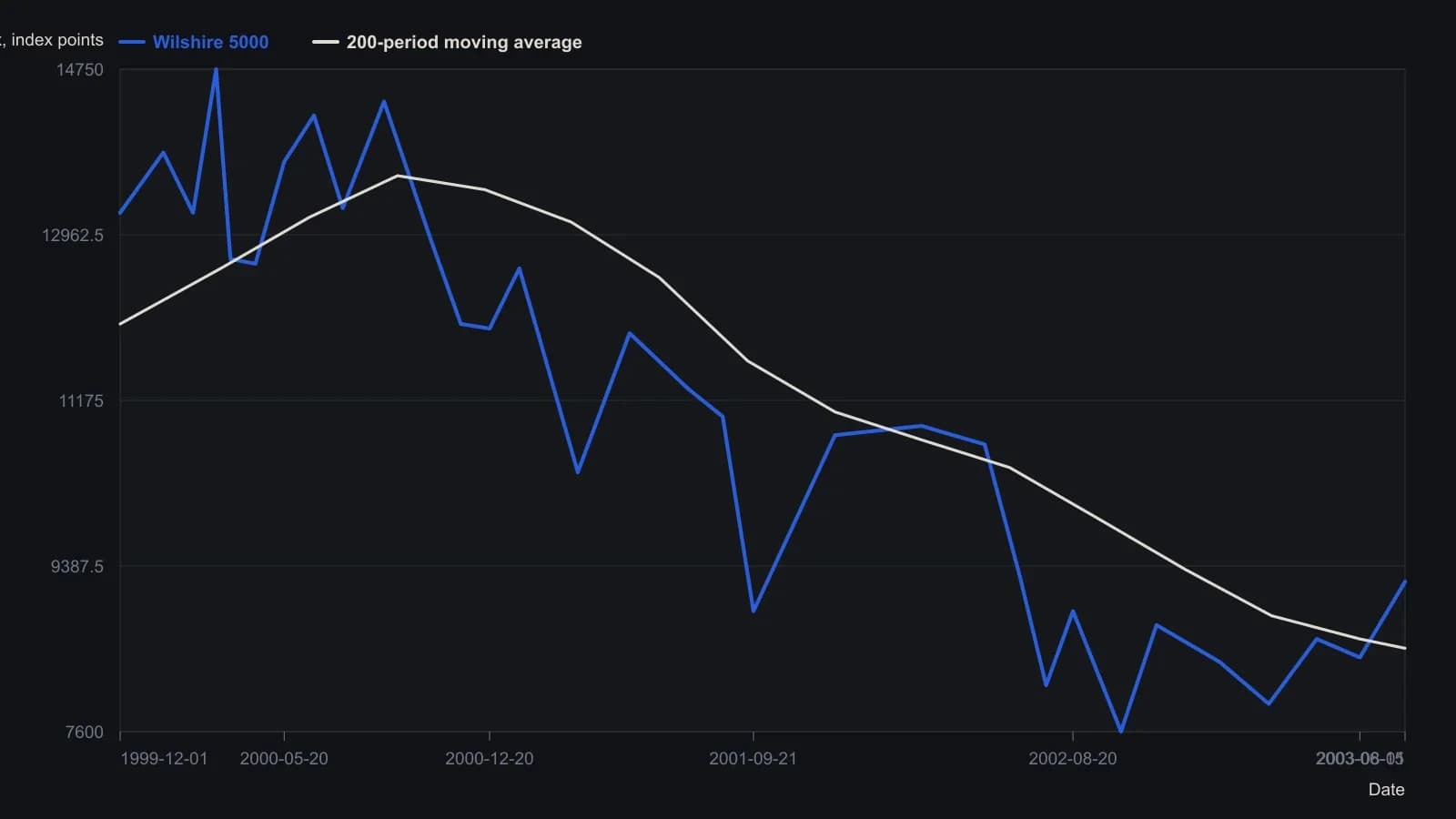
Raster digitization of the TradeStation pane. The axis is labeled ×10, so a printed 900 is 9000 index points. Turning-point dates are month-accurate only; levels are approximate to about 50 index points and are not official prints. The final close 9219 is taken from the platform title bar on that pane.
Disagreement is the reading
Read together, the 2000 to 2002 record shows four sleeves in different regimes at once: gold miners lifting after 2000, equity REITs losing both moving averages after a 2002 peak, short bills reversing from a 1999-2000 rate rise into a 2001 policy-rate collapse, and the total equity market printing three major troughs.
An editorial close is to treat disagreement among the sleeves as the lesson, not a search for a winner. Keep the four series on one board so a single position is placed in a diversified, regime-aware context.
All readings on this track · 33 readings
- 1990Policy-auction spread as a weekly equity regime filter
- 1992Electric utilities as bond-regime context
- 1992Reading the dollar as a rates-regime check
- 1992Evaluating weekly intermarket context for equity regimes
- 1993Specifying the stock-bond yield gap as a hold-or-abstain regime
- 1996Constructing dual-gate bond-fund entries from gold-silver jumps
- 1996Name the regime before the sector breakout
- 2002Falling prices flip stock-bond confirmation
- 2003Four sleeves on one regime board: gold miners, REITs, bills, and equities
- 2003Four currency regimes for the yen, loonie, pound and Australian dollar
- 2003Read gold through the dollar regime, the hedge spread, and a stop
- 2003When deflation flips the stock-bond map
- 2003Commodity subgroup regime boards and dual averages
- 2003Reading a liquidity regime when gold, bonds, and stocks rise together
- 2003A shared weekly checklist for four country funds
- 2004Size-and-style sleeves as a weekly regime map
- 2004Country closed-end funds shared one average checklist and four regimes
- 2004A 2004 four-pair snapshot of a dollar-bloc FX regime
- 2005Country closed-end funds as a weekly regime comparison
- 2005Weekly regime maps for production-weighted commodity subgroups
- 2005Four technology sleeves on one weekly regime map
- 2006The Australian dollar as a commodity regime and timing filter
- 2008Dual-listing moving averages as a crowd-regime test
- 2008Cross-market regime context for a single trade
- 2010Dollar index, cross rates, and commodity context for forex targets
- 2010Gold and silver forex session candles as metals-regime context
- 2012Yield curve regime and equity timing
- 2013Yield curve shapes as stock market regime context
- 2013Yield spreads as country-specific equity regime context
- 2016Credit spreads as an equity cash regime filter
- 2016The summer lull is a context error
- 2019Financial sector spreads as regime tells around a global stablecoin
- 2019The negative-yield regime as an equity intermarket filter