2006issue C011-4
The Australian dollar as a commodity regime and timing filter
Treat the Australian dollar as a commodity-currency regime filter first. Use its trend versus the US dollar, and confirmation versus the yen, to decide whether commodities and cyclical assets deserve risk. Only after that backdrop is set should a short-horizon predicted-moving-average supply rule-based-entry and exit timing.
- Treat a commodity-currency such as the Australian dollar as a capital-gateway and intermarket-lead first, and as a short-horizon timing input only after the regime is identified.
- A sustained Australian-dollar rise versus the US dollar is presented as typically coinciding with, and sometimes leading, a long-term commodity advance. A later break of the support that defined that uptrend is treated as a sign that capital is no longer leaving the US dollar toward commodity-sensitive regions.
- Australian-dollar weakness versus the US dollar is treated as a forecast of softer commodities. Weakness versus both the US dollar and the yen is treated as stronger cycle-top-confirmation for energy.
- Long-horizon intermarket charts may identify possible trend changes weeks or months ahead, which is not a complete short-term procedure. Once the regime is set, a predicted-moving-average defines rule-based-entry and exit in that direction.
A commodity-currency as the first filter
The Australian dollar is grouped with other resource-linked currencies because it often rises or falls together with, or slightly ahead of, commodity prices. Editorial: that grouping is most useful when the currency is treated as a regime filter for commodities and cyclical assets, and only later as a short-horizon timing input.
A commodity-currency is a currency whose medium-term direction often moves with, or slightly ahead of, raw-materials prices because national income is closely tied to resource exports. The Australian dollar is used in that sense here.
An intermarket-lead, not a simultaneous confirmation
A sustained rise in the Australian dollar versus the US dollar is presented as typically coinciding with, and sometimes leading, a long-term rise in commodity prices. That relationship is an intermarket-lead: a cross-market relationship in which one asset’s trend change is treated as an earlier signal for another related market rather than as a simultaneous confirmation.
From 2002 into 2005 the Australian dollar appreciated versus the US dollar while energy and broader commodity prices also moved higher after the Australian dollar bottomed in 2001.
Australian dollar versus the US dollar, 2000–2005
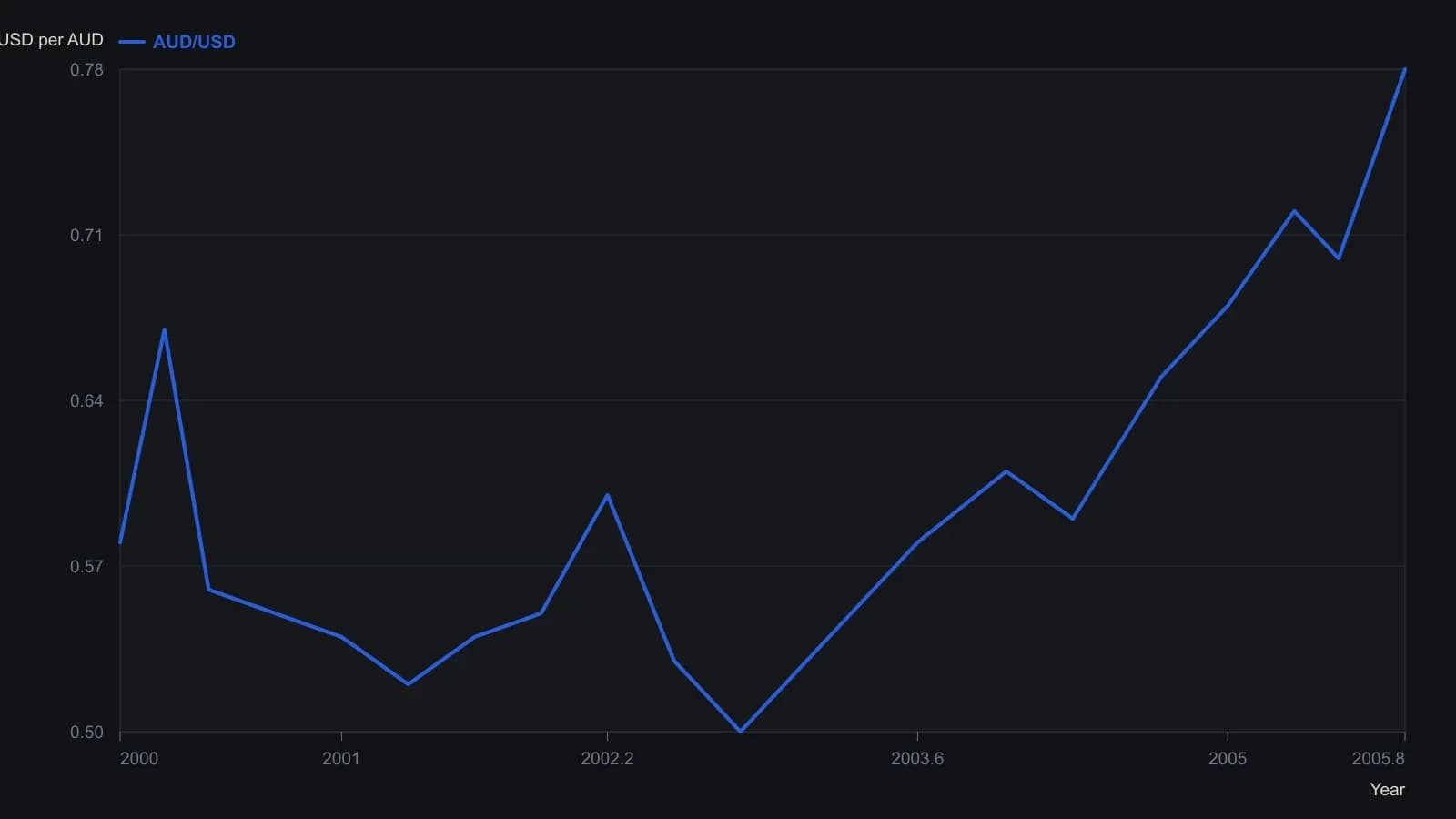
Read from the candlestick pane against the printed 0.39–0.79 scale, so levels are only approximate to about a cent. The companion crude-oil pane is omitted because it is scaled in dollars per barrel.
A capital-gateway turning
A later break of the Australian dollar below the support that had defined its uptrend is treated as a sign that capital is no longer leaving the US dollar toward commodity-sensitive regions. Editorial: read that break as a capital-gateway turning rather than as an isolated chart event.
A capital-gateway is the idea that a currency’s appreciation or depreciation reveals the direction of medium-term capital flows across regions and asset classes.
Cycle-top-confirmation from the yen
Crude oil made multiyear peaks in 1990 and 1997 near lows in the yen versus the Australian dollar, so renewed yen strength against the Australian dollar is used as confirmation that energy prices may be topping.
Australian-dollar weakness against the US dollar is treated as a forecast of softer commodities, while weakness against both the US dollar and the yen is treated as stronger confirmation of an energy cycle top. Cycle-top-confirmation is a second cross-rate move used to corroborate that an energy or commodity advance is exhausting rather than merely pausing.
What a major cycle top is used for
A major Australian-dollar cycle top is framed as a cue to move commodity exposure toward neutral or negative and to rotate equity allocations away from cyclical sectors toward more consumer-oriented issues.
Timing only after the regime is set
Once a long-term intermarket regime is identified, a shorter-term predicted-price-trend method is used to define rule-based entries and exits in the direction of that regime.
In 2005, crude oil futures peaked in late March and early April, declined into May, then rose again into late-August highs after a five-day predicted moving average and a five-day actual moving average turned higher.
A predicted-moving-average is a short-horizon moving-average construct used to forecast the next value of a price series so that a rule can compare the predicted path with the actual average. A rule-based-entry is a predefined procedure that converts market-state inputs into a testable enter, exit, or stand-aside decision rather than a discretionary call.
Editorial: keep that short-horizon comparison inside the already identified regime. The moving-average procedure is a timing input, not a substitute for the commodity-currency backdrop.
All readings on this track · 33 readings
- 1990Policy-auction spread as a weekly equity regime filter
- 1992Electric utilities as bond-regime context
- 1992Reading the dollar as a rates-regime check
- 1992Evaluating weekly intermarket context for equity regimes
- 1993Specifying the stock-bond yield gap as a hold-or-abstain regime
- 1996Constructing dual-gate bond-fund entries from gold-silver jumps
- 1996Name the regime before the sector breakout
- 2002Falling prices flip stock-bond confirmation
- 2003Four sleeves on one regime board: gold miners, REITs, bills, and equities
- 2003Four currency regimes for the yen, loonie, pound and Australian dollar
- 2003Read gold through the dollar regime, the hedge spread, and a stop
- 2003When deflation flips the stock-bond map
- 2003Commodity subgroup regime boards and dual averages
- 2003Reading a liquidity regime when gold, bonds, and stocks rise together
- 2003A shared weekly checklist for four country funds
- 2004Size-and-style sleeves as a weekly regime map
- 2004Country closed-end funds shared one average checklist and four regimes
- 2004A 2004 four-pair snapshot of a dollar-bloc FX regime
- 2005Country closed-end funds as a weekly regime comparison
- 2005Weekly regime maps for production-weighted commodity subgroups
- 2005Four technology sleeves on one weekly regime map
- 2006The Australian dollar as a commodity regime and timing filter
- 2008Dual-listing moving averages as a crowd-regime test
- 2008Cross-market regime context for a single trade
- 2010Dollar index, cross rates, and commodity context for forex targets
- 2010Gold and silver forex session candles as metals-regime context
- 2012Yield curve regime and equity timing
- 2013Yield curve shapes as stock market regime context
- 2013Yield spreads as country-specific equity regime context
- 2016Credit spreads as an equity cash regime filter
- 2016The summer lull is a context error
- 2019Financial sector spreads as regime tells around a global stablecoin
- 2019The negative-yield regime as an equity intermarket filter