2019issue C0844-45
Financial sector spreads as regime tells around a global stablecoin
In 2019, a planned asset-backed-stable-token was framed as a possible long-run alternative to dollar-centered settlement while the dollar was still described as the dominant reserve currency. TradersWeek editorial: treat that headline as a regime event, read the financials-versus-broad-equity relative-strength-spread first, and only then judge the sector-unweighting.
- Treat a planned digital-settlement launch as a market-regime event, then read the financials-versus-broad-equity relative-strength-spread before the product story.
- A lagging financials print can be an intermarket-tell of sector-unweighting, which is positioning rather than a standalone forecast.
- Keep that reading inside a reserve-currency-regime still described as dollar-centered and a backdrop of about 12 trillion dollars in negative-yielding instruments.
- An incumbent-friction-regime can delay an asset-backed-stable-token and inject volatility without proving the challenger is finished.
A settlement headline is a regime event first
A 2019 market note treated a planned 2020 asset-backed-stable-token as a possible long-run alternative to dollar-centered settlement. The design was tied to a very large social-platform user base and a consortium of payments and technology firms.
TradersWeek editorial: treat a headline digital-settlement launch as a market-regime event. Do not start with a sector view and work backward to the funding map.
The reserve-currency-regime was still dollar-centered
Contemporaneous commentary still described the dollar as the dominant reserve currency because of the scale of the US economy and financial markets. The same commentary asked whether a widely adopted digital alternative could eventually change that status.
The archive facts therefore sit inside a reserve-currency-regime that was still described as dollar-centered, with only a long-run question attached.
The relative-strength-spread came with a lag in financials
In the week discussed, a broad US equity fund was up 2.17 percent while a financial-sector fund was up 0.88 percent. Over about one year the same pair was 7.39 percent versus 0.26 percent.
The note interpreted that relative lag as markets already discounting known or anticipated information by reducing financial-sector weight. That is sector-unweighting: a reduction in a group’s relative performance or portfolio weight versus a broad benchmark, read as positioning rather than as a standalone forecast.
By the fixed definition used here, that gap is the relative-strength-spread: the gap between a sector vehicle and a broad equity vehicle over the same window, used here as market-regime context for one theme.
SPY versus XLF returns after the Libra announcement
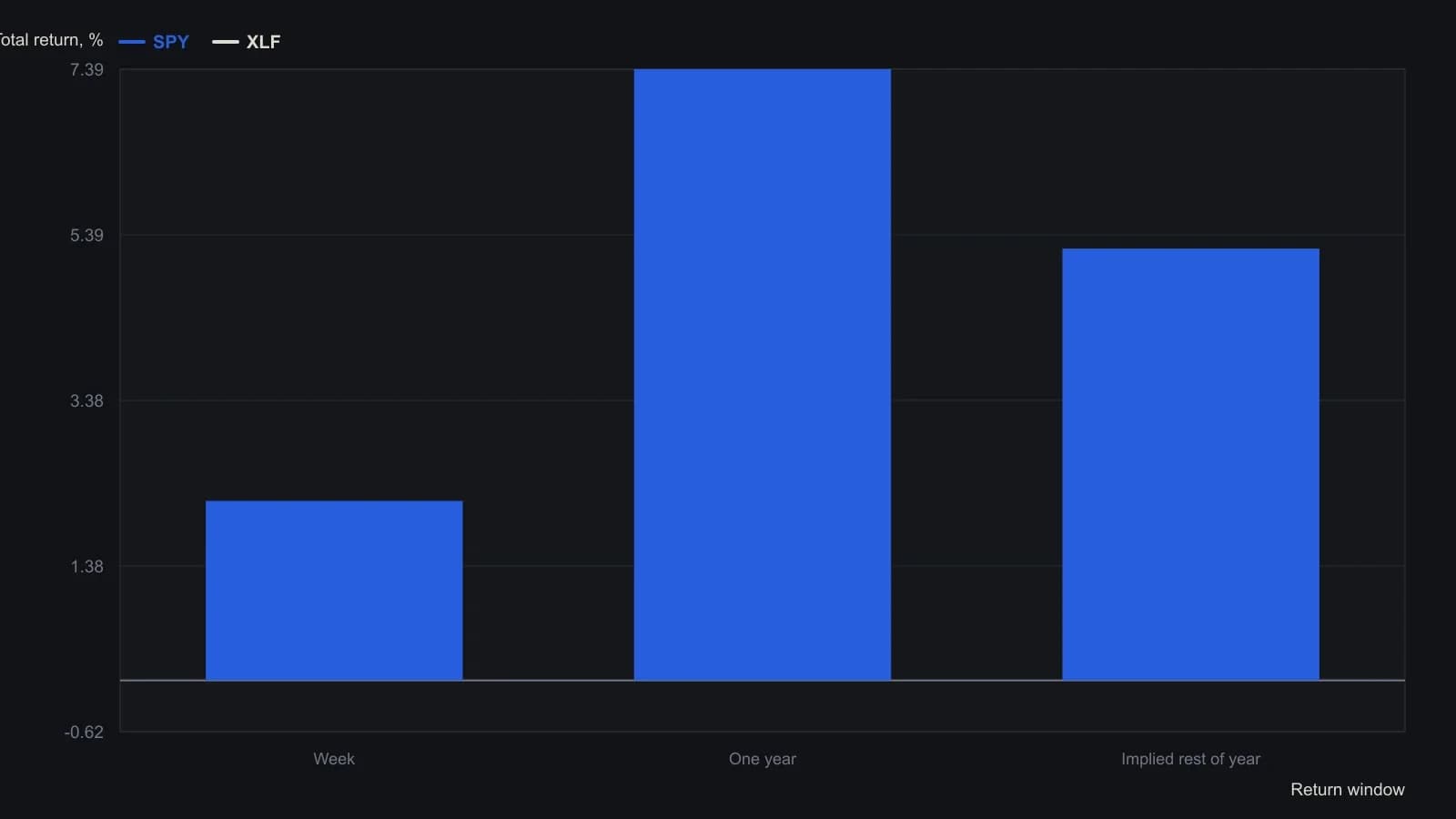
The author flags the one-week pair as a very small sample and uses the one-year pair as the more informative picture. The attached image is a headshot of the columnist and contains no chart or table.
What the asset-backed-stable-token was designed to do
Design notes for the token included proof-of-stake validation. A reserve of bank deposits and short-term government securities would be created or retired to support stability. Reserve interest was to cover operating costs and association capital rather than be paid to users. The design also intended a later shift from permissioned nodes toward a permissionless chain over about five years.
Those notes define an asset-backed-stable-token: a digital unit meant to hold a relatively steady value by matching issuance to a pool of bank deposits and short-term government securities. They also sketch payments-franchise-risk: the chance that cheaper, programmable settlement compresses the fee, float, and intermediation income of incumbent banks and card networks.
Negative yields, access costs, and incumbent friction
Broader regime context included about 12 trillion dollars then allocated to negative-yielding instruments, large unbanked populations, and high costs for maintaining accounts and sending money. The note also cited a historical contrast of twelve US systemic banking crises since 1840 versus none in Canada.
The same note argued that incumbent financial interests could delay a shift toward a single digital unit of global trade and inject volatility. Privacy and trust deficits around the sponsoring platform were additional adoption roadblocks.
That pairing is an incumbent-friction-regime: a market state in which established financial interests can delay, confuse, or raise volatility around a structural challenger without proving they can stop it.
How to close the reading
TradersWeek editorial: after the relative-strength-spread is in view, ask whether the sector-unweighting looks like informed repositioning around payments-franchise-risk. Ask that question inside a reserve-currency-regime still described as dollar-centered, and inside a funding backdrop that then included about 12 trillion dollars allocated to negative-yielding instruments.
The archive does not settle whether the token would become a global unit of trade. It only supplies the 2019 objects: a planned asset-backed-stable-token, a lagging financials spread, a still-dollar reserve map, and an incumbent-friction-regime that could delay adoption while adding volatility.
All readings on this track · 33 readings
- 1990Policy-auction spread as a weekly equity regime filter
- 1992Electric utilities as bond-regime context
- 1992Reading the dollar as a rates-regime check
- 1992Evaluating weekly intermarket context for equity regimes
- 1993Specifying the stock-bond yield gap as a hold-or-abstain regime
- 1996Constructing dual-gate bond-fund entries from gold-silver jumps
- 1996Name the regime before the sector breakout
- 2002Falling prices flip stock-bond confirmation
- 2003Four sleeves on one regime board: gold miners, REITs, bills, and equities
- 2003Four currency regimes for the yen, loonie, pound and Australian dollar
- 2003Read gold through the dollar regime, the hedge spread, and a stop
- 2003When deflation flips the stock-bond map
- 2003Commodity subgroup regime boards and dual averages
- 2003Reading a liquidity regime when gold, bonds, and stocks rise together
- 2003A shared weekly checklist for four country funds
- 2004Size-and-style sleeves as a weekly regime map
- 2004Country closed-end funds shared one average checklist and four regimes
- 2004A 2004 four-pair snapshot of a dollar-bloc FX regime
- 2005Country closed-end funds as a weekly regime comparison
- 2005Weekly regime maps for production-weighted commodity subgroups
- 2005Four technology sleeves on one weekly regime map
- 2006The Australian dollar as a commodity regime and timing filter
- 2008Dual-listing moving averages as a crowd-regime test
- 2008Cross-market regime context for a single trade
- 2010Dollar index, cross rates, and commodity context for forex targets
- 2010Gold and silver forex session candles as metals-regime context
- 2012Yield curve regime and equity timing
- 2013Yield curve shapes as stock market regime context
- 2013Yield spreads as country-specific equity regime context
- 2016Credit spreads as an equity cash regime filter
- 2016The summer lull is a context error
- 2019Financial sector spreads as regime tells around a global stablecoin
- 2019The negative-yield regime as an equity intermarket filter