2003issue C031-2
Four currency regimes for the yen, loonie, pound and Australian dollar
A single currency position is easier to place when it is paired with the real-economy driver that actually moves it. The archive then uses long-horizon moving averages to confirm or reject that market-regime, rather than to issue a standalone price forecast.
- Intermarket-analysis places one currency position inside a market-regime defined by equities, property, commodities, neighbor-economy growth, or energy, not by the pair alone.
- The yen is framed as an equity-and-property-linked-currency, while the Canadian dollar and the Australian dollar are framed as commodity-linked-currency units.
- A moving-average on a 50-week or 200-week horizon is used to judge whether a currency has left a long downtrend or is only oscillating inside an old range.
- A weaker US dollar, firmer energy prices, neighbor-economy growth, and high yields sit inside the same backdrop as the currency move, not in a separate story.
A currency sits inside a market-regime
A single currency position is not a self-contained story. Intermarket-analysis reads the unit through linked markets such as equities, real estate, commodities, neighbor-economy growth, and energy, then places that unit inside a market-regime that can last weeks to months.
The moving-average is the confirmation step, not the opening forecast. It is a multi-week average of price used as a baseline to judge whether a currency has left a long downtrend or is only oscillating inside an old range.
The yen as an equity-and-property-linked-currency
The yen is described as the third most widely traded currency after the US dollar and the euro. It is described as aligning more closely with Japanese equities and real estate than with commodity production, so the archive treats it as an equity-and-property-linked-currency.
The yen is described as having declined steadily since 1995. Revival efforts after late-1980s equity and property bubbles are described as tending to favor a weaker yen.
The Canadian dollar as a commodity-linked-currency
The Canadian dollar is framed as responding both to US economic fortunes and to commodity-export prices, including forestry and energy. That mix makes it a commodity-linked-currency that also tracks the neighbor economy.
Retreating inflation and lower policy rates are cited as major contributors to Canadian-dollar weakness through the 1990s. A later lift is tied to a weaker US dollar and firmer energy prices.
Canada is described as posting 4.4% growth over the first three quarters of the referenced year and only one negative-growth quarter, versus three in the United States, with oil-price strength supporting the energy sector.
The pound checked by long-horizon averages
The pound is described as a major traded currency that still trails the yen and the euro. The archive notes a late-1970s surge, an early-1980s drop, and a later-decade rally.
Pound strength against the dollar over about one and a half years is tied to a first-half-2002 move above both the 50-week and 200-week moving averages, after which price sat in a 1990s-style range.
The Australian dollar and commodity demand
The Australian dollar is presented as a commodity-based currency used for exposure to minerals, farm products, and energy, and later as a possible beneficiary of Asian, especially Chinese, raw-material demand. That is another commodity-linked-currency, with the later driver sitting in Asian industrial demand.
After a long US-dollar bear market and a spring-2001 low near 0.45 US dollars, the Australian dollar is described as advancing more than 25%, clearing the 50-week average at the start of 2002 and the 200-week average at the start of 2003.
A contemporaneous Australian-dollar print of 58.70 US cents is described as a two-year high, with one-month peaks versus the euro and the yen and support from a weak US dollar plus high yields.
Australian dollar weekly versus the US dollar, 1999–2003
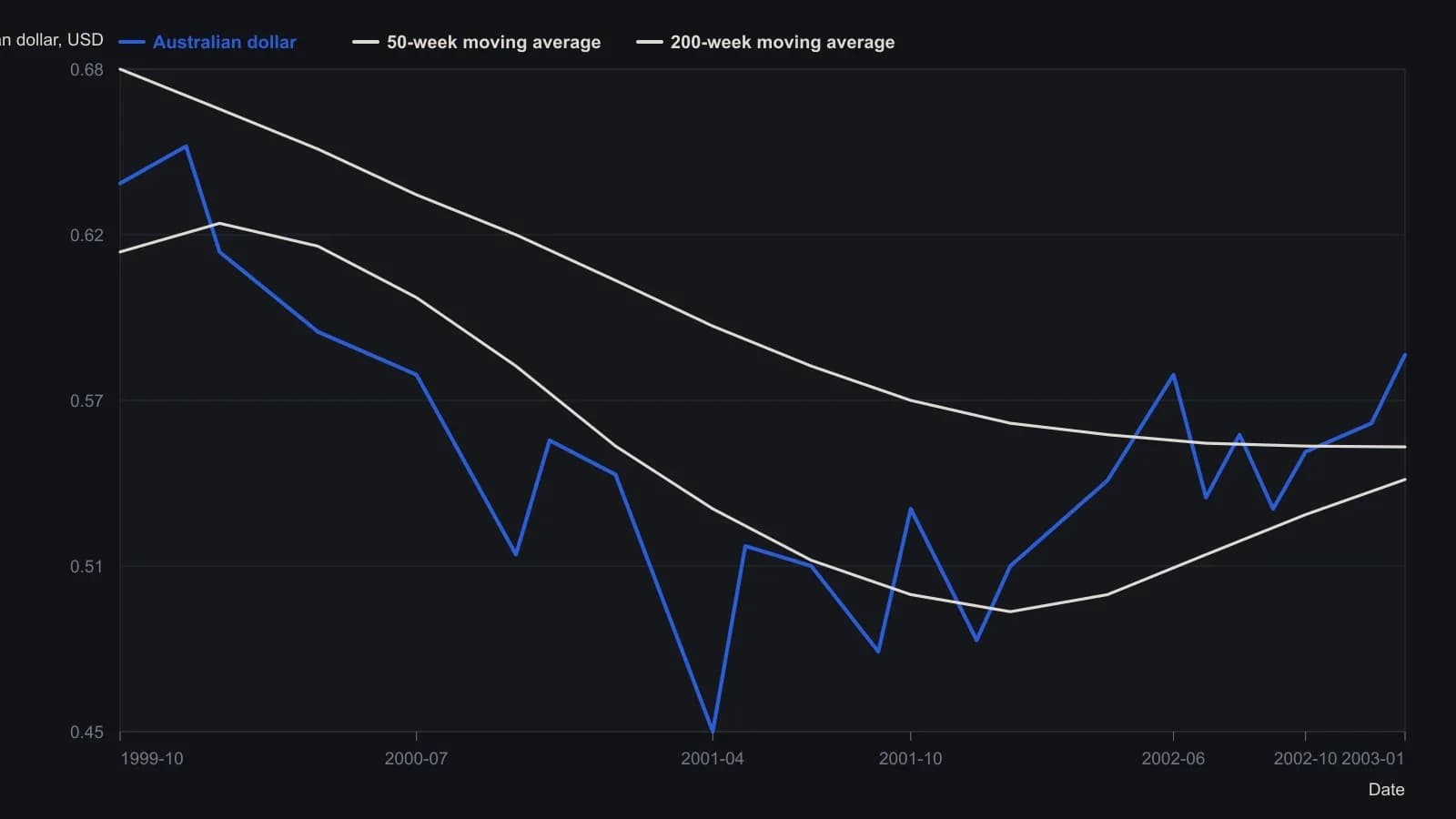
Average lengths are the 50-week and 200-week windows named in the review. Intermediate prices are digitized from weekly candles and are approximate to about half a US cent; the final print 0.5820 and the two right-scale average readings are exact.
Editorial reading of the four cases
TradersWeek editorial reading: the four units do not share one driver. Pair the yen with equities and property, pair the Canadian and Australian dollars with commodity-export prices and neighbor or Asian demand, and treat the pound as a major traded currency whose regime is confirmed when it clears long-horizon moving averages.
The same moving-average test appears on both the pound and the Australian dollar. Clearing the 50-week and 200-week averages is used to ask whether the old downtrend has ended. In the pound case, price then sat in a 1990s-style range, which keeps the average in the role of a regime check rather than a price target.
All readings on this track · 33 readings
- 1990Policy-auction spread as a weekly equity regime filter
- 1992Electric utilities as bond-regime context
- 1992Reading the dollar as a rates-regime check
- 1992Evaluating weekly intermarket context for equity regimes
- 1993Specifying the stock-bond yield gap as a hold-or-abstain regime
- 1996Constructing dual-gate bond-fund entries from gold-silver jumps
- 1996Name the regime before the sector breakout
- 2002Falling prices flip stock-bond confirmation
- 2003Four sleeves on one regime board: gold miners, REITs, bills, and equities
- 2003Four currency regimes for the yen, loonie, pound and Australian dollar
- 2003Read gold through the dollar regime, the hedge spread, and a stop
- 2003When deflation flips the stock-bond map
- 2003Commodity subgroup regime boards and dual averages
- 2003Reading a liquidity regime when gold, bonds, and stocks rise together
- 2003A shared weekly checklist for four country funds
- 2004Size-and-style sleeves as a weekly regime map
- 2004Country closed-end funds shared one average checklist and four regimes
- 2004A 2004 four-pair snapshot of a dollar-bloc FX regime
- 2005Country closed-end funds as a weekly regime comparison
- 2005Weekly regime maps for production-weighted commodity subgroups
- 2005Four technology sleeves on one weekly regime map
- 2006The Australian dollar as a commodity regime and timing filter
- 2008Dual-listing moving averages as a crowd-regime test
- 2008Cross-market regime context for a single trade
- 2010Dollar index, cross rates, and commodity context for forex targets
- 2010Gold and silver forex session candles as metals-regime context
- 2012Yield curve regime and equity timing
- 2013Yield curve shapes as stock market regime context
- 2013Yield spreads as country-specific equity regime context
- 2016Credit spreads as an equity cash regime filter
- 2016The summer lull is a context error
- 2019Financial sector spreads as regime tells around a global stablecoin
- 2019The negative-yield regime as an equity intermarket filter