2002issue C061-4
Falling prices flip stock-bond confirmation
Equity prices tended to follow bond prices in inflation-tolerant decades. A falling-price backdrop can invert that map so equities travel with yields. Editorial view: treat the pair as a two-regime confirmation problem and notice the switch before a lone-market move is treated as confirmed.
- Price-to-price confirmation is the inflation-tolerant map, in which equity prices tend to follow bond prices, sometimes with a lag.
- Gibson's paradox is the falling-price map, in which equity prices tend to move with bond yields rather than with bond prices.
- Regime-dependence means the useful stock-bond confirmation rule changes when the inflation-versus-falling-price backdrop changes.
- Intermarket confirmation checks one asset class against another before a single-market signal is treated as complete.
A two-regime confirmation problem
For much of the twentieth century, equity prices tended to follow bond prices, sometimes with a noticeable lag. That pattern is price-to-price confirmation.
Editorial view: inflation-tolerant decades trained observers to treat that mapping as a single historical rule. A falling-price backdrop can invert the map so equities travel with yields. Regime-dependence means the useful stock-bond confirmation rule changes when the inflation-versus-falling-price backdrop changes. Intermarket confirmation checks one asset class against another before a single-market signal is treated as complete.
The inflation-tolerant map
In the 1969-70 equity decline, 10-year Treasury yields rose. The 1970-73 equity advance came with falling note yields. The 1973-74 cyclical equity drop saw those yields climb from below 6 percent to near 8.5 percent.
After U.S. inflation was contained, 1980s charts of the S&P 500 and 10-year note prices showed equities tracking bond prices, with bonds leading. The 1990s U.S. price-to-price alignment held until after the 1998-99 bond break and the 2000 equity downturn.
The falling-price map
When the price level falls inside an expanding money-supply system, weaker corporate margins can put downward pressure on equities even as bond prices rise and yields fall. Corporate pricing power is the ability of firms to protect margins when the general price level is rising or falling. A rebound in the price level can lift bond yields and press bond prices while equities recover as firms regain pricing power.
That inverted pairing is Gibson's paradox: equity prices tend to move with bond yields rather than with bond prices. In 1990s Japan, equity prices moved opposite government-bond prices and therefore more closely with those bond yields.
The equity-follows-yields mapping was more common when a gold standard made falling-price episodes frequent, and it faded from use after that standard was left in the early 1970s.
Japanese government-bond prices, 1992–2002
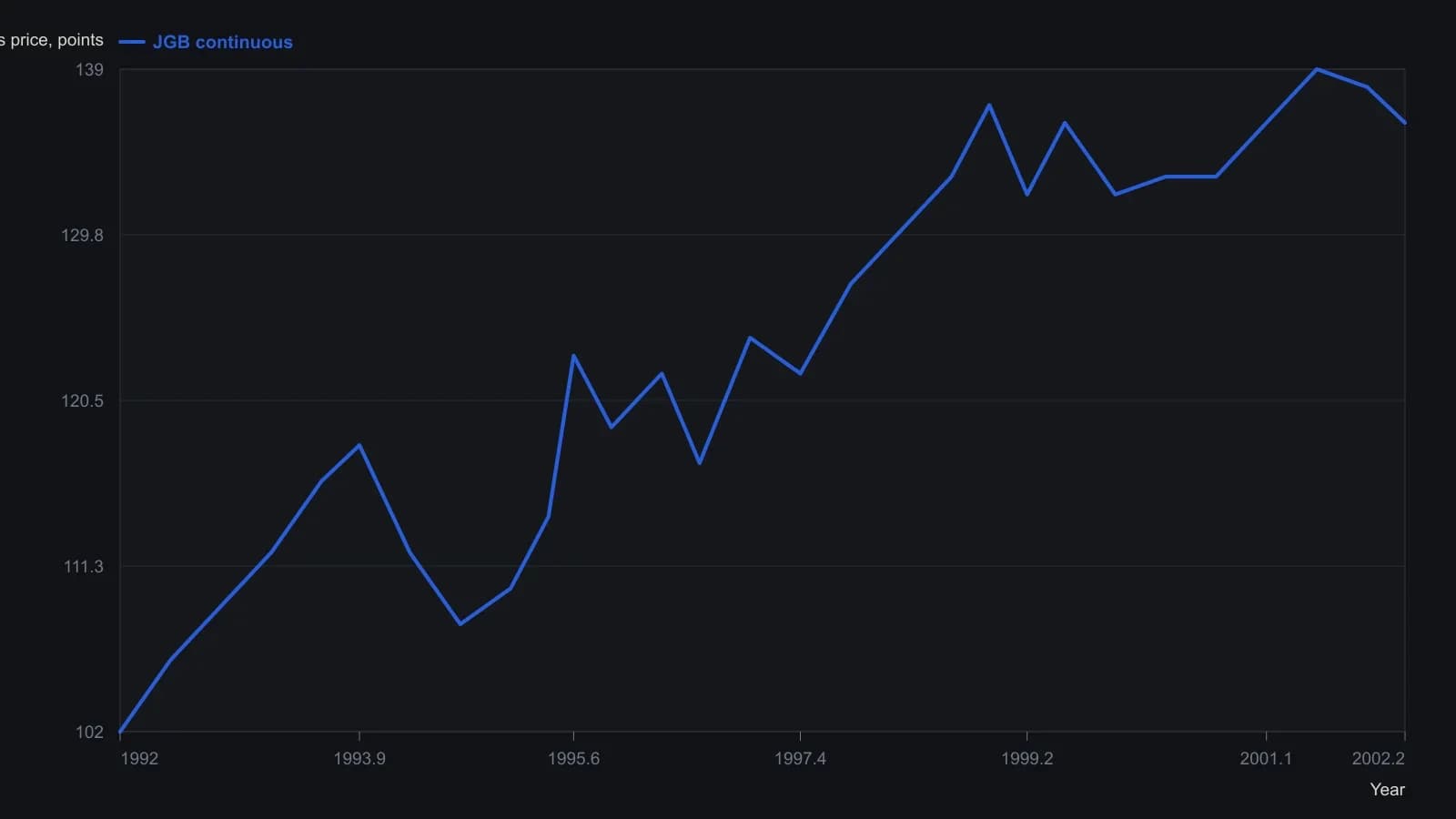
Approximate readings from the upper pane only, rounded to the nearest point. The continuous JGB future’s last on-chart prints sit near 136. The lower Nikkei pane uses a different scale and is not overlaid here.
Currency and the long bond
Long-maturity bonds embed the market's inflation and currency view. Expected currency weakness tends to lift yields and depress bond prices so that eroded principal and coupons are offset. That long-bond currency signal is one reading of the backdrop.
Unit-of-account valuation judges inflation or falling prices by whether the currency is cheap or dear versus goods, often using gold as a reference. A falling-price regime pairs a strong, overvalued currency with declining goods prices, squeezing corporate pricing power and making existing debts harder to service, while high-quality creditors can benefit from a stronger unit of account.
Noticing the switch
From 2000, stock and bond prices moved opposite. The early-March 2002 note break alongside an equity rally was readable as equities following yields during an inflationary pause inside an otherwise falling-price backdrop.
Editorial view: the teaching point is how to notice that switch before a lone-market move is treated as confirmed under the wrong map.
All readings on this track · 33 readings
- 1990Policy-auction spread as a weekly equity regime filter
- 1992Electric utilities as bond-regime context
- 1992Reading the dollar as a rates-regime check
- 1992Evaluating weekly intermarket context for equity regimes
- 1993Specifying the stock-bond yield gap as a hold-or-abstain regime
- 1996Constructing dual-gate bond-fund entries from gold-silver jumps
- 1996Name the regime before the sector breakout
- 2002Falling prices flip stock-bond confirmation
- 2003Four sleeves on one regime board: gold miners, REITs, bills, and equities
- 2003Four currency regimes for the yen, loonie, pound and Australian dollar
- 2003Read gold through the dollar regime, the hedge spread, and a stop
- 2003When deflation flips the stock-bond map
- 2003Commodity subgroup regime boards and dual averages
- 2003Reading a liquidity regime when gold, bonds, and stocks rise together
- 2003A shared weekly checklist for four country funds
- 2004Size-and-style sleeves as a weekly regime map
- 2004Country closed-end funds shared one average checklist and four regimes
- 2004A 2004 four-pair snapshot of a dollar-bloc FX regime
- 2005Country closed-end funds as a weekly regime comparison
- 2005Weekly regime maps for production-weighted commodity subgroups
- 2005Four technology sleeves on one weekly regime map
- 2006The Australian dollar as a commodity regime and timing filter
- 2008Dual-listing moving averages as a crowd-regime test
- 2008Cross-market regime context for a single trade
- 2010Dollar index, cross rates, and commodity context for forex targets
- 2010Gold and silver forex session candles as metals-regime context
- 2012Yield curve regime and equity timing
- 2013Yield curve shapes as stock market regime context
- 2013Yield spreads as country-specific equity regime context
- 2016Credit spreads as an equity cash regime filter
- 2016The summer lull is a context error
- 2019Financial sector spreads as regime tells around a global stablecoin
- 2019The negative-yield regime as an equity intermarket filter