2003issue C121-2
A shared weekly checklist for four country funds
Four listed country closed-end funds covering Brazil, Israel, Ireland, and Southern Africa were scored on the same 20-week and 50-week moving averages after the 2002 global equity trough. The editorial habit is to judge a rebound as a shared regime event before placing it in a broader portfolio context.
- Score every country closed-end fund on the same 20-week and 50-week moving averages so one rebound is compared with peers rather than read as a standalone chart.
- Treat a close back above a lost weekly-average band, or a prior range high, as the breakout that turns a consolidation or failed breakdown into a testable regime hypothesis.
- Use a retest of a prior low or a recently lost average to see whether the uptrend is restored or the breakdown is confirmed.
- After a completed breakout, note extension above the averages so a stretched new regime is visible before the reading is placed in a broader portfolio context.
Four country funds on one checklist
Four listed country closed-end funds covering Brazil, Israel, Ireland, and Southern Africa were examined together as contemporaneous regional case studies after the 2002 global equity trough. A country closed-end fund is an exchange-listed vehicle that packages a national or regional equity basket into a single price series for cross-market comparison.
Intermarket analysis, in this setting, is reading several regional equity vehicles side by side so one market's rebound is judged against whether peers share the same trend and breakout state. Editorial interpretation: TradersWeek treats that side-by-side reading as a same-checklist habit, so a rebound is judged as a shared regime event before it is placed in a broader portfolio context.
The shared weekly baseline
Each fund was scored against the same 20-week and 50-week moving averages, creating one trend baseline for cross-market comparison rather than a one-chart reading. A moving average here is a rolling mean of weekly closes used as that shared 20-week and 50-week baseline across every country fund on the panel.
A breakout is a close back above a lost weekly-average band or a prior range high that turns a consolidation or failed breakdown into a testable regime hypothesis.
Brazil and Israel
The Brazil fund lost both weekly averages in spring 2002, bottomed with equities worldwide in October 2002, then recovered in spring 2003 after a February retest that briefly undercut the 20-week average.
The Israel fund slipped under both weekly averages early in 2002, retested its October 2002 low in February 2003, and then advanced from March into the following summer.
A retest is a return to a prior low or to a recently lost moving average that either holds and restores the uptrend or confirms a failed breakdown.
Brazil Fund weekly price with 20- and 50-week averages
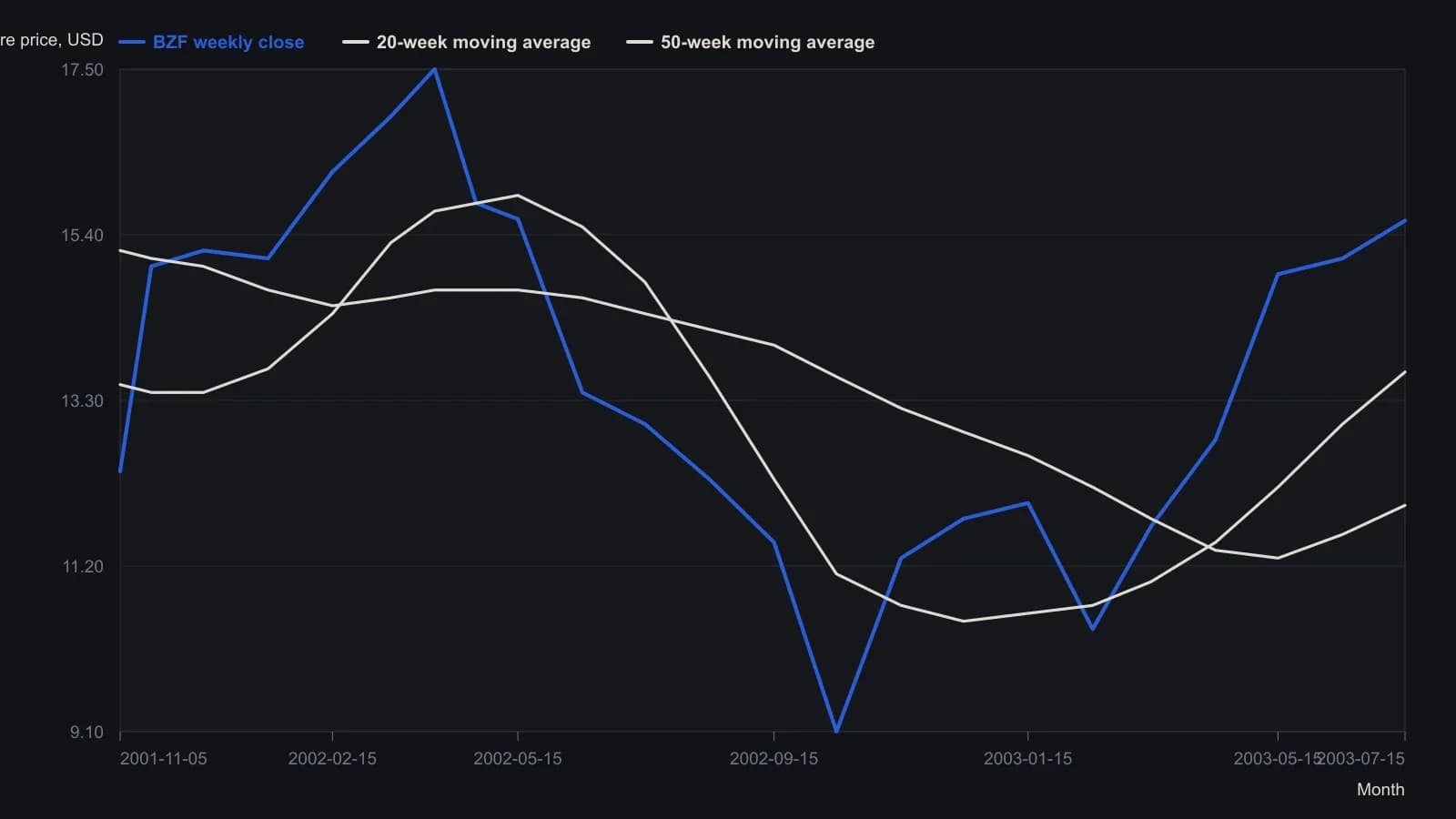
Intermediate points are approximate monthly readings from the weekly raster. Only the final close and the two labeled moving-average values are exact prints from the chart.
Ireland and Southern Africa
The Ireland fund collapsed through both weekly averages in summer 2002, consolidated from late 2002 into early 2003, and then broke out above both averages in early summer 2003.
The Southern Africa fund broke out above both weekly averages during the autumn 2002 global equity rebound and, by midsummer 2003, had surpassed its 2002 highs while remaining extended above those averages. Extension above averages is price standing far above its weekly moving-average band after a completed breakout, marking how stretched the new regime already is.
The panel by summer 2003
By summer 2003 the Ireland fund stood above any level seen since before autumn 2001, while the Southern Africa fund was positioned to challenge highs from late spring and early summer 2001.
Editorial interpretation: TradersWeek reads those later levels as a reminder that funds on the same weekly checklist can still sit at different stages of a shared regime. The Ireland breakout and the Southern Africa extension are contemporaneous states to weigh before a single rebound is placed in a broader portfolio context.
All readings on this track · 33 readings
- 1990Policy-auction spread as a weekly equity regime filter
- 1992Electric utilities as bond-regime context
- 1992Reading the dollar as a rates-regime check
- 1992Evaluating weekly intermarket context for equity regimes
- 1993Specifying the stock-bond yield gap as a hold-or-abstain regime
- 1996Constructing dual-gate bond-fund entries from gold-silver jumps
- 1996Name the regime before the sector breakout
- 2002Falling prices flip stock-bond confirmation
- 2003Four sleeves on one regime board: gold miners, REITs, bills, and equities
- 2003Four currency regimes for the yen, loonie, pound and Australian dollar
- 2003Read gold through the dollar regime, the hedge spread, and a stop
- 2003When deflation flips the stock-bond map
- 2003Commodity subgroup regime boards and dual averages
- 2003Reading a liquidity regime when gold, bonds, and stocks rise together
- 2003A shared weekly checklist for four country funds
- 2004Size-and-style sleeves as a weekly regime map
- 2004Country closed-end funds shared one average checklist and four regimes
- 2004A 2004 four-pair snapshot of a dollar-bloc FX regime
- 2005Country closed-end funds as a weekly regime comparison
- 2005Weekly regime maps for production-weighted commodity subgroups
- 2005Four technology sleeves on one weekly regime map
- 2006The Australian dollar as a commodity regime and timing filter
- 2008Dual-listing moving averages as a crowd-regime test
- 2008Cross-market regime context for a single trade
- 2010Dollar index, cross rates, and commodity context for forex targets
- 2010Gold and silver forex session candles as metals-regime context
- 2012Yield curve regime and equity timing
- 2013Yield curve shapes as stock market regime context
- 2013Yield spreads as country-specific equity regime context
- 2016Credit spreads as an equity cash regime filter
- 2016The summer lull is a context error
- 2019Financial sector spreads as regime tells around a global stablecoin
- 2019The negative-yield regime as an equity intermarket filter