2012issue C1254-57
Staged stops as one mechanical entry and exit procedure
A price-only algorithm can stage a prebuy or presell together with a protective stop and more than one profit-taking level. Editorial point: treat that package as one mechanical procedure, and treat a blank scan as an abstention rather than a prompt to improvise.
- A single price-only algorithm can emit buy and sell signals for stocks, exchange-traded funds, futures, and currency pairs.
- Each staged signal is packaged with a protective stop and more than one profit-taking level, so exit is specified with the entry.
- A daily presell can be treated as a stronger short candidate when it coincides with bearish readings on shorter bars and on the weekly frame.
- Editorial takeaway: write the staged entry, the protective stop, and the targets as one procedure, and treat a blank scan as an abstention rather than a prompt to improvise.
What the workflow emits
A single price-only algorithm can emit buy and sell signals for stocks, exchange-traded funds, futures, and currency pairs. Short-horizon setups are taken from intraday or daily data, while long-horizon setups are taken from weekly data. Intraday signals are defined on five fixed bars of 15, 30, 60, 120, and 240 minutes.
The system's output is a signal: an instruction to enter, exit, or stay out. In the terms used here, that makes the workflow a mechanical-trading-system, a complete and repeatable set of entry, exit, and abstention rules applied the same way each time the inputs appear. A rule-based-entry is the predefined condition that issues the buy, sell, or stand-aside instruction from market state and execution constraints rather than from discretionary judgment.
What is chosen before a scan runs
Before a scan runs, the user chooses market, time frame, bullish or bearish bias, and whether the desired signal is a prebuy or a presell. The tradable universe can be narrowed by subcategory, price limits, and a minimum-volume filter.
Staged stops arrive with exits already written
A prebuy is a staged long entry price that has not yet traded and is placed in advance as a buy-stop. A presell is a staged short entry price that has not yet traded and is placed in advance as a sell-stop. In this workflow, a prebuy or presell is a staged stop price that has not yet been reached at the last scan update.
Each staged signal is packaged with a protective stop and more than one profit-taking level so exit is specified with the entry. The holding-period is the time a position remains open once the system's entry rule has fired. Editorial reading: the package is written for that holding-period, so the trader is not asked to invent an exit after the signal appears.
Time-frame alignment on a short search
A top-down short search ranks weak sectors, then industries inside those sectors, then the weakest names for presell signals. A name can be treated as a stronger short candidate when a daily presell coincides with bearish readings on shorter bars and on the weekly frame. Time-frame-alignment is that check: whether shorter and longer bars agree before the signal is treated as confirmed.
Editorial framing: the procedure follows the prevailing trend across the holding-period instead of forecasting a reversal, which is the sense of a momentum-strategy used here.
A calendar of past marks
Past buy and sell marks can be reviewed on a calendar of daily and weekly history for the market or for a single security. Editorial reading: the calendar is for reviewing how the mechanical-trading-system already marked the tape. It is not a substitute for a blank scan, and it is not a reason to write a new rule on the spot.
Bed Bath & Beyond staged short on 1 June 2012
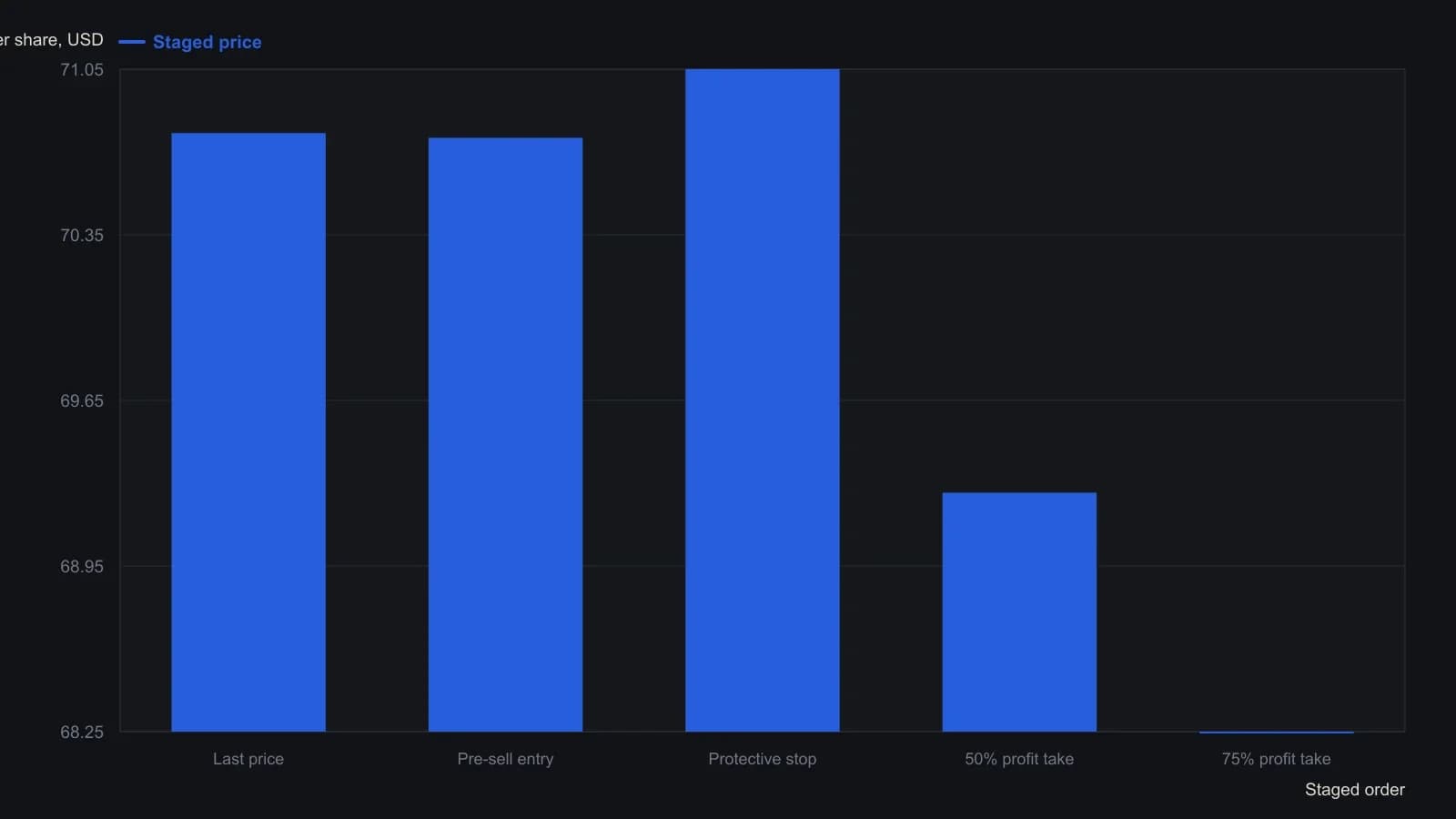
Conservative 15-minute TheWizard presell scan on Friday 1 June 2012. The 50% and 75% prints are the algorithm’s scaled covers on the short.
All readings on this track · 51 readings
- 1984Half-cycle differencing for momentum signals
- 1987Relative strength evaluation under competing optimization criteria
- 1988Weekly MACD as a two-clock momentum confirmation stack
- 1989Equal-weight zero-cross from smoothed spreads
- 1989Testing relative-strength-index reversal rules against trend continuation
- 1989Smoothed three-day futures filter for index option bounces
- 1989Cycle-length windows for momentum, Relative Strength Index, and stochastic construction
- 1991Filtered rally magnitude as a bull-regime breakout
- 1992Constructing true strength from double-smoothed momentum
- 1992Constructing a double-smoothed true strength index
- 1993When momentum structure and breadth break together
- 1993Constructing double-smoothed range and momentum oscillators
- 1993Constructing a two-parameter relative momentum index
- 1993Building a bounded momentum oscillator with RSI smoothing
- 1993Two-speed oscillators with divergence and trendline gates
- 1993Constructing a relative momentum index from the relative strength index
- 1994Constructing daily advance-decline breadth tools
- 1994Building a composite regime score from monetary climate and weekly trend
- 1994Averaging Relative Strength Index and the stochastic oscillator into one reversal oscillator
- 1995Dividend-yield regression as a hold versus momentum gate
- 1996Jump and hold filters for long-term Treasury yield direction
- 1997Constructing extendedness from a 10 percent swing filter
- 1997A range-expansion oscillator that can refuse its own stretch
- 1997RSI trend permission and Fibonacci pullback rules
- 1998Nested midpoint construction for a range-normalized oscillator
- 1999Evaluating Relative Strength Index momentum with zero-line and threshold rules
- 1999Treat RSI and momentum as three mechanical procedures
- 2000Thrust strength figure from moving-average swings
- 2001Constructing a non-range-bound balance of market power score
- 2004Cleaned breadth oscillator and new-high divergence: a swing-market case file
- 2004Evaluating advance-issues-momentum on a fixed-symbol-basket
- 2004Constructing a trend filter from two adjacent high-low windows
- 2006A dollar-versus-commodity extreme as a regime case
- 2008Zero-centered stochastic bands and bracket stops
- 2012Evaluating engulfing momentum across hold windows
- 2012Staged stops as one mechanical entry and exit procedure
- 2012Stacking a relative-strength-index forecast, a trend filter, and long-only momentum
- 2013Constructing fair-value filters from averages and momentum
- 2014Constructing a multi-window slope divergence entry
- 2015Bandedge trend filter construction with inverse crossover rules
- 2017Opposite rules for index price and volatility momentum
- 2018A three-state overlay that colors a trend only after the line clears the bar
- 2018Half-cycle relative-strength index with a Fisher map for cyclic reversals
- 2018Emotion as a rule input when momentum breaks
- 2018Two-bar body expansion as a momentum breakout construction
- 2019Pair a two-day high breakout with a volume-weighted exit on the same chart
- 2020Building reflex and trendflex cross and extreme entry rules
- 2020Construct a dual-series price momentum oscillator overlay
- 2020A multi-timeframe stochastic as a panel of weekly voters
- 2020Centerline crossovers that compare index momentums
- 2020Multi-timeframe stochastic voting as one mechanical rule