1982issue C011-7
Three gates on a 1982 pork-belly short
This archive case walks one July 1982 pork-belly short through three gates: whether a short was even permitted, whether a Commodity Channel Index and stochastic sequence had finished, and whether a stop-loss could sit beyond ordinary daily noise before a price was named.
- The first gate asked only whether a short was permitted: a weekly stochastic chart was checked to see if the short already looked underway or was only beginning to form.
- The second gate waited for a finished sequence: a 20-day Commodity Channel Index cross below zero, a regular stochastic collapse as confirmation, and a failed zero-line recross before the breakout was treated as established.
- The third gate named a price only after a stop-loss could sit beyond ordinary daily swings, and the short used a range-edge entry rather than the signal bar.
- Adds and the exit reused the same studies: later Commodity Channel Index bumps and matching stochastic rest spots for possible adds, then narrowing tails after a limit day for a buy-stop exit plan.
A short that had to pass three gates
The archive records a short in the July 1982 pork-belly contract that was not taken the moment an oscillator flipped. Editorial reading: the useful lesson is the order of the gates, not any single print.
First a weekly stochastic chart was used to ask whether a short already looked underway or was only beginning to form. Only then did a 20-day Commodity Channel Index, read here as a channel-breakout timer rather than as a stand-alone forecast, get the short ready and time the signal. A price was named only after a stop-loss could be placed beyond ordinary daily swings.
July 1982 pork-belly futures, Sept 1981–July 1982
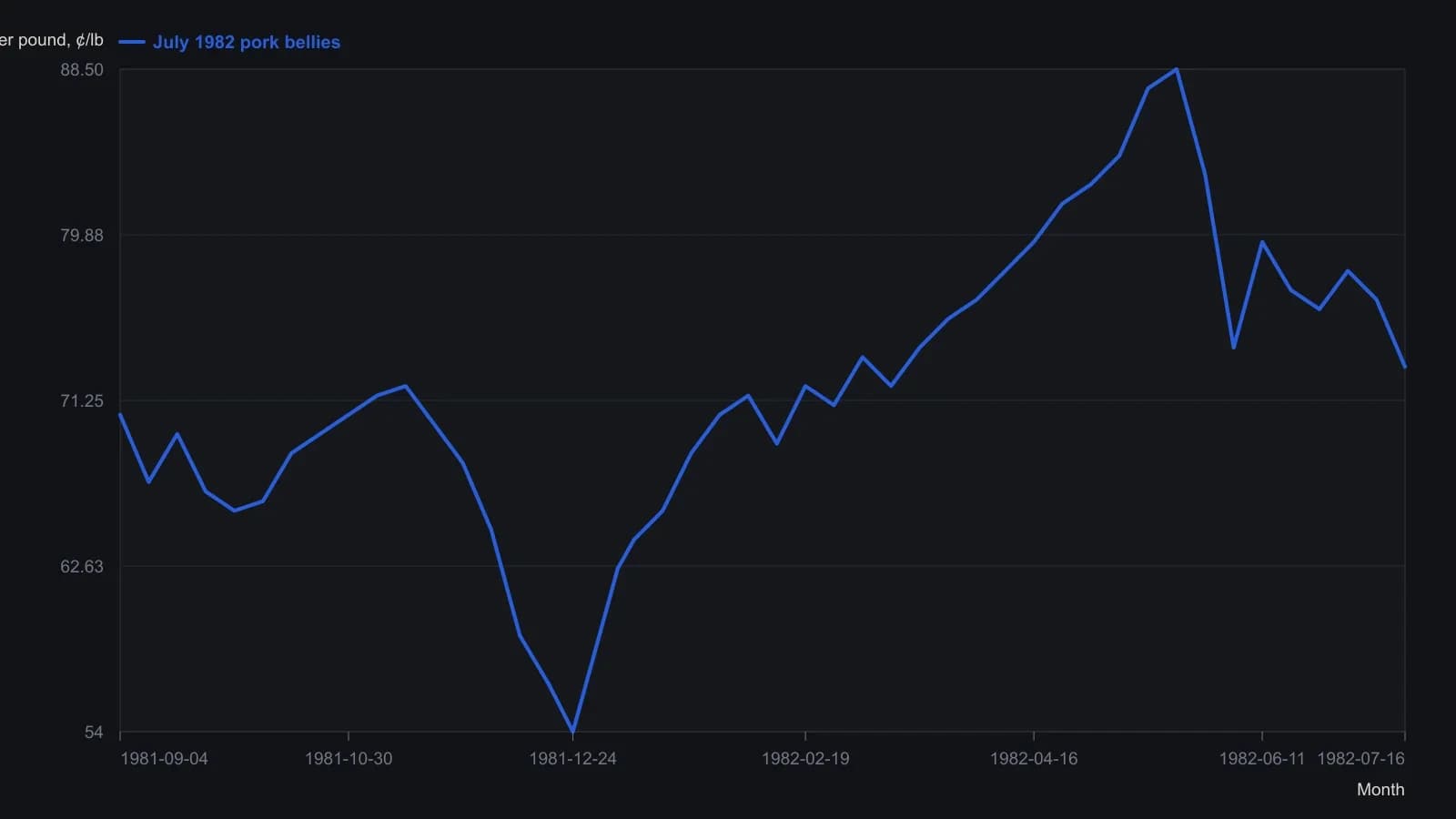
Closes sampled from the printed daily-bar chart (each horizontal line = 100 points). Values are approximate; the raster cannot support tick-level precision.
First gate: is a short even permitted
A weekly stochastic chart was checked before the short was treated as eligible. The stochastic oscillator is a short-horizon reading of where the close sits inside a recent high-low range, used here to confirm timing for entries, adds, and exits.
On the weekly chart the question was narrower. Did a short already look underway, or was it only beginning to form? Editorial reading: that check was a permission gate. If the weekly reading had not supported a short, the later daily sequence would not have been enough to name a price.
Second gate: wait until the sequence is finished
A 20-day Commodity Channel Index was used on pork bellies both to get ready for a short and to time the short signal. The index is a zero-centered oscillator on a fixed lookback of prices. In this case it was treated as a channel-breakout marker: a cross from above zero to below zero counted as a short setup. The July 1982 pork-belly contract was read as having broken downward on 19 May 1982.
That breakout was not trusted on its own. A regular stochastic collapse on 14 May 1982 was used as the short-term confirmation sought before trusting the Commodity Channel Index breakout.
After the Commodity Channel Index crossed below zero, the rule was to wait for the line to stall and try to recross zero. If that recross failed, the breakout was treated as established. That sequence was judged complete on 28 May 1982. Editorial reading: the zero-line recross test is the difference between a setup and a finished gate. A failed attempt to recross back through zero was treated as evidence that the old channel did not reassert itself.
A lookback that still needed a local check
A 20-day Commodity Channel Index lookback was used as a shared default across a listed set of futures including pork bellies, with copper noted at 30 days and Treasury bills near 22 days. The pork-belly series itself briefly recrossed above zero, showing the lookback might need local adjustment. Editorial reading: the default was a starting clock, not a claim that one lookback fits every contract.
Third gate: name a price only after the stop can sit
The short was not taken on the signal bar. On 1 June 1982 the July 1982 pork-belly contract was sold at 84.90, just outside the prior session's range. That is a range-edge entry: an order placed just beyond the prior session's high or low so that a fill requires price to leave yesterday's range.
A defensive stop at 86.10 was chosen to keep risk near 550 per contract including commission while remaining beyond ordinary daily swings. The stop-loss is a preplaced exit that bounds how far price may move against a position before the trade is closed. Editorial reading: the third gate is not a hunt for a better print. It is the refusal to name a price until the stop can sit outside ordinary noise.
Adds, a limit day, and the exit
Later stops were reset from recent daily highs so that a touch implied only a 20 percent chance the stop had been too close, which over the prior 300 sessions translated to 1.47 cents above the most recent lowest high.
Small Commodity Channel Index bumps on 8 June and 14 June were treated as possible add-on short points for the following day, and the stochastic study was described as showing the same rest spots.
After another limit-down session, narrowing tails on both the regular stochastic and the Commodity Channel Index were read as a possible short-term correction. A limit day is a session in which exchange rules cap how far price may travel, which can leave unfinished directional pressure into the next open. A buy-stop exit plan was then used, first at 70.52 and later attempted at 68.35, with the position closed on the 22 June 1982 opening at 72.85.
All readings on this track · 39 readings
- 1982Three gates on a 1982 pork-belly short
- 1982Scale-free Commodity Channel Index construction
- 1986Constructing a commodity channel index and a regression price channel
- 1987Constructing scaled OHLC matrices for study overlays
- 1987Constructing the commodity channel, average directional, and relative strength indexes on a shared cycle scale
- 1992Eleven-bar commodity channel index from typical price and mean deviation
- 1992Evaluating Commodity Channel Index breakout versus range rules
- 1992Evaluating breakout and CCI rules as complete mechanical procedures
- 1993Constructing stochastic, RSI and CCI inputs for forecasts
- 1993Nested centered channels with a commodity channel index confirmation gate
- 1993Listed-option timing as three separable clocks
- 1994Constructing an eleven-period commodity channel index
- 1994Confirming Elliott wave turns with channels and the commodity channel index
- 1995Commodity Channel Index band rules lag zero-line timing
- 1995Building the commodity channel index from typical price
- 1995Staged reversal rules with commodity channel index and average channels
- 1995Commodity channel index construction from typical price to a smoothed zero line
- 2001Reader tests for unfinished lookback oscillators
- 2002Constructing the commodity channel index from typical price
- 2003Breadth-filtered commodity channel index entry and exit rules
- 2003Constructing the Commodity Channel Index from typical price and scaled deviation
- 2003A shallow, poorly participated advance is an unconfirmed trend
- 2003CCI and RSI parameter defaults as scaling conventions
- 2003A cost and capital audit of a Commodity Channel Index trade engine
- 2003Commodity channel index peak divergence as an exit after twin patterns
- 2004Constructing the Commodity Channel Index from typical price
- 2004Constructing the Commodity Channel Index from typical price and mean deviation
- 2006Building custom indicators from the Commodity Channel Index, a least squares moving average and a rule-based entry
- 2012Confirming breakouts and retracements with CCI, ADX, and averages
- 2012Stacking oscillator lookbacks into a heatmap mosaic
- 2013Constructing a consensus and volatility-normalized value oscillator
- 2013Walk-forward system evaluation with a commodity channel index and chandelier exits
- 2014Dual detrended oscillators and dual Bollinger Band channels
- 2014RSI, CCI, and moving-average trend-filter construction
- 2014Dual RSI, a moving average, and CCI as a confirmation stack
- 2017Constructing dual-average cross and channel-index filters
- 2018Treat CAM as a classification layer before confirmation becomes an entry
- 2018Four-state slope labels gated by a moving average and a commodity channel index
- 2018Deviation-Scaled Moving Average construction from a two-bar difference