2001issue C121-4
Threshold RSI and stochastic setups with next-bar stops
Threshold occupancy is only a presignal. A rule-based entry arms on a defined extreme, then waits for a next-bar stop one increment beyond the current high or low. The procedure is incomplete unless a protective stop covers the case where the opposite band never prints.
- Crossing into an oversold or overbought band is a presignal, not an order. Occupancy alone is a different error from waiting for a later confirmed exit from that zone.
- A rule-based entry pairs a setup that only arms the trade with a next-bar stop one increment beyond the current high or low.
- An RSI long exit that waits for a later cross below 70 can fail if the upper band never prints, so a protective stop is a required companion.
- A stochastic threshold-plus-cross setup still uses the same next-bar stop, and other bands or lookbacks remain open to retest.
What the two oscillators measure
Relative strength index is a 0-to-100 oscillator of recent upward versus downward price change in the same series. The reading is 50 when those moves are equal, above 50 when upward change dominates, and below 50 when downward change dominates. A common lookback is 14, with 3, 9, and 25 also cited as alternatives.
The stochastic oscillator is a 0-to-100 two-line comparison of the latest close with a prior price range. The primary line, percent-k, sits at 50 at the range midpoint and is usually plotted with a smoothed companion, percent-d. The stochastic lookback is commonly taken from the 5-to-21 range.
Conventional RSI oversold and overbought bands used in the procedure are 30 and 70. Conventional stochastic bands are 20 and 80. Each band is a threshold that marks an extreme on the bounded oscillator.
A threshold is a presignal area
Crossing into a threshold zone is treated as a presignal, not an order. The zone beyond the threshold is a presignal area: a later band-cross may be near, but a trade is not yet authorized.
The oscillator can remain beyond the band for a long stretch. Buying or selling on occupancy alone is a distinct error from waiting for a later confirmed exit from that zone.
A rule-based entry has two parts
A complete rule-based entry is written as two parts. The setup is the oscillator condition that must be true before an entry order is even eligible. It only arms the trade.
The next-bar stop is a buy or sell stop placed one increment beyond the current high or low and active on the following bar, so price must already be moving in the intended direction. That stop must be hit before a fill.
RSI setup and next-bar stops
One RSI long rule uses a cross above 30 as setup and a buy-stop one increment above the current high on the next bar. The matching short rule uses a cross below 70 and a sell-stop one increment below the current low.
An RSI long exit that waits for a later cross below 70 can fail to fire if the oscillator never reaches the upper band after entry. A protective stop is treated as a required companion to the oscillator rule.
Stochastic setups that use the same stop
A stochastic long setup can require percent-d below 20 with percent-k crossing above it. A short setup can require percent-d above 80 with percent-k crossing below it. Each still uses the same next-bar stop entry.
Other stochastic rules include a percent-k cross of 20 or 80, or percent-k versus percent-d crosses that need not occur inside the bands. The threshold-plus-cross version was then evaluated on a multi-year daily sample, and the write-up invites retesting with other bands and lookbacks.
AOL stochastic next-bar system: closed-trade profit
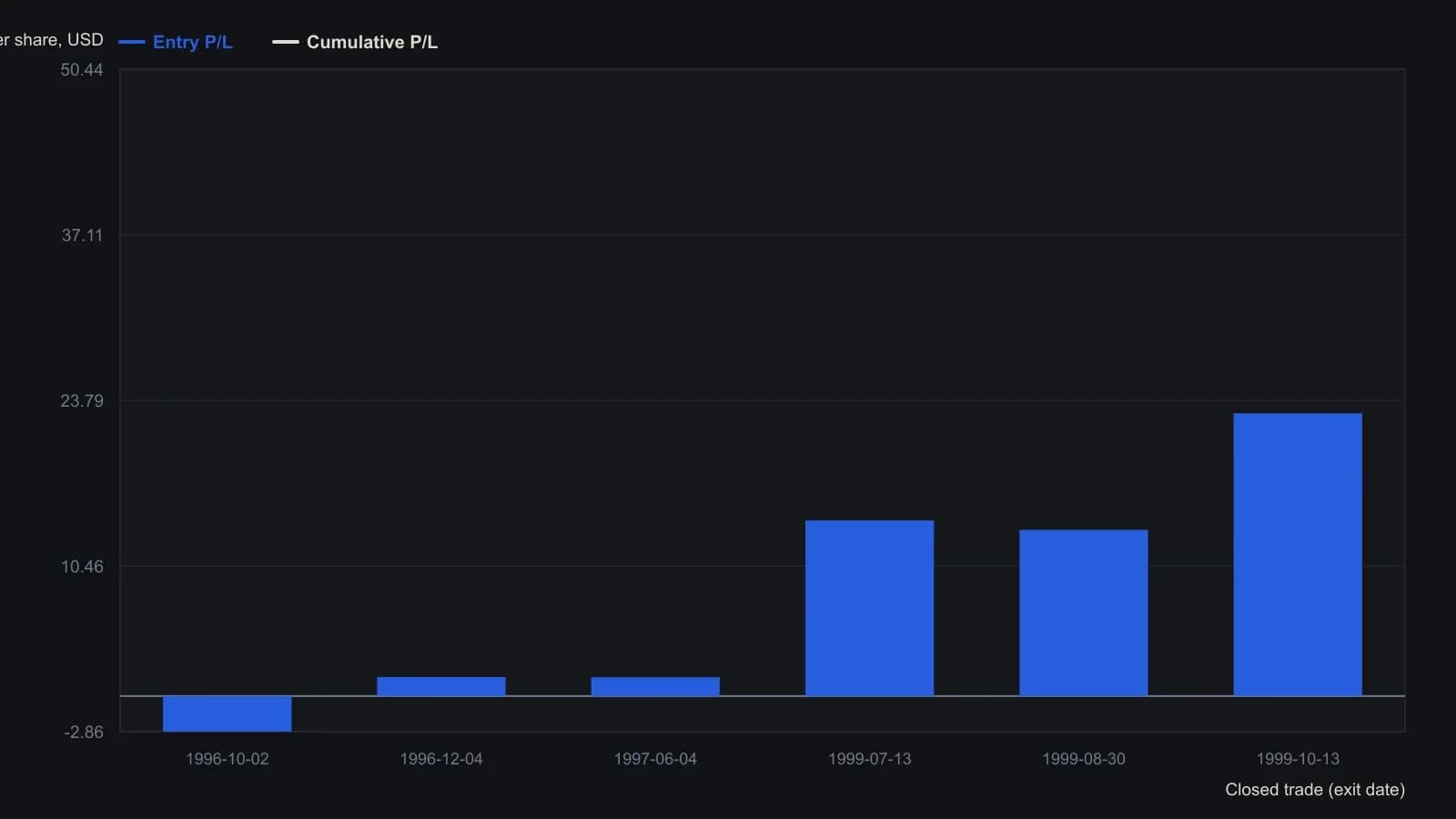
One-contract SuperCharts test, 8 Feb 1996–15 Oct 1999. Longs armed when %D was below 20 and %K crossed above %D, then filled on a next-bar stop one increment above that day’s high.
If the opposite band never prints
Editorial: the object of evaluation is the two-gate pair, not the oscillator print alone. If the opposite band never prints, an exit that waits for that later cross never fires. That is why the protective stop is written as a companion, and why the procedure is incomplete without it.
All readings on this track · 42 readings
- 1987Stochastic fast and slow construction as a rebuildable stack
- 1989Building the stochastic oscillator from close location
- 1990Monthly stochastics as a multi-year bond regime filter
- 1990Walk-forward screen for yen indicator rules
- 1990Slow stochastic construction for index pullback entries
- 1991Random Walk Index construction with an adaptive lookback
- 1991Building a two-stage stochastic oscillator from close location
- 1992Constructing fast and slow stochastic oscillator lines
- 1992Constructing nested stochastic lookbacks
- 1994Construct the four-state price-volume rank before filtering it
- 1996Crowded stochastics, false breakouts, and hidden stops
- 1997Fade and follow entries from stochastic extremes
- 1998Oversold confirmation as a staged rule-based-entry case
- 1999Constructing regular and slow stochastic oscillators
- 2001Construct a variable-interval simple moving average from stacked extremes
- 2001Threshold RSI and stochastic setups with next-bar stops
- 2001Two tests of a rate-adjusted earnings-yield gap
- 2002Constructing a two-line stochastic from a range-normalized close
- 2002Inspect mechanical stochastic daytrade rules on one bar
- 2003Constructing an adaptive stochastic RSI
- 2003Four parameters that construct a stochastic oscillator
- 2004Volume breakout as signal, pullback as entry
- 2004A first currency-market checklist with two averages and a slow stochastic
- 2005Shared-scale cycle indexes with companion oscillators
- 2005Current-bar versus prior-bar range construction for the stochastic oscillator
- 2005Two-session moving-average pullback short
- 2006Market condition as a permission layer for moving averages and oscillators
- 2008Lock the stop at support before sizing a stochastic entry
- 2010Construct a center-line volume oscillator and read it with a stochastic oscillator
- 2010Sharpened RSI turns with rainbow averages and a slow stochastic
- 2011Build a Spearman rank oscillator from ordered closes
- 2012Gold as a regime-dependent hedge in the euro-area crisis
- 2012Pairing moving averages with variable-length stochastics
- 2014Two-leg stochastic stress oscillator as a rebuild drill
- 2014Ingress dates as price bases for relative strength, stochastics, and moving averages
- 2017Constructing a dual EMA stochastic from range normalization
- 2018Constructing a two-stage stochastic RSI for comparable price-oscillator divergences
- 2018Combining a weekly stochastic, a long moving average, and two-day resistance
- 2018Weekly and daily stochastic readings with a long moving average and support
- 2018A confirming workflow for rotating from discretionary to staples
- 2019Stochastic scan thresholds, averages, and formula syntax
- 2020Constructing Slow %K as a two-stage helper