1997issue C121-4
Fade and follow entries from stochastic extremes
The same stochastic oscillator can feed two fully specified rule-based entries: a fade that acts only after an extreme turns, and a follow that acts only after that extreme persists. Each package ends with a nearby stop-loss so entry, abstention, and exit stay testable as one procedure.
- The stochastic oscillator places the latest close on a zero-to-100 scale inside a chosen high-low lookback, with conventional extreme bands above 70 and below 30.
- A fade rule-based entry waits for a turn after a reading near 70 to 80 or 20 to 30, and may require a cross of a short trigger average before the signal is valid.
- A follow rule treats a lasting stretch beyond those bands as a candidate trend and uses a persistence count, commonly five consecutive sessions, with shorter and longer windows noted for a choppy equity index and for currencies.
- Aggressive and swing-break entries still attach a stop-loss, often referenced to a recent two- or three-session extreme, because follow-through can last only one or two sessions or fail as a trend signal.
The oscillator as construction material
A stochastic oscillator is a zero-to-100 reading that locates the latest close inside a chosen high-low lookback. Conventional construction treats readings above 70 as an upper extreme band and readings below 30 as a lower extreme band.
The calculation specifies that lookback for the close versus the period high and low. Optional slowing of the raw reading treats one period as fast and three or more periods as slow. A short average of the oscillator, commonly three periods, serves as the trigger average.
A fade that waits for a turn
A range-style rule-based entry waits for an upper-extreme turn after a reading near 70 to 80, or a lower-extreme turn after a reading near 20 to 30. The procedure may also require the oscillator to cross its trigger average before the signal is valid. If those conditions are not met, the instruction is to stand aside.
Digital Equipment five-day stochastic and the 80/20 fade
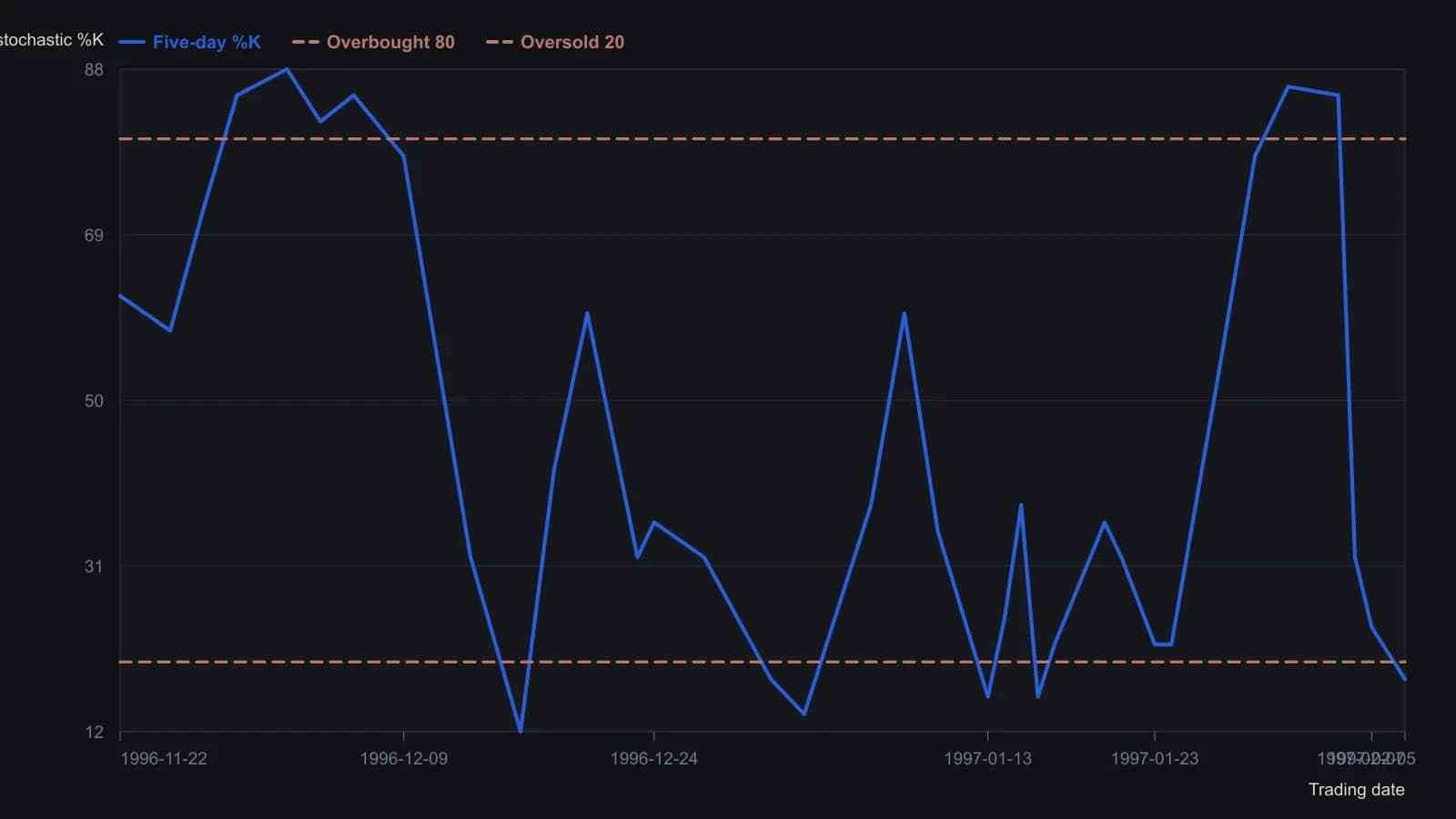
Visual readings of the orange 5-period %K on the 7 February 1997 MetaStock print; expect about ±5 oscillator points of raster error. The print draws guides at 75 and 25, while Luisi’s fade rule uses 80 and 20.
A follow that waits for persistence
A reverse, trend-oriented rule set treats a reading above 70 as a candidate long and a reading below 30 as a candidate short. Trend onset is defined by counting consecutive sessions spent beyond those extreme bands.
That persistence count is a tunable construction parameter. The worked rule requires five consecutive sessions beyond 70 or 30. A shorter three-to-five-session window is noted for a choppy equity index, and a longer five-to-ten-session window is noted for currencies.
Confirmation, aggression, and the stop
An aggressive rule-based entry buys a crossing above 80 or sells a crossing below 20 and immediately attaches a stop-loss referenced to a recent two- or three-session low, so a failed continuation is bounded before the trade is left open.
A swing-break entry records the high or low printed when 70 or 30 is first reached and acts only if that swing reference is broken. A stop-loss remains part of the procedure because some follow-through lasts only one or two sessions or fails as a trend signal. The nearby stop is often referenced to a recent two- or three-session extreme.
All readings on this track · 42 readings
- 1987Stochastic fast and slow construction as a rebuildable stack
- 1989Building the stochastic oscillator from close location
- 1990Monthly stochastics as a multi-year bond regime filter
- 1990Walk-forward screen for yen indicator rules
- 1990Slow stochastic construction for index pullback entries
- 1991Random Walk Index construction with an adaptive lookback
- 1991Building a two-stage stochastic oscillator from close location
- 1992Constructing fast and slow stochastic oscillator lines
- 1992Constructing nested stochastic lookbacks
- 1994Construct the four-state price-volume rank before filtering it
- 1996Crowded stochastics, false breakouts, and hidden stops
- 1997Fade and follow entries from stochastic extremes
- 1998Oversold confirmation as a staged rule-based-entry case
- 1999Constructing regular and slow stochastic oscillators
- 2001Construct a variable-interval simple moving average from stacked extremes
- 2001Threshold RSI and stochastic setups with next-bar stops
- 2001Two tests of a rate-adjusted earnings-yield gap
- 2002Constructing a two-line stochastic from a range-normalized close
- 2002Inspect mechanical stochastic daytrade rules on one bar
- 2003Constructing an adaptive stochastic RSI
- 2003Four parameters that construct a stochastic oscillator
- 2004Volume breakout as signal, pullback as entry
- 2004A first currency-market checklist with two averages and a slow stochastic
- 2005Shared-scale cycle indexes with companion oscillators
- 2005Current-bar versus prior-bar range construction for the stochastic oscillator
- 2005Two-session moving-average pullback short
- 2006Market condition as a permission layer for moving averages and oscillators
- 2008Lock the stop at support before sizing a stochastic entry
- 2010Construct a center-line volume oscillator and read it with a stochastic oscillator
- 2010Sharpened RSI turns with rainbow averages and a slow stochastic
- 2011Build a Spearman rank oscillator from ordered closes
- 2012Gold as a regime-dependent hedge in the euro-area crisis
- 2012Pairing moving averages with variable-length stochastics
- 2014Two-leg stochastic stress oscillator as a rebuild drill
- 2014Ingress dates as price bases for relative strength, stochastics, and moving averages
- 2017Constructing a dual EMA stochastic from range normalization
- 2018Constructing a two-stage stochastic RSI for comparable price-oscillator divergences
- 2018Combining a weekly stochastic, a long moving average, and two-day resistance
- 2018Weekly and daily stochastic readings with a long moving average and support
- 2018A confirming workflow for rotating from discretionary to staples
- 2019Stochastic scan thresholds, averages, and formula syntax
- 2020Constructing Slow %K as a two-stage helper