2002issue C031-4
Inspect mechanical stochastic daytrade rules on one bar
A sell-side daytrading procedure requires stacked FastD conditions before a support sell stop is armed, then applies a same-session gate and a session-close exit. Bar-level commentary is compared with the chart so the coded rules can be confirmed against the intended design.
- A sell stop is armed at the lowest low of the last 10 bars only after a 45-period FastD reading above 70, a prior-bar 7-period FastD reading above 88, and a current 7-period FastD turn lower are all true.
- The slower FastD condition may be satisfied only on the day the trade would be entered, and the boolean flag is forced false on the second-to-last bar of the session.
- The system is specified for five-minute bars and closes every position at the end of the trading session, with no other protective stop described in the construction.
- Bar-level commentary of both FastD values, the 10-bar lowest-low support level, and the entry flag is compared with the same quantities on the chart to confirm the coded conditions match the intended design.
Stack the FastD conditions before arming a stop
The sell-side daytrading procedure is constructed so that three Stochastic oscillator conditions must all be true before a sell stop is armed. A 45-period FastD reading must stand above 70, the prior-bar 7-period FastD reading must stand above 88, and the current 7-period FastD must turn lower.
Only then is a sell stop armed at the lowest low of the last 10 bars.
Keep the slower FastD gate inside the same session
The same-session constraint is built into the procedure. The slower FastD condition may be satisfied only on the day the trade would be entered.
The boolean flag is forced false on the second-to-last bar of the session.
Specify the holding rule as a same-day exit
The mechanical holding rule is a same-day exit. The system is specified for five-minute bars and closes every position at the end of the trading session.
No other protective stop is described in the construction.
Confirm the coded bar against the intended design
A bar-level commentary output is used during construction to display both FastD values, the 10-bar lowest-low support level, and the true or false state of the entry flag on a selected bar.
The construction check compares those commentary values with the same stochastic and price quantities shown on the chart so the coded conditions can be confirmed as matching the intended entry design.
Exercise the assembled rules as a sell-side illustration
The procedure was exercised on September 2001 S&P 500 five-minute data from August 20 through September 5, 2001, as a sell-side-only illustration of the assembled rules.
Sell-side dual stochastic daytrade P/L on the September 2001 S&P 500
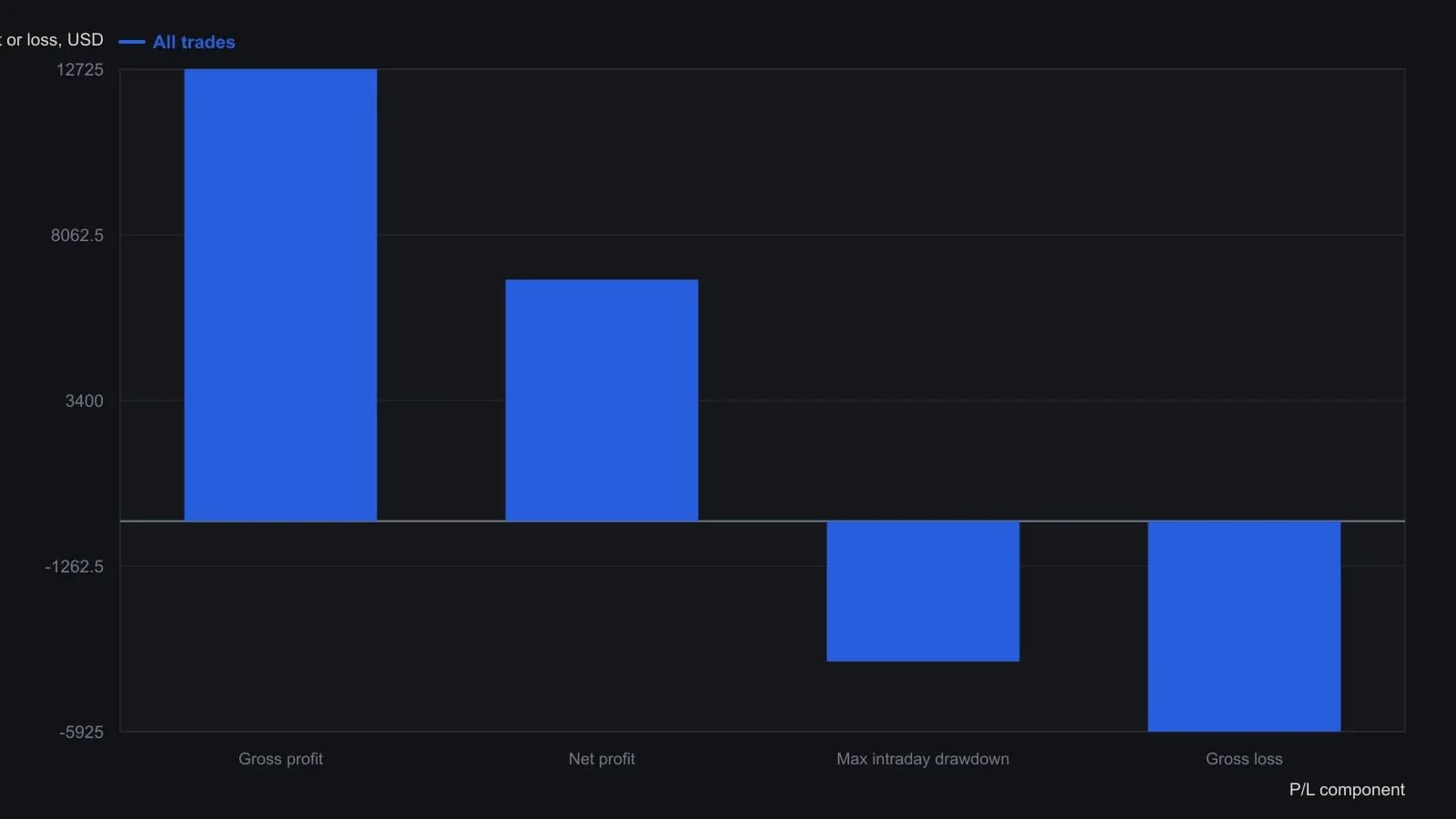
The source tested only the short side, armed a sell stop at the 10-bar lowest low, and exited at the session close with no other stop. Eight trades, 37.5 percent winners, profit factor 2.15, one contract.
All readings on this track · 42 readings
- 1987Stochastic fast and slow construction as a rebuildable stack
- 1989Building the stochastic oscillator from close location
- 1990Monthly stochastics as a multi-year bond regime filter
- 1990Walk-forward screen for yen indicator rules
- 1990Slow stochastic construction for index pullback entries
- 1991Random Walk Index construction with an adaptive lookback
- 1991Building a two-stage stochastic oscillator from close location
- 1992Constructing fast and slow stochastic oscillator lines
- 1992Constructing nested stochastic lookbacks
- 1994Construct the four-state price-volume rank before filtering it
- 1996Crowded stochastics, false breakouts, and hidden stops
- 1997Fade and follow entries from stochastic extremes
- 1998Oversold confirmation as a staged rule-based-entry case
- 1999Constructing regular and slow stochastic oscillators
- 2001Construct a variable-interval simple moving average from stacked extremes
- 2001Threshold RSI and stochastic setups with next-bar stops
- 2001Two tests of a rate-adjusted earnings-yield gap
- 2002Constructing a two-line stochastic from a range-normalized close
- 2002Inspect mechanical stochastic daytrade rules on one bar
- 2003Constructing an adaptive stochastic RSI
- 2003Four parameters that construct a stochastic oscillator
- 2004Volume breakout as signal, pullback as entry
- 2004A first currency-market checklist with two averages and a slow stochastic
- 2005Shared-scale cycle indexes with companion oscillators
- 2005Current-bar versus prior-bar range construction for the stochastic oscillator
- 2005Two-session moving-average pullback short
- 2006Market condition as a permission layer for moving averages and oscillators
- 2008Lock the stop at support before sizing a stochastic entry
- 2010Construct a center-line volume oscillator and read it with a stochastic oscillator
- 2010Sharpened RSI turns with rainbow averages and a slow stochastic
- 2011Build a Spearman rank oscillator from ordered closes
- 2012Gold as a regime-dependent hedge in the euro-area crisis
- 2012Pairing moving averages with variable-length stochastics
- 2014Two-leg stochastic stress oscillator as a rebuild drill
- 2014Ingress dates as price bases for relative strength, stochastics, and moving averages
- 2017Constructing a dual EMA stochastic from range normalization
- 2018Constructing a two-stage stochastic RSI for comparable price-oscillator divergences
- 2018Combining a weekly stochastic, a long moving average, and two-day resistance
- 2018Weekly and daily stochastic readings with a long moving average and support
- 2018A confirming workflow for rotating from discretionary to staples
- 2019Stochastic scan thresholds, averages, and formula syntax
- 2020Constructing Slow %K as a two-stage helper