1991issue C041-8
Constructing five-session forecasts from stochastic, ADX, and MACD inputs
A predictor of this type is usable only if the builder first defines the input architecture and the desired output. Lock complementary lookbacks, an MACD histogram definition, and a five-session percentage-change target before the training phase adjusts connection strengths.
- Lock the input architecture and the five-session target before the training phase raises or lowers any connection strengths.
- Use a nine-session slow stochastic pair, an 18-session average directional index, and a defined MACD histogram rather than stacking slight variants of the same series.
- Replace a three-layer default with four layers and size the added hidden layer at about 12 percent of the input-layer unit count.
- After most training examples produce the intended output, freeze the weights and use the same net as a predictor or as a source of later rule combinations.
Specify the output before any weights move
A market predictor of this type is stored as layers of units whose numeric connection strengths are adjusted during training until the architecture maps examples to a specified target.
Whether the trained system is usable depends on how the builder defines the input architecture and the desired output, because the finished weight matrix does not expose an inspectable reason for each decision.
Editorial reading: treat that dependence as a specification problem. Lock complementary lookbacks, an MACD histogram definition, and a five-session target before any network is allowed to fit weights.
Lock complementary lookbacks and a five-session target
The illustrated input block includes a nine-session slow stochastic %K and %D pair and an 18-session average directional index. The stochastic oscillator is a slow %K and %D pair computed over a nine-session lookback and supplied as ordered oscillator inputs to a forecast network. The average directional index is an 18-session directional-movement reading used as a trend-strength input rather than as a standalone chart rule.
An MACD histogram input is formed as the difference between a 12-versus-26-session exponential MACD line and a nine-session signal of that line. That histogram is used as a chart-derived input.
Two further inputs are the current index close and the close five sessions earlier. The designated target is the percentage change in that index five sessions ahead. That forecast horizon is a fixed five-session lead that defines the network output as a percentage change, not as a contemporaneous classification.
Treat near-duplicate series as a design risk
Financial inputs that are slight variants of one another can hinder training. Stacking more series of the same type is treated as a design risk.
Input redundancy is overlap among indicators that recode nearly the same price path and can impair training if they are stacked without a construction reason.
Five-session S&P 500 change the network is trained to emit
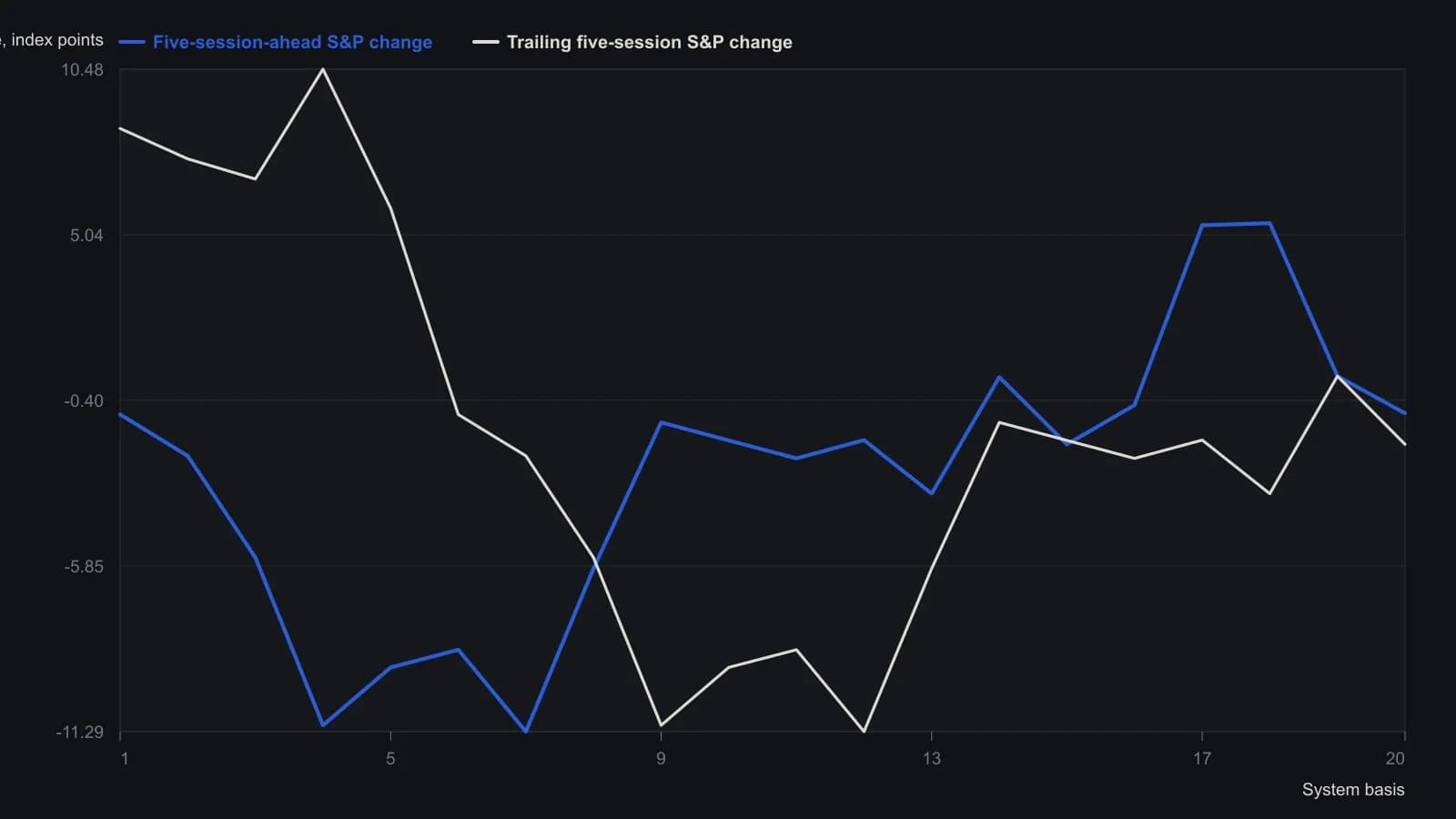
The article calls the target a five-session percentage difference, but the printed Result column equals the S&P 500 close five rows later minus the current close, so the series is carried in index points. Companion inputs in the same table are 9-day slow %D and %K, ADX, the MACD histogram, the S&P 500 close, and the trailing five-session change.
Add a sized hidden layer, then run the training phase
One construction choice replaces a three-layer default with four layers and sizes the added hidden layer at about 12 percent of the input-layer unit count. The hidden layer is an intermediate layer of weighted units that transforms the indicator block before it reaches the forecast output.
The training phase is the interval when connection strengths are raised or lowered according to whether a guess matches the designated target.
After most training examples produce the intended output, the frozen weights are used as a predictor. The same net can also surface indicator combinations that a later rule system might encode.
All readings on this track · 56 readings
- 1986Cycle-aligned directional trend indicator
- 1987What crossover and directional entry rules actually compare
- 1988A directional-line cross needs a trend filter, an extreme-point rule, and a dollar stop
- 1988Constructing true range by offset addressing
- 1988Constructing directional movement from bar range
- 1988Average directional index construction: recursive smoothing and lookback offset
- 1988Staged Average Directional Index construction with Relative Strength Index confirmation and stop alerts
- 1988Average Directional Index construction with frozen true range and directional rules
- 1991Constructing the average directional index from range expansion and true range
- 1991Constructing five-session forecasts from stochastic, ADX, and MACD inputs
- 1993Constructing the average directional index from directional movement and true range
- 1993Confirming n-bar breakouts with ADX and DX filters
- 1994Constructing a Bollinger band-width trend filter
- 1994A pre-trade checklist that can refuse a long three ways
- 1997An ADX threshold and a moving average as a trend filter
- 1998Regime filters for mutated indicators
- 1999Building the average directional index from range extension and true range
- 2000Evaluating ADX, RSI, and moving averages in a multi-stock warehouse
- 2000Stochastic pop as a filtered continuation setup
- 2000Onset and exit from one average directional index
- 2002Joint ADX and MACD readout for trend strength and direction
- 2003Adaptive Donchian breakout with implied volatility and volume
- 2004The average directional index as a regime gate for the relative strength index and the stochastic oscillator
- 2004Constructing true-range-specified volume as a directional filter
- 2005Constructing a multi-filter penny stock breakout procedure
- 2005Construct one playbook that flips with session regime
- 2005Combining Bollinger Bands, the average directional index, and Fibonacci retracement on currency pairs
- 2006Assembling an adaptive price zone from double-smoothed averages
- 2006An ADX strength gate for MACD and the stochastic oscillator
- 2007Directional movement as a filter plus trigger
- 2007Constructing a veto-first trend permission stack
- 2007ADX gates for trend end, range, and reversal
- 2008Constructing a nine-cell directional-ratio grid
- 2008Average directional index and directional trend indicator lookbacks as trend-filter parameters
- 2008A holding-matched market lens from averages and directional-line crosses
- 2008A nine-cell directional scoreboard for multi-horizon entries
- 2010Building a Vortex Indicator from high-low distances
- 2010Constructing ADX, RSI, and MACD price filters
- 2011Constructing a volume zone oscillator with a moving-average and Average Directional Index regime filter
- 2011A volume zone oscillator conditioned by an Average Directional Index filter
- 2011Candlestick names need volume-price, ADX, and moving-average checks
- 2012Clustered average-directional-index traces as a trend-start filter
- 2012Average Directional Index cluster filters for trend-start signals
- 2012Confirming a trend start or turn with a triple ADX cluster
- 2013Constructing a late-entry stack from a signed DMI oscillator
- 2013A directional oscillator and its stochastic as a stacked timing filter
- 2013ADX cluster lookbacks are a locked specification, not a chart label
- 2013Combining moving averages, stochastics, and ADX in a daily scan
- 2015Assembling the Average Directional Index from directional movement
- 2016How an Average Directional Index filter and a breakout entry form one procedure
- 2016Score RSI and stochastic crossings only when ADX confirms the trend
- 2018Constructing an ADX filter for intraday breakouts
- 2018An ADX volatility gate for prior-day breakouts
- 2019Exponential deviation bands with a moving average, RSI and ADX
- 2020A normalized-slope trend filter from linear regression
- 2020Gating volatility-momentum divergences with a Trend filter