2020issue C1041
When mechanical historical tests decay after optimization
A visually tidy historical equity path is not, by itself, a reliable basis for expecting a mechanical trading system to keep working after live use. Treat that polish as a design warning, and keep simplicity, parameter restraint, and explicit abstention inside the same mechanical procedure.
- Favorable historical results from a mechanical procedure are not, by themselves, a reliable basis for expecting the same procedure to keep producing favorable results after it is used live.
- Searching tunable inputs for a near-perfect historical equity path is a common route to over-optimization, and adding extra rules until a historical test looks acceptable can curve-fit the procedure to the recorded sample.
- A stated counterweight is to use only enough rules and parameter search to reach an adequate historical test, then stop, with abstention kept inside the same mechanical procedure.
- Market change over spans of one, five, and ten years, plus an unknown luck component that may reverse, can still break a carefully developed procedure, so live use requires accepting that the historical result may not continue.
What a favorable historical test does not settle
A mechanical trading system is a fully specified mapping from rule inputs, market state, and execution constraints into a signal, including the choice to stand aside. System optimization searches those rule inputs against recorded market state and execution constraints so entry, exit, and abstention produce one testable signal over the system's holding period.
Favorable historical results from that mechanical procedure are not, by themselves, a reliable basis for expecting the same procedure to keep producing favorable results after it is used live.
How the recorded path becomes too tidy
Searching tunable inputs such as averaging lookback, stop size, or indicator thresholds for a near-perfect historical equity path is a common route to over-optimization. Over-optimization is continuing parameter search until the historical path looks near-perfect instead of merely adequate.
Adding extra rules and filters until a historical test looks acceptable can fit the procedure to the recorded sample. Curve-fitting is that habit of adding rules or filters until the recorded sample yields an acceptable historical path.
Mechanical backtest equity that later decays
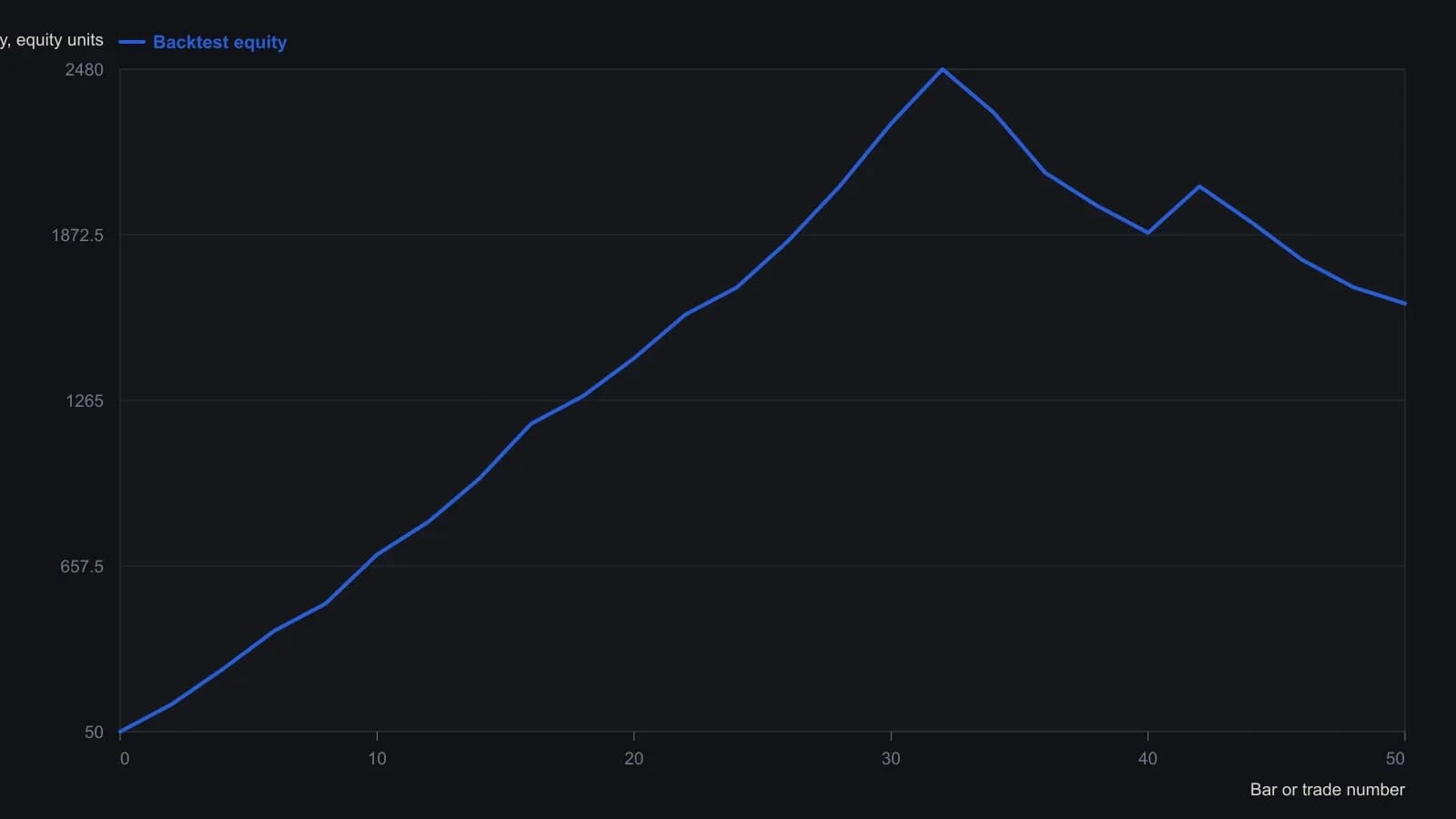
Raster digitization of a dark, unlabeled equity plot. Vertical scale is equity in the source chart’s units (axis ticks at 0, 500, 1000, 1500, 2000, 2500). Horizontal scale is bar/trade index with ticks at 0, 10, 20, 30, 40, 50. Peak near 2500 around index 32; boxed later window is the decay. Values are approximate to the nearest 50 equity units.
Stop at an adequate test
A stated counterweight is to use only enough rules and parameter search to reach an adequate historical test, then stop rather than chase a visually perfect path.
Robustness testing checks whether that same mechanical procedure still holds when extra rules, regime change, and an unknown luck component are not assumed to match the fitted sample.
Market change, luck, and abstention
Changes in market conditions and in the mix of participants over spans of one, five, and ten years can produce price behavior that no longer matches the sample used to build the rules.
Keeping the rule set simple and suspending trading in unusual conditions, including volatility at recorded highs or lows until activity returns toward a typical range, is offered as a way to limit damage from market change. Abstention is a tested rule that suspends trading when conditions leave the range the procedure was built to handle.
A successful historical test can contain an unknown luck component, and that component is not expected to persist and may reverse. Careful development can reduce but not remove these failure modes, so moving a historically tested procedure into live use still requires accepting that the historical result may not continue.
All readings on this track · 57 readings
- 1986Degrees of freedom in trading system optimization
- 1988Walk-forward and neighborhood tests after optimization
- 1988Undisclosed rules block system robustness tests
- 1988Testing re-optimization calendars against random parameter controls
- 1989Binary search limits on multi-peak average grids
- 1989Parameter neighborhoods that survive a shift
- 1990Use profit mapping to keep a cycle and stop plateau
- 1990Why popular indicator optimization fails robustness
- 1991Retesting weighted indicator balances across horizons
- 1992Constructing forecast models with regression, walk-forward, and robustness
- 1992Diagnose regimes before you lock parameters
- 1992When stops change system timing
- 1993Walk-forward halt rules for forecast models
- 1994Walk-forward evaluation of genetic index rules
- 1995Input pruning as walk-forward system evaluation
- 1995Critiquing neural nets as incomplete trading systems
- 1996Rebuild the equity-path ratio before it ranks a designed system
- 1996Parameter grids can fit random walks
- 1996Walk-forward analysis belongs in the design of a mechanical trading system
- 1997When a holdout fails, discard the rule set
- 1997Test rewarded rule breaks before replacing the system
- 1997Walk-forward rules keep system research from rewriting live trades
- 1999Keep a channel-breakout to two lookbacks and test neighbor stability
- 1999Constant investment size in stock system evaluation
- 2000Forcing optimization maps mechanical system failure boundaries
- 2000Robust parameter selection with surface charts
- 2001A two-gate classroom test for a two-window momentum trend filter
- 2002How a two-sided continuation factor becomes a testable trend rule
- 2002Evaluating two-window trend intensity as a reversal rule
- 2003Discounting speculative bubbles in system robustness tests
- 2003Walk-forward evaluation of locked stochastic oscillator rules
- 2003Critiquing mechanical system design after extreme price regimes
- 2004Evaluating a two-window trend trigger
- 2005Grade backtested signals with holdouts and optimization plateaus
- 2006Reserved-sample evaluation of trading system design
- 2006Walk-forward critique of hindsight crossover systems
- 2008Condition-matched walk-forward evaluation for mechanical systems
- 2011Session-split evaluation of regular and overnight systems
- 2012Walk-forward evaluation as operator rehearsal
- 2013Two-window evaluation of mechanical trading systems
- 2013Walk-forward filter selection for repeated-median velocity
- 2014Walk-forward evaluation for fading-memory velocity systems
- 2015Test oscillator events before tuning rules
- 2016Walk-forward evaluation of a five-parameter parabolic stop-and-reversal
- 2016Walk-forward optimization without curve fitting
- 2017Optimization without overfitting in trend-system evaluation
- 2017Parameter stability is a better guide than a larger crossover grid
- 2018Point-in-time universes for system evaluation
- 2018Walk-forward robustness evaluation for optimized systems
- 2018Critiquing breakout systems through robustness tests
- 2018A critique of parameter fitting in system design
- 2019Noise-matched rules still need trend filters and robustness tests
- 2019Three gates for evaluating a trading system
- 2020Data construction as a mechanical system input
- 2020Hidden optimization in ported relative-strength systems
- 2020When mechanical historical tests decay after optimization
- 2025Add a second procedure before you retune the first