2003issue C061-4
Walk-forward evaluation of locked stochastic oscillator rules
The archive frames stochastic oscillator rules as a quantitative baseline inside a complete trading-system procedure. Walk-forward analysis and robustness testing keep entry, exit, and abstention testable on later windows.
- The stochastic oscillator is treated as a quantitative baseline whose forecast comes from ordered price, volume, or breadth observations over a defined lookback.
- Walk-forward analysis and robustness testing keep entry, exit, and abstention as one procedure, judged over the system's holding period.
- A recommended reliability check is to identify a strategy on one historical window and test that same locked strategy on a later out-of-sample window.
- Archive notes repeat the same evaluation design from listed futures to an equity-index futures contract and treat parameter-sensitivity, stops, windows, and tradable choice as stages of test design.
A complete procedure rather than an isolated reading
Archive system-evaluation guidance is framed around designing or testing a trading system as a complete procedure rather than as an isolated indicator reading.
The supplied taxonomy treats the stochastic oscillator as a quantitative model whose output is a forecast from ordered price, volume, or breadth observations over a defined sampling interval and lookback.
Here that oscillator is the explicit quantitative baseline: a bounded oscillator built from ordered price observations over a defined lookback, whose forecast-like readings are compared with later out-of-sample results.
Walk the locked rules onto later windows
Walk-forward analysis is specified as a trading-system procedure whose output is a signal and whose horizon is the system's holding period.
It is a sequential evaluation procedure that re-estimates or re-applies a locked rule set on successive out-of-sample windows so entry, exit, and abstention remain one testable system.
The holding period is the system-defined interval from entry through exit or abstention, and it is the horizon against which robustness and walk-forward results are judged.
A recommended reliability check is to identify a strategy on one historical window and then test that same locked strategy on a later window.
That later segment is out-of-sample: a time window reserved after a rule or parameter is chosen, used to judge whether the procedure still behaves as specified.
Manugistics daily closes on the locked FVE sample
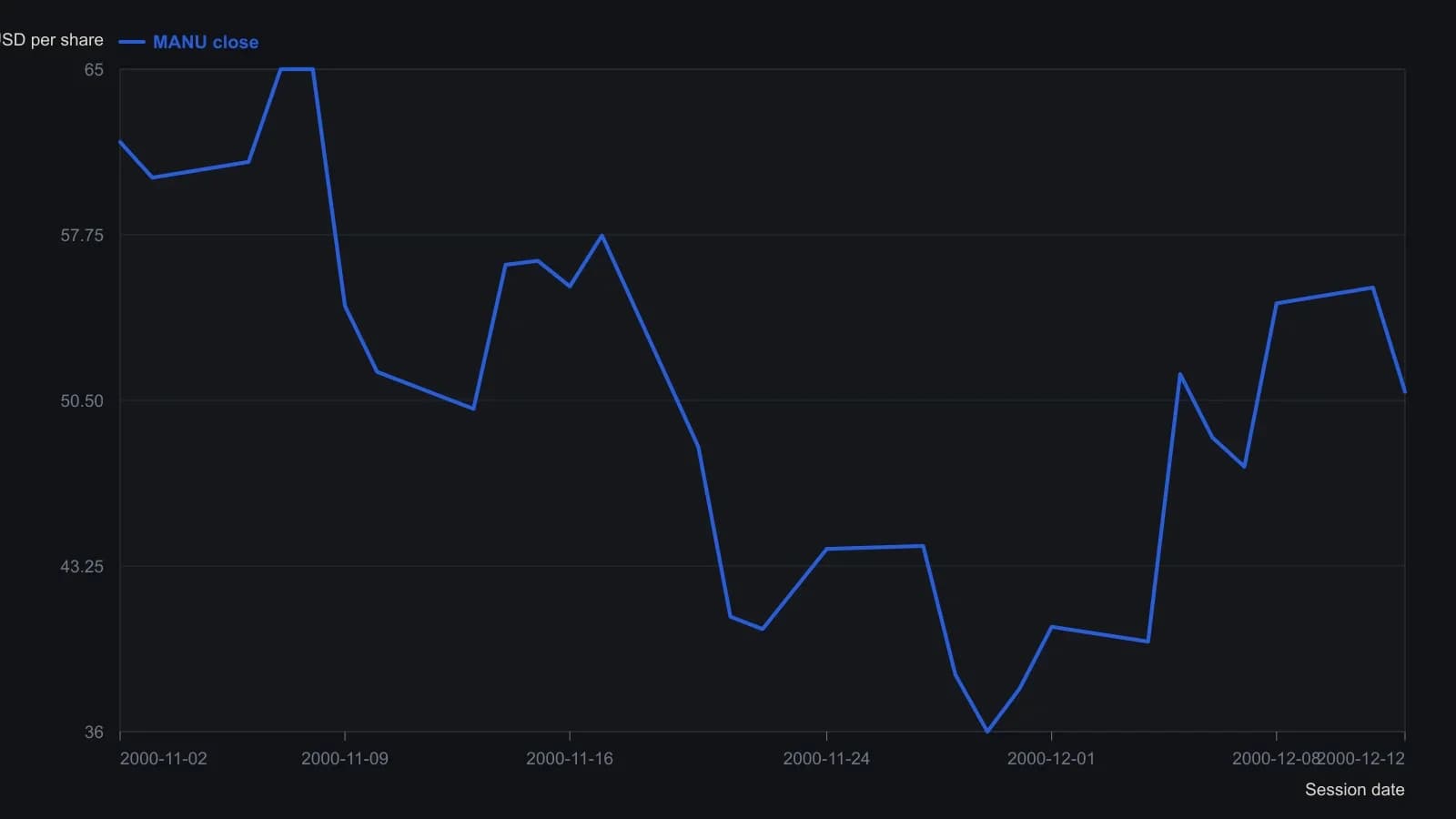
FVE is defined only after a locked 22-session lookback and a 0.3 percent-of-close volume gate. The June 2003 revision drops an extra illustration row so the sum is 22 sessions, not 23.
Robustness as the same testable process
Robustness testing is specified as the same class of procedure: rule inputs, market state, and execution constraints are exercised together so entry, exit, and abstention remain one testable process.
The check is whether those same inputs still produce a coherent signal when parameters, windows, or related markets change.
Parameter-sensitivity asks how much a system's signals change when a coefficient or lookback is moved inside a stated range rather than left at a single fitted value.
How the archive evolves a timing model
Related archive notes point readers to prior work that applied stochastics and other oscillators to listed futures and then repeated the same evaluation design on an equity-index futures contract.
The same notes flag out-of-sample testing, parameter-sensitivity testing, and the addition of nonprice timing inputs as explicit stages in how a timing model is evolved.
Further evaluation notes describe improving a system's test design by varying stops, trading windows, and the choice of tradables across different time periods.
All readings on this track · 51 readings
- 1986Degrees of freedom in trading system optimization
- 1988Walk-forward and neighborhood tests after optimization
- 1988Undisclosed rules block system robustness tests
- 1988Testing re-optimization calendars against random parameter controls
- 1989Binary search limits on multi-peak average grids
- 1989Parameter neighborhoods that survive a shift
- 1990Use profit mapping to keep a cycle and stop plateau
- 1990Why popular indicator optimization fails robustness
- 1991Retesting weighted indicator balances across horizons
- 1992Constructing forecast models with regression, walk-forward, and robustness
- 1992Diagnose regimes before you lock parameters
- 1992When stops change system timing
- 1993Walk-forward halt rules for forecast models
- 1994Walk-forward evaluation of genetic index rules
- 1995Input pruning as walk-forward system evaluation
- 1995Critiquing neural nets as incomplete trading systems
- 1996Rebuild the equity-path ratio before it ranks a designed system
- 1996Parameter grids can fit random walks
- 1996Walk-forward analysis belongs in the design of a mechanical trading system
- 1997When a holdout fails, discard the rule set
- 1997Test rewarded rule breaks before replacing the system
- 1997Walk-forward rules keep system research from rewriting live trades
- 1999Keep a channel-breakout to two lookbacks and test neighbor stability
- 1999Constant investment size in stock system evaluation
- 2000Forcing optimization maps mechanical system failure boundaries
- 2000Robust parameter selection with surface charts
- 2001A two-gate classroom test for a two-window momentum trend filter
- 2002How a two-sided continuation factor becomes a testable trend rule
- 2002Evaluating two-window trend intensity as a reversal rule
- 2003Discounting speculative bubbles in system robustness tests
- 2003Walk-forward evaluation of locked stochastic oscillator rules
- 2003Critiquing mechanical system design after extreme price regimes
- 2004Evaluating a two-window trend trigger
- 2005Grade backtested signals with holdouts and optimization plateaus
- 2006Reserved-sample evaluation of trading system design
- 2006Walk-forward critique of hindsight crossover systems
- 2008Condition-matched walk-forward evaluation for mechanical systems
- 2011Session-split evaluation of regular and overnight systems
- 2012Walk-forward evaluation as operator rehearsal
- 2013Two-window evaluation of mechanical trading systems
- 2013Walk-forward filter selection for repeated-median velocity
- 2014Walk-forward evaluation for fading-memory velocity systems
- 2015Test oscillator events before tuning rules
- 2016Walk-forward evaluation of a five-parameter parabolic stop-and-reversal
- 2016Walk-forward optimization without curve fitting
- 2017Optimization without overfitting in trend-system evaluation
- 2017Parameter stability is a better guide than a larger crossover grid
- 2018Point-in-time universes for system evaluation
- 2018Walk-forward robustness evaluation for optimized systems
- 2018Critiquing breakout systems through robustness tests
- 2018A critique of parameter fitting in system design