2013issue C1038-41
Two-window evaluation of mechanical trading systems
A mechanical rule set is first viewed across about one thousand daily bars spanning more than one market type, then examined on the most recent three months. Equity curves are reviewed before the procedure is treated as ready to use.
- A mechanical trading procedure is described as having both strengths and weaknesses, and no single system is presented as suitable for every trader or every market state.
- Robustness is framed as repeating one rule set through bullish, bearish, and sideways stretches, where losing trades in a mismatch such as trend-following in a choppy market are treated as expected.
- After a multi-year first window of about one thousand daily bars, the same entry, exit, and sit-out rules are examined on the most recent three months so recent signals are judged separately.
- Reviewing equity curves is presented as a check to complete before treating a mechanical procedure as ready to use.
A fully specified rule set
A mechanical trading system is a fully specified procedure that turns rule inputs, market state, and execution constraints into entry, exit, or sit-out signals over the system holding period. The whole rule set can then be tested as one process rather than as isolated chart opinions.
A mechanical trading procedure is described as having both strengths and weaknesses, with no single system presented as suitable for every trader or every market state.
Stress the same rules across market types
A first historical evaluation is recommended to use four years of data, described as about one thousand daily bars, so the same rules can be viewed across more than one market type.
Robustness testing repeats one rule set through bullish, bearish, and sideways stretches to locate where the procedure fits the market state and where it is mismatched. Robustness is framed as that multi-state check rather than a test confined to a single market phase.
When a trend-following procedure meets a choppy market, losing trades are treated as an expected mismatch between the rules and the current market state.
XLF weekly price with 10-week and 40-week moving averages, 2011–2012
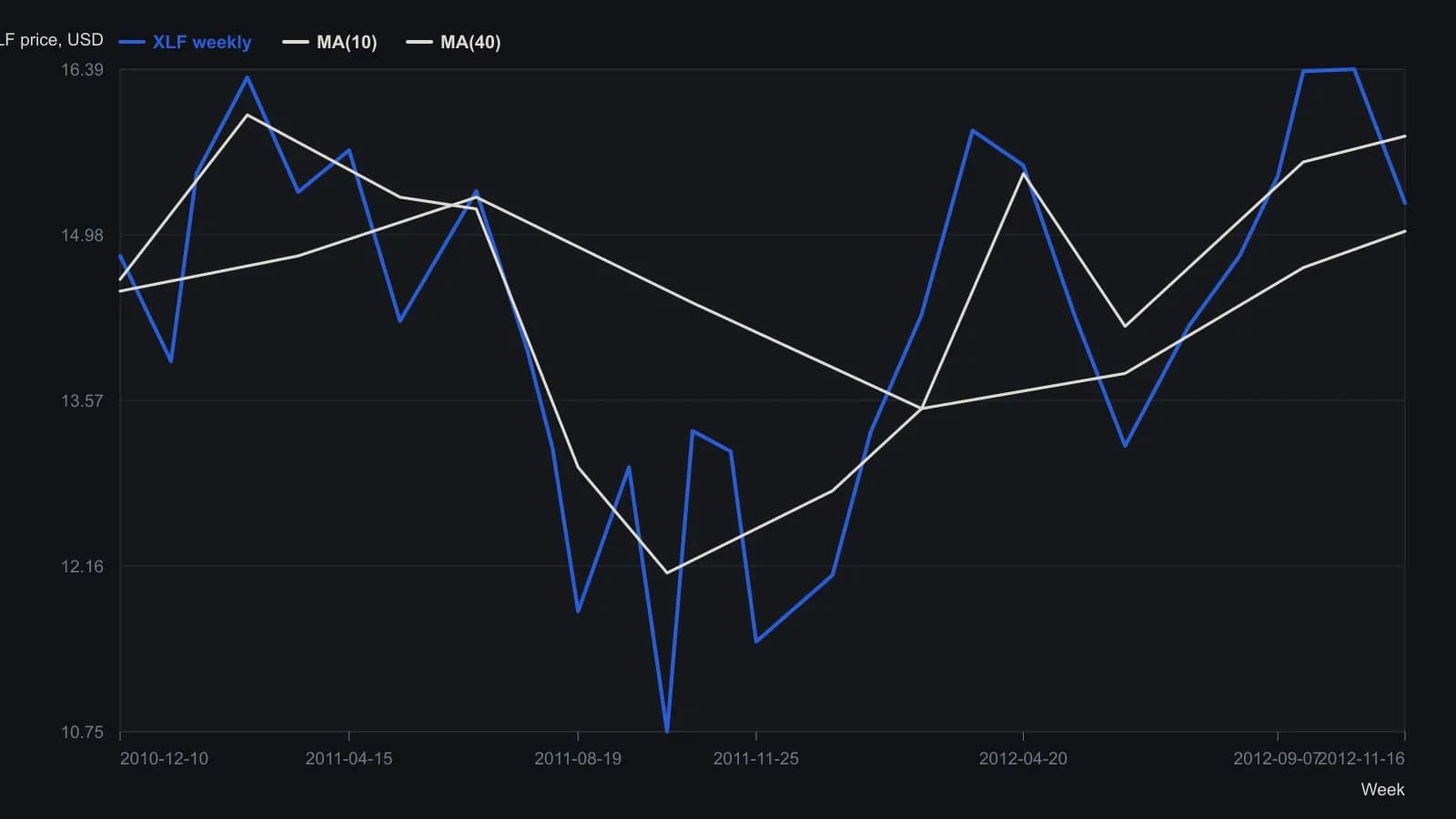
Weekly StockCharts snapshot dated 16 November 2012 (open 15.57, high 15.63, low 15.06, last 15.25). Labeled swings keep the printed three-decimal tags; unlabeled in-between prices were read from the candlesticks to about a tenth of a point.
Check the same rules on recent bars
After that multi-year window, the same rules are then examined on the most recent three months so recent signals can be judged separately from the longer sample.
Editorial note: that later-window check is walk-forward analysis. The same mechanical rules are applied to recent bars so entry, exit, and abstention signals are not judged on the full sample alone.
Read the equity path before use
Reviewing equity curves is presented as a check to complete before treating a mechanical procedure as ready to use.
What the check does not settle
Projecting later prices from historical patterns or indicators is described as imperfect, with no guarantee attached to any technology or trading system.
Broad awareness of a method is not treated as automatic failure of that method, because market liquidity is described as large and many competing procedures remain unpublished.
Because markets are described as globally linked and news-sensitive, a static long-term hold is presented as harder to treat as a complete standalone procedure than shorter, predefined entries and exits.
All readings on this track · 51 readings
- 1986Degrees of freedom in trading system optimization
- 1988Walk-forward and neighborhood tests after optimization
- 1988Undisclosed rules block system robustness tests
- 1988Testing re-optimization calendars against random parameter controls
- 1989Binary search limits on multi-peak average grids
- 1989Parameter neighborhoods that survive a shift
- 1990Use profit mapping to keep a cycle and stop plateau
- 1990Why popular indicator optimization fails robustness
- 1991Retesting weighted indicator balances across horizons
- 1992Constructing forecast models with regression, walk-forward, and robustness
- 1992Diagnose regimes before you lock parameters
- 1992When stops change system timing
- 1993Walk-forward halt rules for forecast models
- 1994Walk-forward evaluation of genetic index rules
- 1995Input pruning as walk-forward system evaluation
- 1995Critiquing neural nets as incomplete trading systems
- 1996Rebuild the equity-path ratio before it ranks a designed system
- 1996Parameter grids can fit random walks
- 1996Walk-forward analysis belongs in the design of a mechanical trading system
- 1997When a holdout fails, discard the rule set
- 1997Test rewarded rule breaks before replacing the system
- 1997Walk-forward rules keep system research from rewriting live trades
- 1999Keep a channel-breakout to two lookbacks and test neighbor stability
- 1999Constant investment size in stock system evaluation
- 2000Forcing optimization maps mechanical system failure boundaries
- 2000Robust parameter selection with surface charts
- 2001A two-gate classroom test for a two-window momentum trend filter
- 2002How a two-sided continuation factor becomes a testable trend rule
- 2002Evaluating two-window trend intensity as a reversal rule
- 2003Discounting speculative bubbles in system robustness tests
- 2003Walk-forward evaluation of locked stochastic oscillator rules
- 2003Critiquing mechanical system design after extreme price regimes
- 2004Evaluating a two-window trend trigger
- 2005Grade backtested signals with holdouts and optimization plateaus
- 2006Reserved-sample evaluation of trading system design
- 2006Walk-forward critique of hindsight crossover systems
- 2008Condition-matched walk-forward evaluation for mechanical systems
- 2011Session-split evaluation of regular and overnight systems
- 2012Walk-forward evaluation as operator rehearsal
- 2013Two-window evaluation of mechanical trading systems
- 2013Walk-forward filter selection for repeated-median velocity
- 2014Walk-forward evaluation for fading-memory velocity systems
- 2015Test oscillator events before tuning rules
- 2016Walk-forward evaluation of a five-parameter parabolic stop-and-reversal
- 2016Walk-forward optimization without curve fitting
- 2017Optimization without overfitting in trend-system evaluation
- 2017Parameter stability is a better guide than a larger crossover grid
- 2018Point-in-time universes for system evaluation
- 2018Walk-forward robustness evaluation for optimized systems
- 2018Critiquing breakout systems through robustness tests
- 2018A critique of parameter fitting in system design