1992issue C121-11
When stops change system timing
A stop or a profit target can force the book flat and thereby open later entries that the same signal would have skipped while a position was still open. The historical workflow therefore searches entry, stop and target together and still applies a hindsight penalty.
- After a long trade is closed at a fixed dollar target, a later long signal may be taken that would have been ignored if the first position had still been open.
- Stops can raise trade count over a fixed sample because they force the system flat and open slots for additional entries.
- If the entry constant, stop amount and target amount can all vary, they should be searched jointly as three parameters, not treated as one entry rule.
- If over-penalizing turns expected value negative, easing the parameter count just to restore a thin positive expectation is not accepted as proof the system is tradable.
How the full rule set is scored
System optimization means jointly testing entry, stop and target settings as one procedure so the full rule set, not just the entry formula, is what gets scored.
A stop-loss is a pre-set exit that ends a losing or fully captured position and can leave the system flat, which may allow a later entry that would not have fired if the first trade were still open.
Robustness testing means checking whether a backtested rule set still looks usable after a hindsight penalty, instead of treating every extra control as free.
OEX five-day regression forecast oscillator, October 1991–January 1992
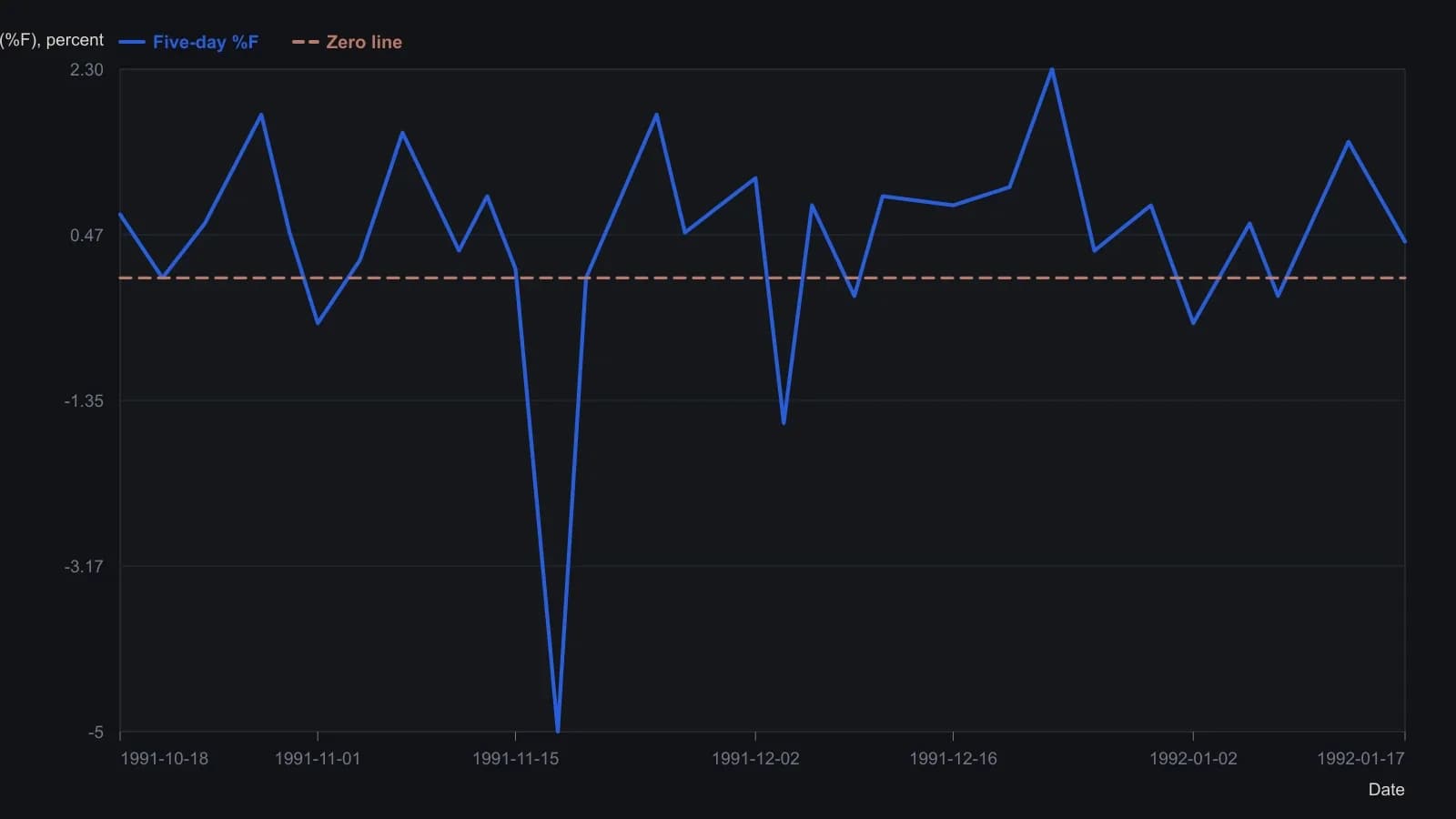
The letter hard-wires a five-period time-series forecast of the close, so each %F print is one hundred times (close minus the prior day's TSF) divided by close. The scan supports roughly half-point accuracy, not tick-level values.
How a stop or target changes later timing
A profit-target exit can change later timing. After a long trade is closed at a fixed dollar target, a subsequent long signal may be taken that would have been ignored if the first position had still been open.
Stops can raise trade count over a fixed sample because they force the system flat at times and thereby open slots for additional entries.
Count entry, stop and target together
If the entry constant, stop amount and target amount are all allowed to vary, they should be counted and searched jointly as three parameters rather than treated as a single entry rule.
If those same three settings are frozen forever across markets and periods, they may be treated as one parameter, but the resulting record still needs a hindsight penalty for having seen the past.
Any artificial control that restricts trading freedom consumes a parameter, regardless of how mild its effect on timing appears. Assigning fractional or fractal weights to interdependent parameters lacks a stated mathematical basis and is treated as an unjustified shortcut.
Parameter counting is used here to strip hindsight bias from simulated trading. If over-penalizing turns expected value negative, easing the count just to restore a thin positive expectation is not accepted as proof the system is tradable.
What a realistic stop is meant to do
A realistic stop is framed as an exit that ends a small loss before it becomes large. That includes a trailing stop a fixed percent below the highest price reached in the trade, which can be tightened as an open profit grows.
All readings on this track · 51 readings
- 1986Degrees of freedom in trading system optimization
- 1988Walk-forward and neighborhood tests after optimization
- 1988Undisclosed rules block system robustness tests
- 1988Testing re-optimization calendars against random parameter controls
- 1989Binary search limits on multi-peak average grids
- 1989Parameter neighborhoods that survive a shift
- 1990Use profit mapping to keep a cycle and stop plateau
- 1990Why popular indicator optimization fails robustness
- 1991Retesting weighted indicator balances across horizons
- 1992Constructing forecast models with regression, walk-forward, and robustness
- 1992Diagnose regimes before you lock parameters
- 1992When stops change system timing
- 1993Walk-forward halt rules for forecast models
- 1994Walk-forward evaluation of genetic index rules
- 1995Input pruning as walk-forward system evaluation
- 1995Critiquing neural nets as incomplete trading systems
- 1996Rebuild the equity-path ratio before it ranks a designed system
- 1996Parameter grids can fit random walks
- 1996Walk-forward analysis belongs in the design of a mechanical trading system
- 1997When a holdout fails, discard the rule set
- 1997Test rewarded rule breaks before replacing the system
- 1997Walk-forward rules keep system research from rewriting live trades
- 1999Keep a channel-breakout to two lookbacks and test neighbor stability
- 1999Constant investment size in stock system evaluation
- 2000Forcing optimization maps mechanical system failure boundaries
- 2000Robust parameter selection with surface charts
- 2001A two-gate classroom test for a two-window momentum trend filter
- 2002How a two-sided continuation factor becomes a testable trend rule
- 2002Evaluating two-window trend intensity as a reversal rule
- 2003Discounting speculative bubbles in system robustness tests
- 2003Walk-forward evaluation of locked stochastic oscillator rules
- 2003Critiquing mechanical system design after extreme price regimes
- 2004Evaluating a two-window trend trigger
- 2005Grade backtested signals with holdouts and optimization plateaus
- 2006Reserved-sample evaluation of trading system design
- 2006Walk-forward critique of hindsight crossover systems
- 2008Condition-matched walk-forward evaluation for mechanical systems
- 2011Session-split evaluation of regular and overnight systems
- 2012Walk-forward evaluation as operator rehearsal
- 2013Two-window evaluation of mechanical trading systems
- 2013Walk-forward filter selection for repeated-median velocity
- 2014Walk-forward evaluation for fading-memory velocity systems
- 2015Test oscillator events before tuning rules
- 2016Walk-forward evaluation of a five-parameter parabolic stop-and-reversal
- 2016Walk-forward optimization without curve fitting
- 2017Optimization without overfitting in trend-system evaluation
- 2017Parameter stability is a better guide than a larger crossover grid
- 2018Point-in-time universes for system evaluation
- 2018Walk-forward robustness evaluation for optimized systems
- 2018Critiquing breakout systems through robustness tests
- 2018A critique of parameter fitting in system design