1997issue C081-6
Walk-forward rules keep system research from rewriting live trades
A mechanical trading system is a written long, short, or flat stance that live execution must match. The archive workflow froze that book for six months, kept research off-book, and judged robustness testing across a five-year span rather than a short live window.
- A mechanical trading system is complete only when written rules name the long, short, or flat stance at every instant and live execution matches that stance.
- Discretionary oscillator reading was abandoned for a complete rule procedure, and even a coded always-in RSI book was withdrawn from live use after a five-year historical run.
- Robustness testing looks for a wide plateau of parameter sets that move drawdown, profit factor, and average trade as trade frequency changes, not for a single net-profit peak.
- A six-month freeze keeps research off-book and forbids live edits until the scheduled review; passing trades or resizing from opinion breaks the match to the hypothetical path.
A written stance at every instant
A mechanical trading system is defined by knowing the required long, short, or flat stance at every instant from written rules, then matching that hypothetical stance in live execution.
Indicator construction knowledge was treated as insufficient. Discretionary oscillator reading produced many daily trades and was abandoned in favor of a complete rule procedure.
June 1997 S&P futures while Always-in RSI stayed long or short
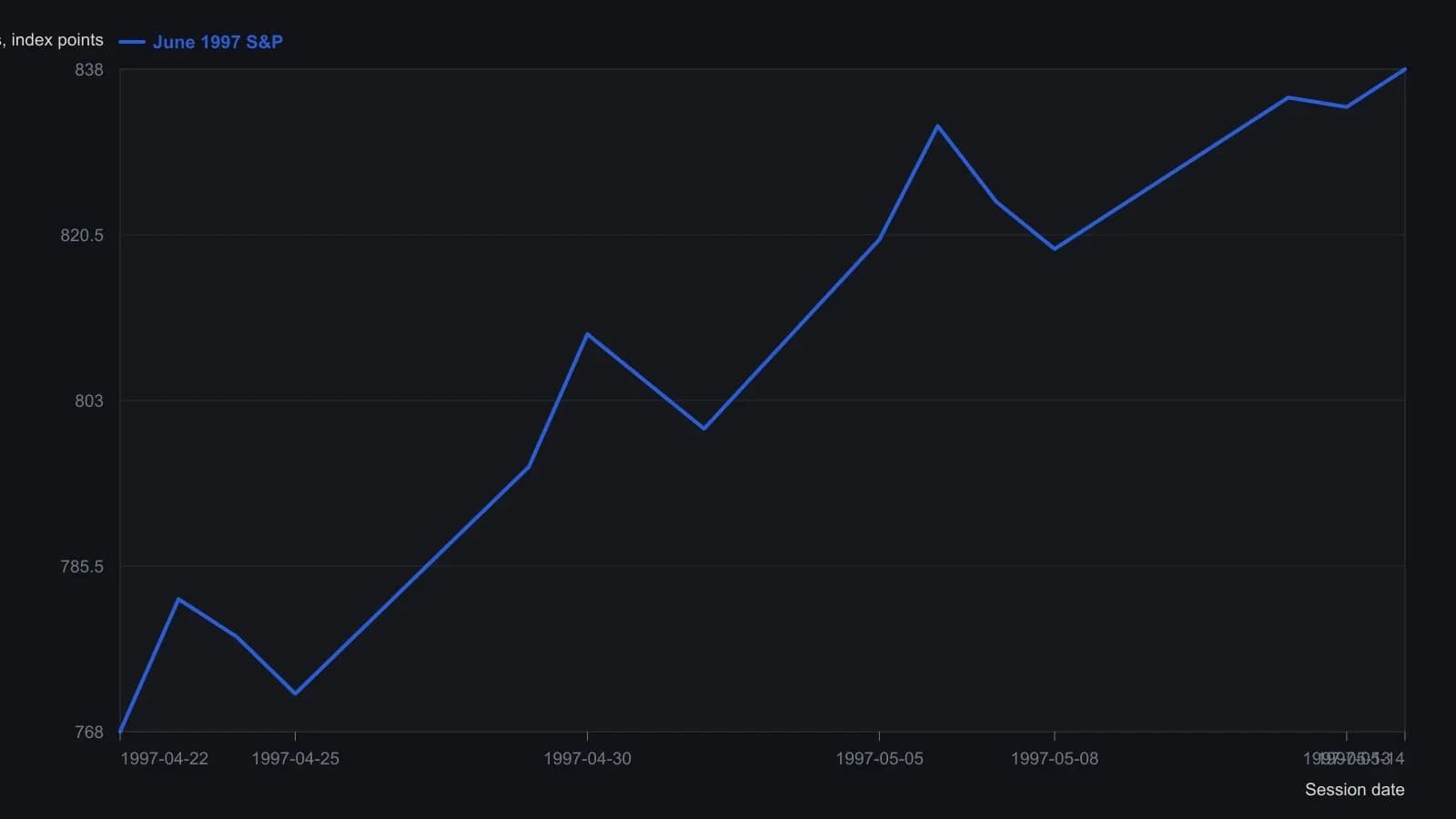
Prices are approximate to the nearest index point. The magazine chart is a 30-minute Always-in RSI plot; individual bar closes cannot be resolved, so each labeled session is one digitized point. He later dropped the rules after a five-year test showed drawdowns near $50,000.
Code the procedure, then withdraw it
One early always-in procedure used a nine-period RSI on 30-minute bars, double-bottom and double-top criteria around the 30 and 70 lines, and a new-low reverse so a failed long could flip short.
After that RSI procedure was coded and run over a five-year history, it was withdrawn from live use rather than treated as finished.
A plateau instead of a peak
Robustness testing is judged by a wide plateau of parameter sets that move drawdown, profit factor, and average trade in the expected direction when trade frequency changes, not by a single net-profit peak.
A six-month test window, even with 200 or 300 trades, was treated as too short because another six-month slice inside a five-year span can look different. Intraday robustness work used five years of actual-contract tests, then joined three-month segments into one equity path instead of relying on a single built-in continuous series.
Research continues, the live book does not
A lifetime pledge to one book is rejected because the operator will abandon it at the worst moment. A six-month freeze lets research continue while forbidding live edits until the scheduled review.
After each six-month window the book may add, drop, or modify systems so the next period again has a known daily procedure.
Opinion breaks the hypothetical path
Passing trades or resizing from opinion converts a mechanical book back into discretion and breaks the match to the hypothetical path.
All readings on this track · 51 readings
- 1986Degrees of freedom in trading system optimization
- 1988Walk-forward and neighborhood tests after optimization
- 1988Undisclosed rules block system robustness tests
- 1988Testing re-optimization calendars against random parameter controls
- 1989Binary search limits on multi-peak average grids
- 1989Parameter neighborhoods that survive a shift
- 1990Use profit mapping to keep a cycle and stop plateau
- 1990Why popular indicator optimization fails robustness
- 1991Retesting weighted indicator balances across horizons
- 1992Constructing forecast models with regression, walk-forward, and robustness
- 1992Diagnose regimes before you lock parameters
- 1992When stops change system timing
- 1993Walk-forward halt rules for forecast models
- 1994Walk-forward evaluation of genetic index rules
- 1995Input pruning as walk-forward system evaluation
- 1995Critiquing neural nets as incomplete trading systems
- 1996Rebuild the equity-path ratio before it ranks a designed system
- 1996Parameter grids can fit random walks
- 1996Walk-forward analysis belongs in the design of a mechanical trading system
- 1997When a holdout fails, discard the rule set
- 1997Test rewarded rule breaks before replacing the system
- 1997Walk-forward rules keep system research from rewriting live trades
- 1999Keep a channel-breakout to two lookbacks and test neighbor stability
- 1999Constant investment size in stock system evaluation
- 2000Forcing optimization maps mechanical system failure boundaries
- 2000Robust parameter selection with surface charts
- 2001A two-gate classroom test for a two-window momentum trend filter
- 2002How a two-sided continuation factor becomes a testable trend rule
- 2002Evaluating two-window trend intensity as a reversal rule
- 2003Discounting speculative bubbles in system robustness tests
- 2003Walk-forward evaluation of locked stochastic oscillator rules
- 2003Critiquing mechanical system design after extreme price regimes
- 2004Evaluating a two-window trend trigger
- 2005Grade backtested signals with holdouts and optimization plateaus
- 2006Reserved-sample evaluation of trading system design
- 2006Walk-forward critique of hindsight crossover systems
- 2008Condition-matched walk-forward evaluation for mechanical systems
- 2011Session-split evaluation of regular and overnight systems
- 2012Walk-forward evaluation as operator rehearsal
- 2013Two-window evaluation of mechanical trading systems
- 2013Walk-forward filter selection for repeated-median velocity
- 2014Walk-forward evaluation for fading-memory velocity systems
- 2015Test oscillator events before tuning rules
- 2016Walk-forward evaluation of a five-parameter parabolic stop-and-reversal
- 2016Walk-forward optimization without curve fitting
- 2017Optimization without overfitting in trend-system evaluation
- 2017Parameter stability is a better guide than a larger crossover grid
- 2018Point-in-time universes for system evaluation
- 2018Walk-forward robustness evaluation for optimized systems
- 2018Critiquing breakout systems through robustness tests
- 2018A critique of parameter fitting in system design