1999issue C041-10
Keep a channel-breakout to two lookbacks and test neighbor stability
A channel-breakout can be specified with one entry lookback-window and one exit lookback-window. The historical workflow read the optimization-table as neighboring parameter-sets, then reused the same unadjusted windows on choppy and declining series before considering a moving-average-filter.
- A channel-breakout changes stance when price penetrates the highest high or lowest low of a lookback-window, and only one long-entry length and one long-exit length are treated as the critical knobs.
- The optimization-table of one-to-four-week pairs is used to check that the idea does not collapse when a window is nudged, not to crown a single parameter-set.
- Shorter lookbacks fire more often, so a one-week pair that generated 95 trades is not preferred over a four-week pair that generated 27.
- The same unadjusted windows are applied to choppy and declining series, and a moving-average-filter is left unadopted when it does not hold on more than one of those series.
How stance is defined
A channel-breakout changes stance when price penetrates the highest high or lowest low of a predefined lookback-window. That penetration is treated as the definition of a trend change.
The same idea can be specified as a stop-and-reverse rule that is always long or short and flips when the opposite channel is broken, as a long-only rule, or as a mixed stance that stays flat when neither an upside nor a downside penetration is defined.
Two lookbacks as the only critical knobs
Only two lookbacks, one for long entry and one for long exit, are treated as the critical knobs. Adding separate short-entry and short-cover lengths, or extra magnitude and time tests, is described as increasing overoptimization risk.
The worked long-only specification buys one point above the highest high of the buy lookback and exits one point below the lowest low of the sell lookback. A three-week high or low on weekly bars is used as a starting definition of a meaningful intermediate move. The weekly bar itself is treated as a noise filter, and the same logic is said to apply on other time frames.
What unsmoothed price accepts
Using unsmoothed price avoids indicator lag and supplies a market-defined stop. The same choice is expected to allow more noise, many false-breakouts, and crowded stops at obvious relative highs and lows.
Reading the optimization-table
A full one-to-four-week iteration of both lookbacks produces sixteen neighboring pairs. That optimization-table is used to check that the concept does not collapse when either window is nudged, not to select the single best cell.
Shorter lookbacks increase how often the rule fires. A one-week pair generated 95 trades versus 27 for a four-week pair, so the busiest cell is not treated as the preferred parameter-set.
Value Line channel-breakout net profit by lookback pair
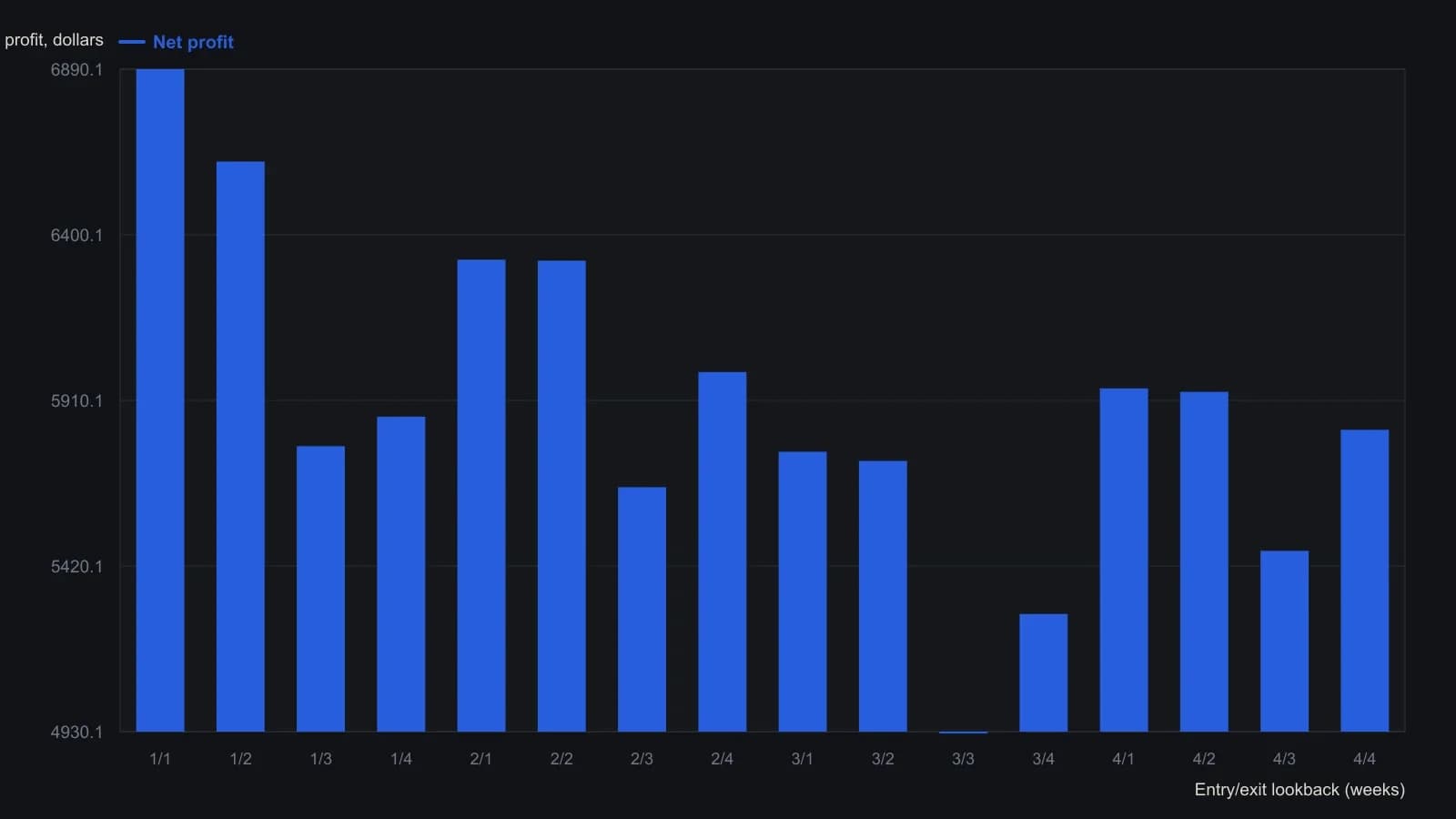
Long-only: buy one point through the n-week high and exit one point through the n-week low. The author kept the 3/3 pair even though it posted the lowest net profit, because shorter windows produced more trades and a thinner average win.
The same windows on harder series
The same unadjusted windows are then applied to additional series chosen for choppiness and for a severe decline. The view in the historical workflow is that a trend-following procedure must be able to go flat in a past collapse and should not be judged only on persistently rising names.
Editorial. TradersWeek uses robustness to mean the same rule and the same windows remaining coherent across neighboring settings, assets, and difficult periods.
A filter treated as a second hypothesis
A longer-window moving-average-filter is introduced as a separate, simple confirmation idea rather than a fitted exception. It changed results favorably on one of the three test series and not the other two, so it is left unadopted pending further checks.
All readings on this track · 51 readings
- 1986Degrees of freedom in trading system optimization
- 1988Walk-forward and neighborhood tests after optimization
- 1988Undisclosed rules block system robustness tests
- 1988Testing re-optimization calendars against random parameter controls
- 1989Binary search limits on multi-peak average grids
- 1989Parameter neighborhoods that survive a shift
- 1990Use profit mapping to keep a cycle and stop plateau
- 1990Why popular indicator optimization fails robustness
- 1991Retesting weighted indicator balances across horizons
- 1992Constructing forecast models with regression, walk-forward, and robustness
- 1992Diagnose regimes before you lock parameters
- 1992When stops change system timing
- 1993Walk-forward halt rules for forecast models
- 1994Walk-forward evaluation of genetic index rules
- 1995Input pruning as walk-forward system evaluation
- 1995Critiquing neural nets as incomplete trading systems
- 1996Rebuild the equity-path ratio before it ranks a designed system
- 1996Parameter grids can fit random walks
- 1996Walk-forward analysis belongs in the design of a mechanical trading system
- 1997When a holdout fails, discard the rule set
- 1997Test rewarded rule breaks before replacing the system
- 1997Walk-forward rules keep system research from rewriting live trades
- 1999Keep a channel-breakout to two lookbacks and test neighbor stability
- 1999Constant investment size in stock system evaluation
- 2000Forcing optimization maps mechanical system failure boundaries
- 2000Robust parameter selection with surface charts
- 2001A two-gate classroom test for a two-window momentum trend filter
- 2002How a two-sided continuation factor becomes a testable trend rule
- 2002Evaluating two-window trend intensity as a reversal rule
- 2003Discounting speculative bubbles in system robustness tests
- 2003Walk-forward evaluation of locked stochastic oscillator rules
- 2003Critiquing mechanical system design after extreme price regimes
- 2004Evaluating a two-window trend trigger
- 2005Grade backtested signals with holdouts and optimization plateaus
- 2006Reserved-sample evaluation of trading system design
- 2006Walk-forward critique of hindsight crossover systems
- 2008Condition-matched walk-forward evaluation for mechanical systems
- 2011Session-split evaluation of regular and overnight systems
- 2012Walk-forward evaluation as operator rehearsal
- 2013Two-window evaluation of mechanical trading systems
- 2013Walk-forward filter selection for repeated-median velocity
- 2014Walk-forward evaluation for fading-memory velocity systems
- 2015Test oscillator events before tuning rules
- 2016Walk-forward evaluation of a five-parameter parabolic stop-and-reversal
- 2016Walk-forward optimization without curve fitting
- 2017Optimization without overfitting in trend-system evaluation
- 2017Parameter stability is a better guide than a larger crossover grid
- 2018Point-in-time universes for system evaluation
- 2018Walk-forward robustness evaluation for optimized systems
- 2018Critiquing breakout systems through robustness tests
- 2018A critique of parameter fitting in system design