1996issue C111-7
Walk-forward analysis belongs in the design of a mechanical trading system
A mechanical trading system is only testable when entries, profitable exits, loss-cutting exits, and execution constraints are coded as one procedure. In the TradersWeek editorial reading, walk-forward analysis and robustness testing are that design, not a cleanup step.
- A mechanical procedure must specify entries, profitable exits, and loss-cutting exits together so discretionary overrides cannot rewrite the test.
- Coded rules evaluated on large historical samples without foresight are required to test whether a chart pattern is actually tradable.
- Transaction costs, slippage, and unfillable orders must be included in the same procedure or the backtest is not a realistic assessment.
- TradersWeek editorial interpretation: walk-forward analysis and robustness testing belong in the design of the procedure, not after the rules are already chosen.
The test is the whole procedure
A mechanical trading system is not a chart pattern plus later judgment. The historical workflow requires coded rules that specify entries, profitable exits, and loss-cutting exits together.
Those rules are then evaluated on large historical samples without foresight. That is what makes a chart pattern testable as a trade, rather than as a story told after the sample is known.
If a discretionary override can change an entry, a profitable exit, or a loss-cutting exit once the sample is visible, the procedure is no longer the thing that was evaluated.
Execution constraints stay inside the rules
Transaction costs, slippage, and unfillable orders must be included in the same procedure. If they sit outside the coded rules, the backtest is not a realistic assessment of whether the pattern is tradable.
Walk-forward analysis is the design
TradersWeek editorial interpretation follows and is not an archive claim. A fully specified mechanical trading system still fails as a research procedure if walk-forward analysis and robustness testing are treated as afterthoughts.
Walk-forward analysis is how entry, exit, and abstention rules stay testable as one procedure across the system holding period. Robustness testing keeps that same procedure attached to rule inputs, market state, and execution constraints, rather than to one chosen path through the sample.
If those checks are attached after the rules already exist, they cannot stop a discretionary override from rewriting the test. They have to be the way the mechanical trading system is written.
In-sample correlation stays near 0.6 while the second test sample does not
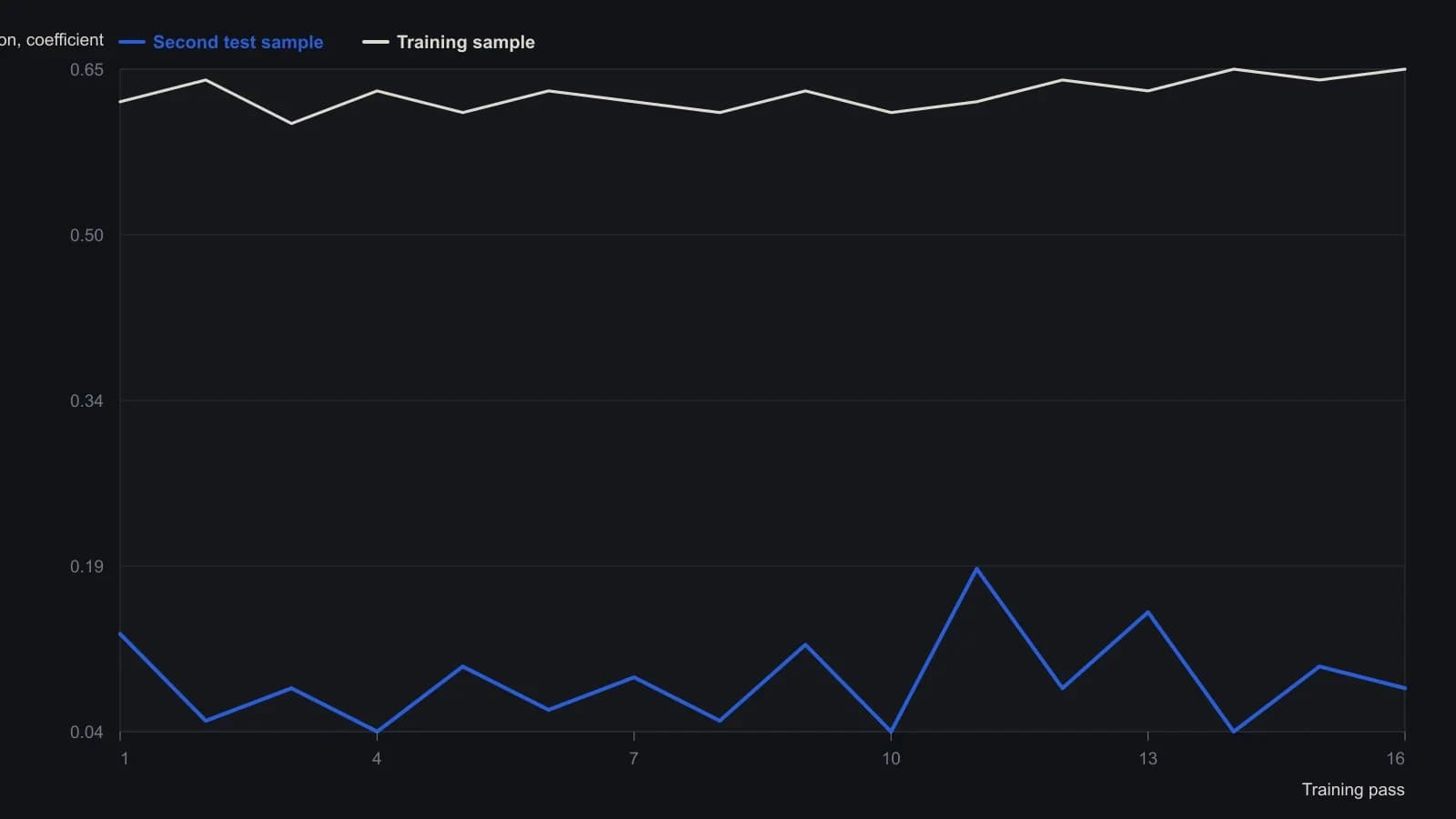
The source trained on bars 3000-4000 of 4,581 daily bond bars ending May 1996, with the first test on bars 2500-3000 and the second test on bars 4000-4500. The net was 10-20-1. The article states average correlations of about 0.6 in-sample and 0.15 out-of-sample; the plotted traces are the live training window, not those averages.
All readings on this track · 51 readings
- 1986Degrees of freedom in trading system optimization
- 1988Walk-forward and neighborhood tests after optimization
- 1988Undisclosed rules block system robustness tests
- 1988Testing re-optimization calendars against random parameter controls
- 1989Binary search limits on multi-peak average grids
- 1989Parameter neighborhoods that survive a shift
- 1990Use profit mapping to keep a cycle and stop plateau
- 1990Why popular indicator optimization fails robustness
- 1991Retesting weighted indicator balances across horizons
- 1992Constructing forecast models with regression, walk-forward, and robustness
- 1992Diagnose regimes before you lock parameters
- 1992When stops change system timing
- 1993Walk-forward halt rules for forecast models
- 1994Walk-forward evaluation of genetic index rules
- 1995Input pruning as walk-forward system evaluation
- 1995Critiquing neural nets as incomplete trading systems
- 1996Rebuild the equity-path ratio before it ranks a designed system
- 1996Parameter grids can fit random walks
- 1996Walk-forward analysis belongs in the design of a mechanical trading system
- 1997When a holdout fails, discard the rule set
- 1997Test rewarded rule breaks before replacing the system
- 1997Walk-forward rules keep system research from rewriting live trades
- 1999Keep a channel-breakout to two lookbacks and test neighbor stability
- 1999Constant investment size in stock system evaluation
- 2000Forcing optimization maps mechanical system failure boundaries
- 2000Robust parameter selection with surface charts
- 2001A two-gate classroom test for a two-window momentum trend filter
- 2002How a two-sided continuation factor becomes a testable trend rule
- 2002Evaluating two-window trend intensity as a reversal rule
- 2003Discounting speculative bubbles in system robustness tests
- 2003Walk-forward evaluation of locked stochastic oscillator rules
- 2003Critiquing mechanical system design after extreme price regimes
- 2004Evaluating a two-window trend trigger
- 2005Grade backtested signals with holdouts and optimization plateaus
- 2006Reserved-sample evaluation of trading system design
- 2006Walk-forward critique of hindsight crossover systems
- 2008Condition-matched walk-forward evaluation for mechanical systems
- 2011Session-split evaluation of regular and overnight systems
- 2012Walk-forward evaluation as operator rehearsal
- 2013Two-window evaluation of mechanical trading systems
- 2013Walk-forward filter selection for repeated-median velocity
- 2014Walk-forward evaluation for fading-memory velocity systems
- 2015Test oscillator events before tuning rules
- 2016Walk-forward evaluation of a five-parameter parabolic stop-and-reversal
- 2016Walk-forward optimization without curve fitting
- 2017Optimization without overfitting in trend-system evaluation
- 2017Parameter stability is a better guide than a larger crossover grid
- 2018Point-in-time universes for system evaluation
- 2018Walk-forward robustness evaluation for optimized systems
- 2018Critiquing breakout systems through robustness tests
- 2018A critique of parameter fitting in system design