2020issue C0348-55
Hidden optimization in ported relative-strength systems
A platform recode of a zero-cross relative-strength hold is already a new procedure when it adds exits, borrowed defaults, or in-sample knobs. Those changes are system optimization, so robustness testing and walk-forward analysis still belong in the workflow before the rules are taught as one method.
- Entry, exit, and abstention all use a second market series, so the published signal is a relative-strength rule rather than a single-symbol price rule.
- Replacing a fixed hold with oscillator exits, or opening the same rule inputs to an in-sample search, turns a port into a new optimization surface.
- A companion critique treats hidden defaults as earlier system optimization and says an untouched default set is not automatically more trustworthy than a later version.
- Editorial reading: keep the initial version for research, then put later versions through robustness testing and walk-forward analysis before treating future use as better supported.
What the ports compute
Several implementations compute the oscillator as 100 times an exponential average of the change in the log close ratio versus a reference series, using a 90-bar difference and 3-bar smoothing.
The baseline long-only procedure buys when that oscillator crosses above zero and exits after a fixed hold. Some ports write the hold as 180 bars. Others write it as nine 21-bar months.
Entry, exit, and abstention all require a second market series as the comparison input, so the signal is a relative-strength rule rather than a single-symbol price rule.
RSMK on AMZN from the TradersStudio port, 2009–2013
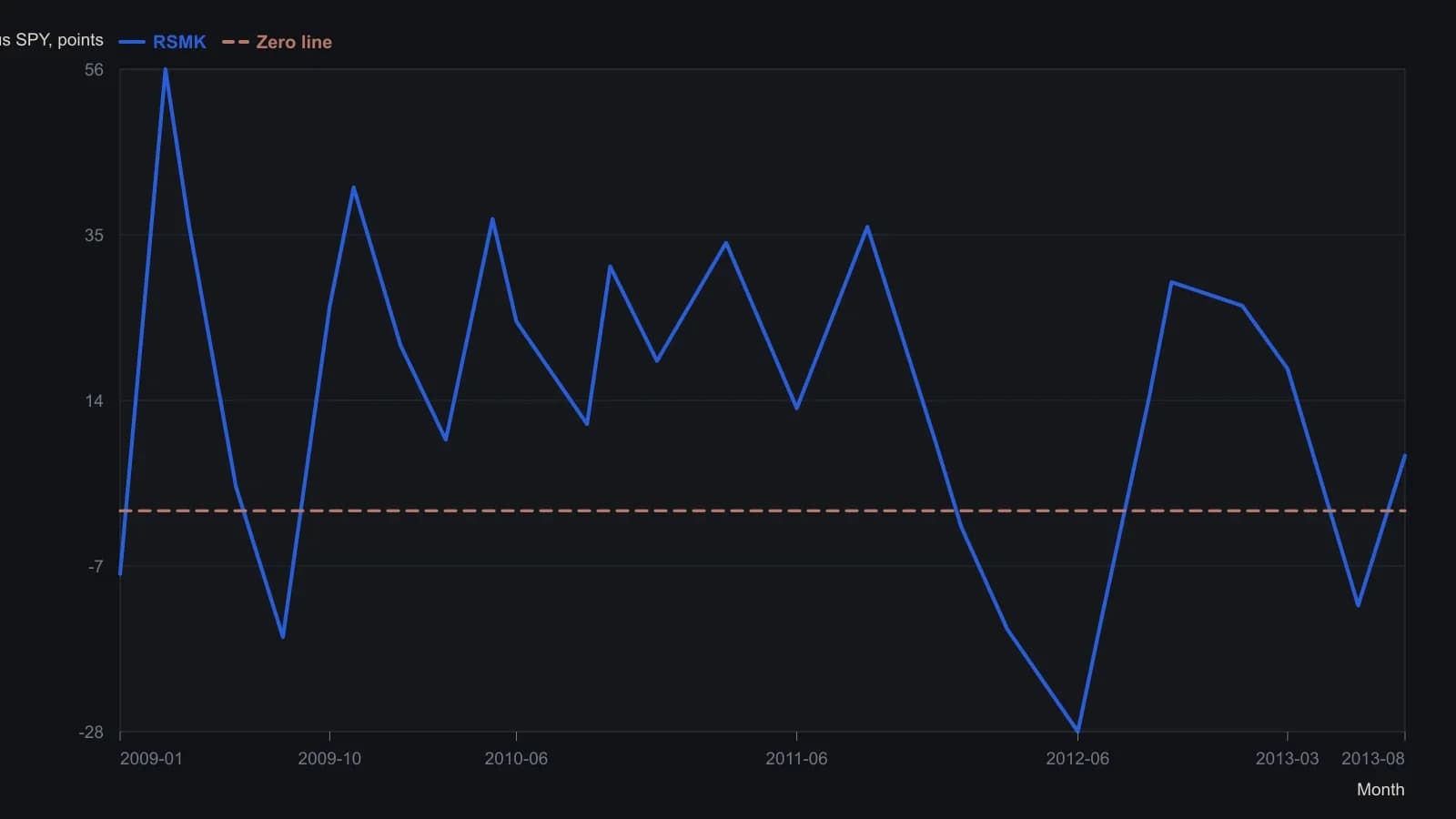
The published port uses a 90-bar lookback and a 3-bar EMA versus the reference series. Digitized readings are approximate to a few indicator points; the pane does not support finer precision.
When a port becomes a search
One recode replaces the calendar hold with three oscillator exits: a 20-point drop from a 20-day high, a cross below a 20-day exponential average, and a return through zero. It marks those periods and point thresholds as search inputs.
At least two ports invite an in-sample search over the same rule inputs, which turns the published defaults into an optimization surface rather than a fixed procedure.
Hidden defaults and later versions
A companion critique states that almost every strategy is optimized to some degree, including hidden defaults such as an ADX length of 14 and a trend threshold of 20 that were themselves chosen after earlier study.
That critique holds that a small rule change means the procedure is no longer the initial version, and that an apparently untouched default set should not be assumed more trustworthy than a later version.
The prescribed response is to keep the initial version for research, still put later versions through a previously proven development process, and only then treat future use as better supported.
Why the later checks still apply
Editorial reading: extra exits, borrowed defaults, and in-sample knobs already count as system optimization. A recode is therefore a new procedure, not a neutral copy of the initial version.
The same robustness testing and walk-forward analysis used for a freshly designed system still apply. Those checks make entry, exit, and abstention rules testable as one procedure before the recode is taught as the method.
All readings on this track · 57 readings
- 1986Degrees of freedom in trading system optimization
- 1988Walk-forward and neighborhood tests after optimization
- 1988Undisclosed rules block system robustness tests
- 1988Testing re-optimization calendars against random parameter controls
- 1989Binary search limits on multi-peak average grids
- 1989Parameter neighborhoods that survive a shift
- 1990Use profit mapping to keep a cycle and stop plateau
- 1990Why popular indicator optimization fails robustness
- 1991Retesting weighted indicator balances across horizons
- 1992Constructing forecast models with regression, walk-forward, and robustness
- 1992Diagnose regimes before you lock parameters
- 1992When stops change system timing
- 1993Walk-forward halt rules for forecast models
- 1994Walk-forward evaluation of genetic index rules
- 1995Input pruning as walk-forward system evaluation
- 1995Critiquing neural nets as incomplete trading systems
- 1996Rebuild the equity-path ratio before it ranks a designed system
- 1996Parameter grids can fit random walks
- 1996Walk-forward analysis belongs in the design of a mechanical trading system
- 1997When a holdout fails, discard the rule set
- 1997Test rewarded rule breaks before replacing the system
- 1997Walk-forward rules keep system research from rewriting live trades
- 1999Keep a channel-breakout to two lookbacks and test neighbor stability
- 1999Constant investment size in stock system evaluation
- 2000Forcing optimization maps mechanical system failure boundaries
- 2000Robust parameter selection with surface charts
- 2001A two-gate classroom test for a two-window momentum trend filter
- 2002How a two-sided continuation factor becomes a testable trend rule
- 2002Evaluating two-window trend intensity as a reversal rule
- 2003Discounting speculative bubbles in system robustness tests
- 2003Walk-forward evaluation of locked stochastic oscillator rules
- 2003Critiquing mechanical system design after extreme price regimes
- 2004Evaluating a two-window trend trigger
- 2005Grade backtested signals with holdouts and optimization plateaus
- 2006Reserved-sample evaluation of trading system design
- 2006Walk-forward critique of hindsight crossover systems
- 2008Condition-matched walk-forward evaluation for mechanical systems
- 2011Session-split evaluation of regular and overnight systems
- 2012Walk-forward evaluation as operator rehearsal
- 2013Two-window evaluation of mechanical trading systems
- 2013Walk-forward filter selection for repeated-median velocity
- 2014Walk-forward evaluation for fading-memory velocity systems
- 2015Test oscillator events before tuning rules
- 2016Walk-forward evaluation of a five-parameter parabolic stop-and-reversal
- 2016Walk-forward optimization without curve fitting
- 2017Optimization without overfitting in trend-system evaluation
- 2017Parameter stability is a better guide than a larger crossover grid
- 2018Point-in-time universes for system evaluation
- 2018Walk-forward robustness evaluation for optimized systems
- 2018Critiquing breakout systems through robustness tests
- 2018A critique of parameter fitting in system design
- 2019Noise-matched rules still need trend filters and robustness tests
- 2019Three gates for evaluating a trading system
- 2020Data construction as a mechanical system input
- 2020Hidden optimization in ported relative-strength systems
- 2020When mechanical historical tests decay after optimization
- 2025Add a second procedure before you retune the first