2000issue C021-5
Forcing optimization maps mechanical system failure boundaries
A mechanical system can produce a smooth, rising equity line on one historical window and then lose money on a later unused window under the same rules. Forcing tests rewrite slope or volatility so the designer can keep only the market-state envelope in which those rules still fire correctly.
- The same moving-average and rate-of-change rules can produce a smooth, rising equity line on one historical window and then lose money on a later unused window.
- Forcing optimization describes the mechanical system, designs tests that push it toward failure, and then interprets those failure conditions.
- Forcing tests change slope or volatility while leaving other price features intact, so the evaluator can see which market-state changes the system cannot interpret.
- Editorial reading: keep only the market-state envelope in which the same rules still fire correctly, and treat a speed measure such as standardized linear increase as a live filter when conditions leave that envelope.
A smooth equity line can still be sample-specific
A mechanical system that combines a moving average with a short and a long rate of change can produce a smooth, rising equity path on one historical window. The same rules and parameters can then lose money on a later unused window.
Walk-forward analysis applies those fixed rules and parameters to the unused period. The equity line is useful for spotting smooth in-sample results that later collapse on that later window.
Coffee system equity and price, 1976–81 backtest
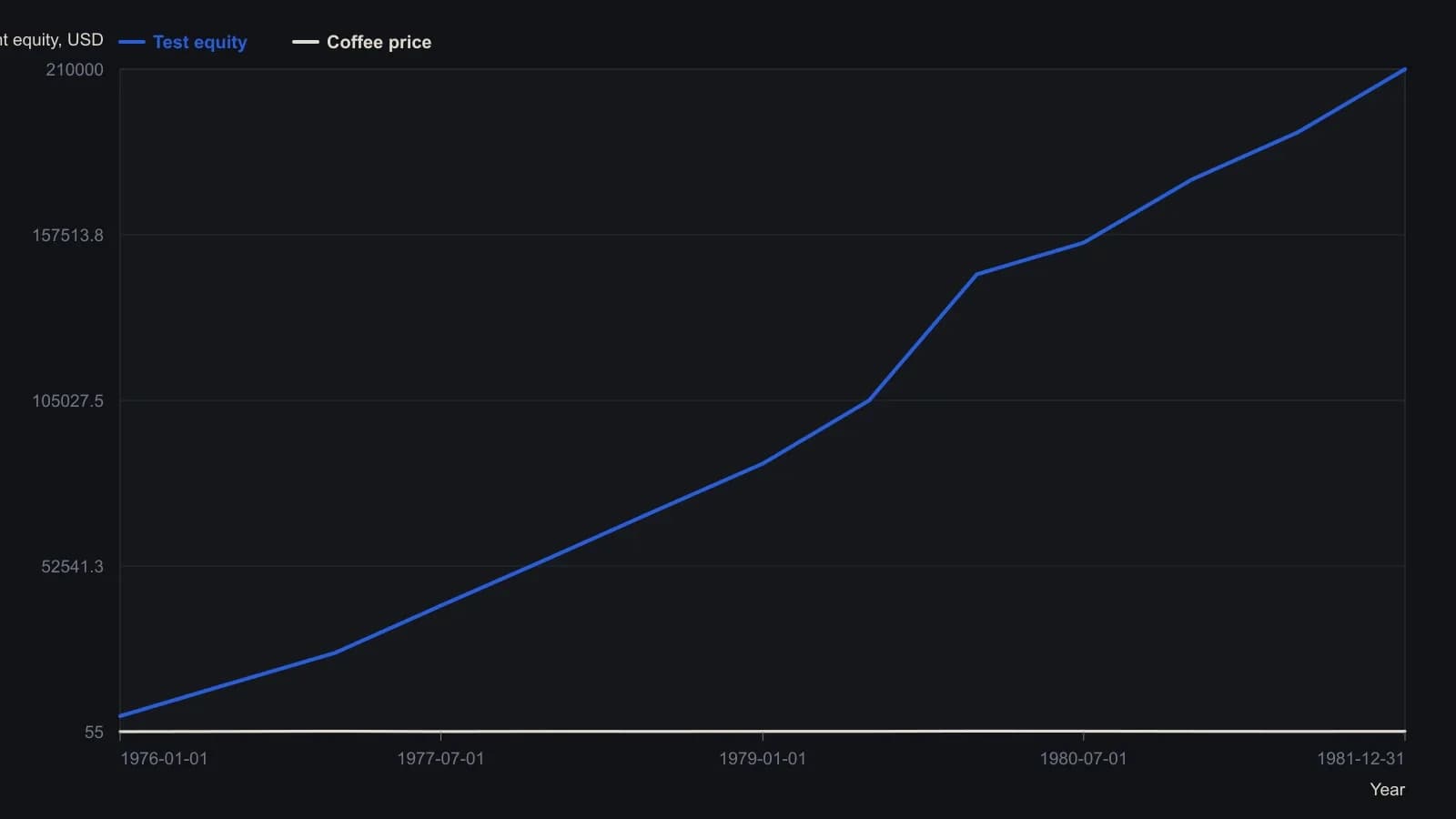
Raster readout of the published MetaStock chart; equity and coffee price are approximate, sampled at yearly ticks. System parameters stated in the article: 30-day average, 15- and 25-day momentum, 0.5% commissions, 100% margin.
Forcing optimization is a three-step evaluation
Forcing optimization first states how a mechanical system should behave, then rewrites historical prices toward extreme slope or fluctuation, and finally maps the conditions under which the same rules stop working. In practice that means describe the mechanical system, design tests that push it toward failure, and then interpret those failure conditions.
A mechanical trading system is a fully specified set of entry, exit and reverse conditions driven by indicator inputs. The illustrated long rule requires price above an x-day moving average and both a y-day and a z-day rate of change above zero. The short rule is the exact reverse of those three conditions. The same procedure can be run on any price series.
Why a slower advance breaks the same rules
A moving average depends on the rate of price increase and on fluctuations around the trend. A slower advance can pull the average toward price so that a previously nearby fluctuation now crosses it. The same slowdown can shrink rate-of-change readings until a small drawdown turns them negative.
Forcing tests isolate one market feature
Forcing tests rewrite the original price series by changing slope or volatility while leaving other features intact. The evaluator can then see which market-state changes the system cannot interpret.
Selecting a backtest segment with an extreme slope and then widening its fluctuations, without changing other features, can show that a system with a good original equity path does not work in every market condition. Those tests also make the failure boundary identifiable. Robustness testing asks whether the same mechanical procedure still produces usable signals after the market features the rules depend on have been pushed beyond the original backtest sample.
Slope and volatility tests are not universal
Forcing tests built around slope and volatility are not automatically relevant to a relative-strength system. Different systems need different forcing tests aimed at their own limits of effectiveness.
A speed envelope can become a live filter
A standardized linear increase measures how fast price advances over a fixed lookback. It can mark a market that has left the tested speed envelope. The same mechanical system that worked above that speed did not work below it.
Editorial reading for system designers
Editorial reading: a profitable backtest remains an untested hypothesis until the designer deliberately warps slope and volatility. After those forcing tests, keep only the market-state envelope in which the same rules still fire correctly. Outside that failure boundary, a standardized linear increase can serve as a live filter for whether current conditions remain inside the tested envelope.
All readings on this track · 51 readings
- 1986Degrees of freedom in trading system optimization
- 1988Walk-forward and neighborhood tests after optimization
- 1988Undisclosed rules block system robustness tests
- 1988Testing re-optimization calendars against random parameter controls
- 1989Binary search limits on multi-peak average grids
- 1989Parameter neighborhoods that survive a shift
- 1990Use profit mapping to keep a cycle and stop plateau
- 1990Why popular indicator optimization fails robustness
- 1991Retesting weighted indicator balances across horizons
- 1992Constructing forecast models with regression, walk-forward, and robustness
- 1992Diagnose regimes before you lock parameters
- 1992When stops change system timing
- 1993Walk-forward halt rules for forecast models
- 1994Walk-forward evaluation of genetic index rules
- 1995Input pruning as walk-forward system evaluation
- 1995Critiquing neural nets as incomplete trading systems
- 1996Rebuild the equity-path ratio before it ranks a designed system
- 1996Parameter grids can fit random walks
- 1996Walk-forward analysis belongs in the design of a mechanical trading system
- 1997When a holdout fails, discard the rule set
- 1997Test rewarded rule breaks before replacing the system
- 1997Walk-forward rules keep system research from rewriting live trades
- 1999Keep a channel-breakout to two lookbacks and test neighbor stability
- 1999Constant investment size in stock system evaluation
- 2000Forcing optimization maps mechanical system failure boundaries
- 2000Robust parameter selection with surface charts
- 2001A two-gate classroom test for a two-window momentum trend filter
- 2002How a two-sided continuation factor becomes a testable trend rule
- 2002Evaluating two-window trend intensity as a reversal rule
- 2003Discounting speculative bubbles in system robustness tests
- 2003Walk-forward evaluation of locked stochastic oscillator rules
- 2003Critiquing mechanical system design after extreme price regimes
- 2004Evaluating a two-window trend trigger
- 2005Grade backtested signals with holdouts and optimization plateaus
- 2006Reserved-sample evaluation of trading system design
- 2006Walk-forward critique of hindsight crossover systems
- 2008Condition-matched walk-forward evaluation for mechanical systems
- 2011Session-split evaluation of regular and overnight systems
- 2012Walk-forward evaluation as operator rehearsal
- 2013Two-window evaluation of mechanical trading systems
- 2013Walk-forward filter selection for repeated-median velocity
- 2014Walk-forward evaluation for fading-memory velocity systems
- 2015Test oscillator events before tuning rules
- 2016Walk-forward evaluation of a five-parameter parabolic stop-and-reversal
- 2016Walk-forward optimization without curve fitting
- 2017Optimization without overfitting in trend-system evaluation
- 2017Parameter stability is a better guide than a larger crossover grid
- 2018Point-in-time universes for system evaluation
- 2018Walk-forward robustness evaluation for optimized systems
- 2018Critiquing breakout systems through robustness tests
- 2018A critique of parameter fitting in system design