2003issue C041-4
Discounting speculative bubbles in system robustness tests
Extraordinary speculative episodes can dominate a model's historical record, so a short recent sample is a weak basis for judging long-term viability. Ending equity is not a sufficient accept-or-reject statistic, and robustness testing discounts extraordinary regimes and windfall trades before rule inputs are refined.
- Extraordinary speculative episodes can dominate a historical record, so a short recent sample is a weak basis for judging long-term viability.
- Confidence that a mechanical procedure is sound requires a large, diverse historical sample across varied conditions, not a window that includes one mania.
- Ending equity is not a sufficient accept-or-reject statistic. Trade-level and period-level review is required to separate a consistent procedure from a few windfalls.
- Robustness testing discounts extraordinary regimes and windfall trades before system optimization refines rule inputs.
A mania window is a weak test
Extraordinary speculative episodes can dominate a model's historical record, so a short recent sample is a weak basis for judging long-term viability.
Confidence that a mechanical procedure is sound requires a large, diverse historical sample across varied conditions, not a window that includes one mania. A mechanical trading system is a fully specified long, short, and exit procedure driven by rule inputs, market state, and execution constraints over the system holding period.
An illustration that isolates the rules
The illustration applied a close-based 21, 34, and 55 moving-average crossover, long and short, to Nasdaq 100 members as of August 2002 from January 1990 through August 2002, or from each name's inception.
Demonstration trades used a constant 1000000 account and 1 percent of equity per name, with no profit reinvestment, so the test isolated rule behavior rather than compounding.
The sample equity path accelerated during the 1999 speculative phase, and calendar-year results flagged that year as the extreme outlier in the window.
Ending equity can hide a windfall trade
Ending equity is not a sufficient accept-or-reject statistic. Trade-level and period-level review is required to separate a consistent procedure from a few windfalls. A windfall trade is a single outsized result that can make an otherwise ordinary rule set look viable if only ending equity is inspected.
In a 50-trade hypothetical, one 30000 winner against 49 results between 2000 and -2000 explained essentially all profit. Omitting it left about 400.
The same rules on one index component produced choppy activity through 1999, then a single long from December 1998 to May 2000 that accounted for most of the path's improvement.
Annual SMA-system profit on Nasdaq 100 names, 1990–2002
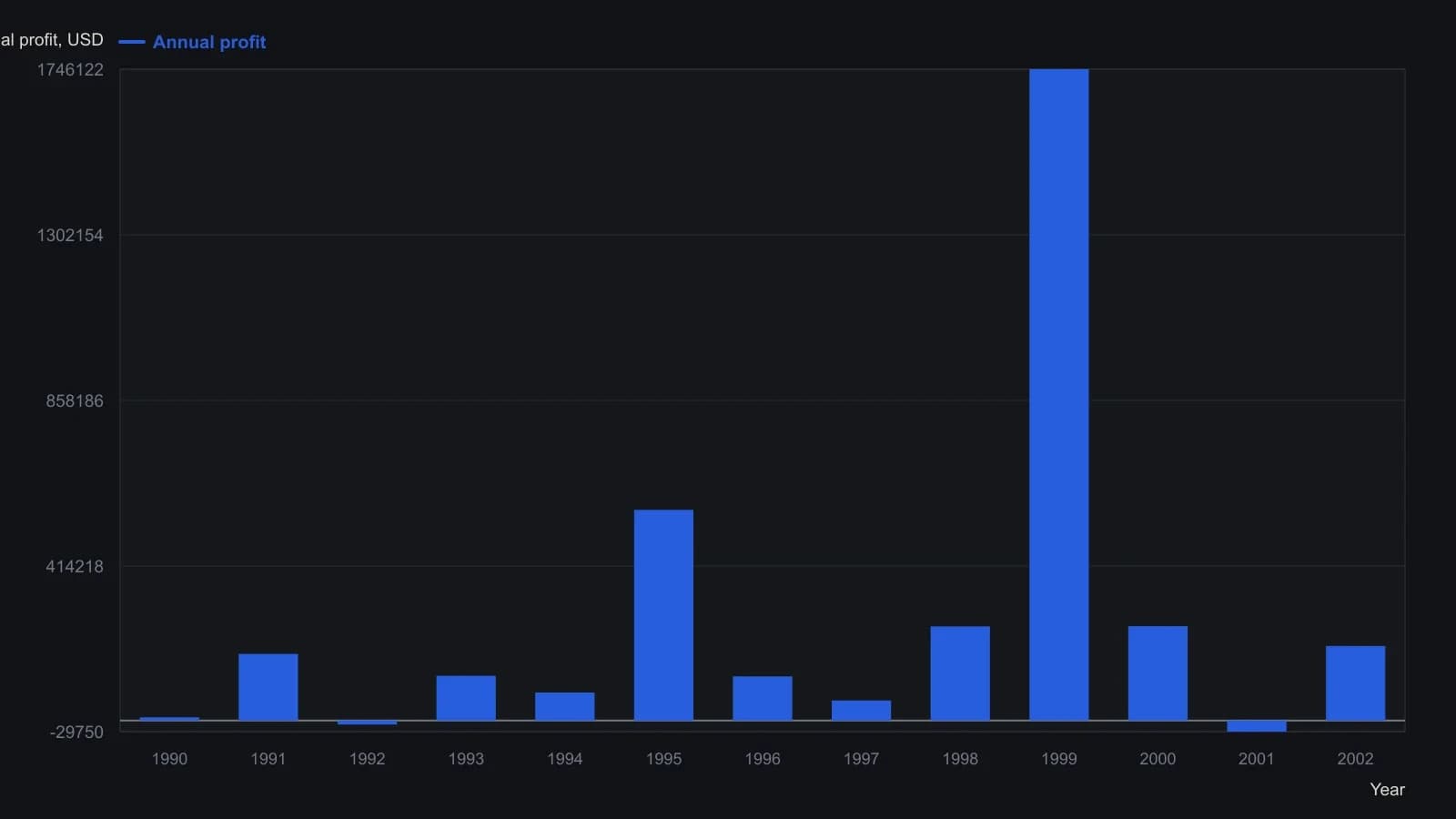
The test applied SMA(21)/SMA(34)/SMA(55) close crossovers to Nasdaq 100 members as of August 2002, January 1990 through August 2002. Each trade was 1 percent of a constant $1 million account with no profit reinvestment, so dollars and percent returns stay proportional. The 2002 row is year-to-date through August, not a full calendar year.
Discount the episode before optimization
Sample contamination is distortion of a backtest by a rare speculative episode that should not be treated as a typical holding-period outcome. Robustness testing checks whether entry, exit, and abstention rules still hold after extraordinary regimes and single-trade windfalls are discounted.
System optimization is refinement of rule inputs only after period-level and trade-level review shows the result is not an artifact of one market episode.
A robustness view favors procedures that can survive ordinary, choppy, and drawdown stretches rather than those that depend on the least probable windfall path.
All readings on this track · 51 readings
- 1986Degrees of freedom in trading system optimization
- 1988Walk-forward and neighborhood tests after optimization
- 1988Undisclosed rules block system robustness tests
- 1988Testing re-optimization calendars against random parameter controls
- 1989Binary search limits on multi-peak average grids
- 1989Parameter neighborhoods that survive a shift
- 1990Use profit mapping to keep a cycle and stop plateau
- 1990Why popular indicator optimization fails robustness
- 1991Retesting weighted indicator balances across horizons
- 1992Constructing forecast models with regression, walk-forward, and robustness
- 1992Diagnose regimes before you lock parameters
- 1992When stops change system timing
- 1993Walk-forward halt rules for forecast models
- 1994Walk-forward evaluation of genetic index rules
- 1995Input pruning as walk-forward system evaluation
- 1995Critiquing neural nets as incomplete trading systems
- 1996Rebuild the equity-path ratio before it ranks a designed system
- 1996Parameter grids can fit random walks
- 1996Walk-forward analysis belongs in the design of a mechanical trading system
- 1997When a holdout fails, discard the rule set
- 1997Test rewarded rule breaks before replacing the system
- 1997Walk-forward rules keep system research from rewriting live trades
- 1999Keep a channel-breakout to two lookbacks and test neighbor stability
- 1999Constant investment size in stock system evaluation
- 2000Forcing optimization maps mechanical system failure boundaries
- 2000Robust parameter selection with surface charts
- 2001A two-gate classroom test for a two-window momentum trend filter
- 2002How a two-sided continuation factor becomes a testable trend rule
- 2002Evaluating two-window trend intensity as a reversal rule
- 2003Discounting speculative bubbles in system robustness tests
- 2003Walk-forward evaluation of locked stochastic oscillator rules
- 2003Critiquing mechanical system design after extreme price regimes
- 2004Evaluating a two-window trend trigger
- 2005Grade backtested signals with holdouts and optimization plateaus
- 2006Reserved-sample evaluation of trading system design
- 2006Walk-forward critique of hindsight crossover systems
- 2008Condition-matched walk-forward evaluation for mechanical systems
- 2011Session-split evaluation of regular and overnight systems
- 2012Walk-forward evaluation as operator rehearsal
- 2013Two-window evaluation of mechanical trading systems
- 2013Walk-forward filter selection for repeated-median velocity
- 2014Walk-forward evaluation for fading-memory velocity systems
- 2015Test oscillator events before tuning rules
- 2016Walk-forward evaluation of a five-parameter parabolic stop-and-reversal
- 2016Walk-forward optimization without curve fitting
- 2017Optimization without overfitting in trend-system evaluation
- 2017Parameter stability is a better guide than a larger crossover grid
- 2018Point-in-time universes for system evaluation
- 2018Walk-forward robustness evaluation for optimized systems
- 2018Critiquing breakout systems through robustness tests
- 2018A critique of parameter fitting in system design