1995issue C121-9
Input pruning as walk-forward system evaluation
Shrinking the input set is the main system-optimization lever when extra capacity fits the training window and fails on unseen data. Each pruned bundle should be walked forward and kept only if robustness screens still agree on the survivors.
- Too many inputs, hidden nodes, or connection weights can fit the training window and fail on unseen data, so shrinking the input set is the main system-optimization lever.
- Walk-forward analysis should judge each pruned bundle on unseen observations and use holdouts longer than the forecast horizon, because later weeks can decay toward chance.
- Robustness testing asks whether surviving inputs persist after collinearity transforms, alternate deletion screens, and more than one training run.
- Linear correlation with the target is a weak prune, and a linear T-stat ranking is not interchangeable with a connection-weight ranking after the same 12-of-24 cut.
Shrink the input set as one procedure
Too many inputs, hidden nodes, or connection weights can fit the training window while producing unreliable forecasts on unseen data. Shrinking the input set is the main system-optimization lever.
An interior capacity optimum
In a one-input, one-output comparison, three hidden nodes generalized better on unseen data than one node or nine nodes. The comparison implies an interior capacity optimum rather than a bigger-is-better rule.
How the protocol trained and stopped
The evaluation protocol trained a 24-input model of a nine-week percent change on 240 weekly records and scored it on a 60-week random holdout drawn from 300 records, without checking that the two samples had similar distributions.
Training inspected test-set mean square error every 100 learning events and stopped after 10,000 events with no new test-set minimum, then used that lowest-error network for later deletion trials.
Deletion screens and collinear pairs
Pruning by linear correlation with the target is a weak system screen because a nonlinear model can still extract usable information from inputs that look almost unrelated to the output.
Connection-weight ranking, replacing an input with its average, and leave-one-input-out search are alternative optimization loops: delete a candidate, retrain, and continue until one input remains.
When input pairs are highly correlated, combining the pair is preferred to deleting one member. The evaluation treated absolute correlation above 0.80 as the threshold for that robustness fix.
Screens that do not agree
After the same 12-of-24 cut, a linear T-stat ranking and a connection-weight ranking kept only seven inputs in common, so the two screens are not interchangeable robustness tests.
A cheaper composite loop is offered as a practical substitute for exhaustive systematic search: keep the strongest weights, transform collinear pairs, batch-delete weak weights, then run sensitivity analysis.
Holdouts, retraining, and the trading objective
Walk-forward blocks should be longer than the forecast horizon because later weeks can decay toward chance. A single training run before each deletion can make the search path unstable. Lowest test-set error need not rank the same systems as a trading objective.
Holdout MSE after each input-pruning rule
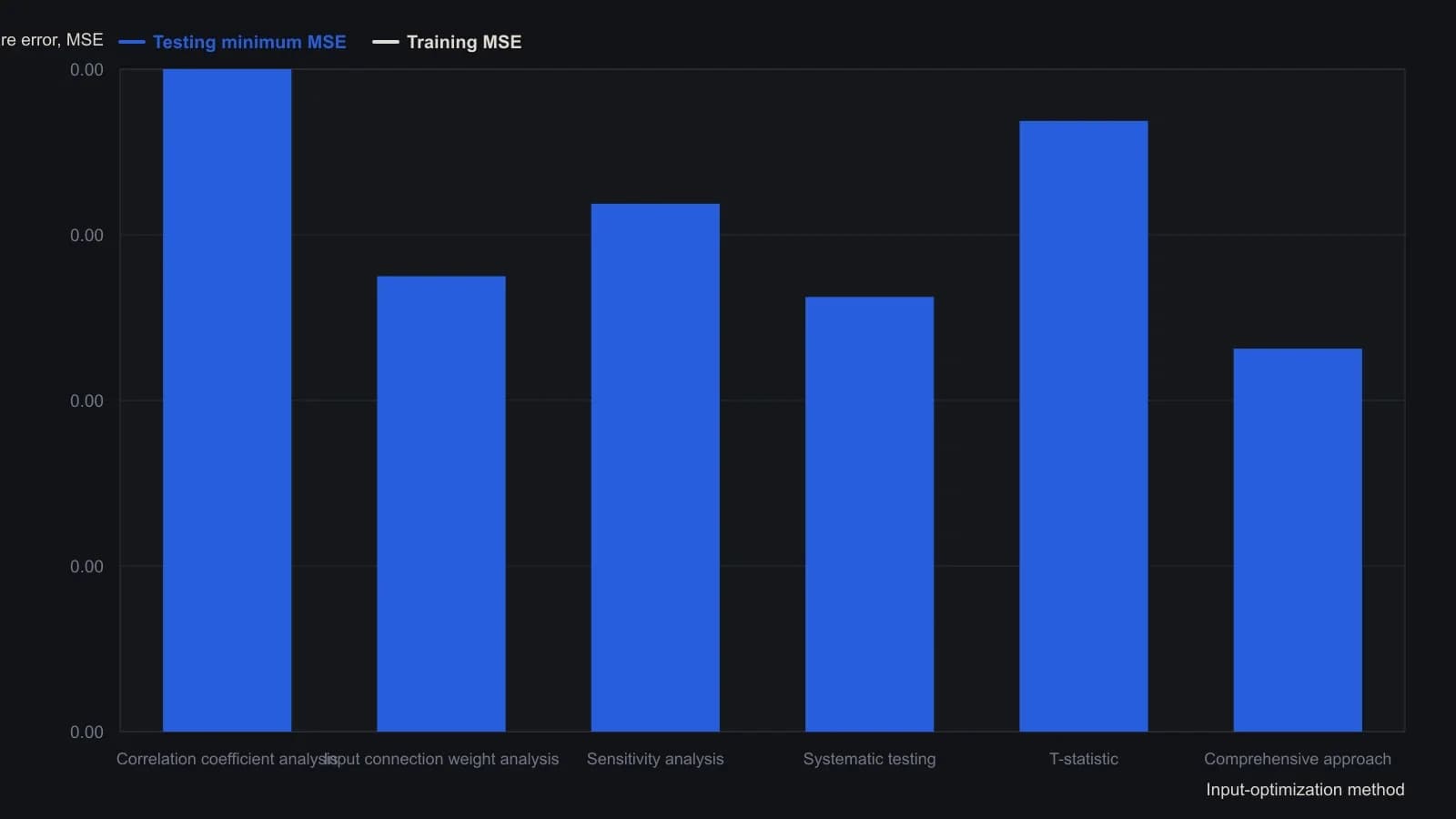
One training run preceded each deletion. Systematic testing was stopped at 21 inputs; the author said more trials would likely have cut error further. Mean-square error was the stop rule, not trading profit. The table lists 16 correlation inputs (the prose says 17) and a T-statistic test MSE of 0.001020 (the prose quotes 0.00094).
All readings on this track · 51 readings
- 1986Degrees of freedom in trading system optimization
- 1988Walk-forward and neighborhood tests after optimization
- 1988Undisclosed rules block system robustness tests
- 1988Testing re-optimization calendars against random parameter controls
- 1989Binary search limits on multi-peak average grids
- 1989Parameter neighborhoods that survive a shift
- 1990Use profit mapping to keep a cycle and stop plateau
- 1990Why popular indicator optimization fails robustness
- 1991Retesting weighted indicator balances across horizons
- 1992Constructing forecast models with regression, walk-forward, and robustness
- 1992Diagnose regimes before you lock parameters
- 1992When stops change system timing
- 1993Walk-forward halt rules for forecast models
- 1994Walk-forward evaluation of genetic index rules
- 1995Input pruning as walk-forward system evaluation
- 1995Critiquing neural nets as incomplete trading systems
- 1996Rebuild the equity-path ratio before it ranks a designed system
- 1996Parameter grids can fit random walks
- 1996Walk-forward analysis belongs in the design of a mechanical trading system
- 1997When a holdout fails, discard the rule set
- 1997Test rewarded rule breaks before replacing the system
- 1997Walk-forward rules keep system research from rewriting live trades
- 1999Keep a channel-breakout to two lookbacks and test neighbor stability
- 1999Constant investment size in stock system evaluation
- 2000Forcing optimization maps mechanical system failure boundaries
- 2000Robust parameter selection with surface charts
- 2001A two-gate classroom test for a two-window momentum trend filter
- 2002How a two-sided continuation factor becomes a testable trend rule
- 2002Evaluating two-window trend intensity as a reversal rule
- 2003Discounting speculative bubbles in system robustness tests
- 2003Walk-forward evaluation of locked stochastic oscillator rules
- 2003Critiquing mechanical system design after extreme price regimes
- 2004Evaluating a two-window trend trigger
- 2005Grade backtested signals with holdouts and optimization plateaus
- 2006Reserved-sample evaluation of trading system design
- 2006Walk-forward critique of hindsight crossover systems
- 2008Condition-matched walk-forward evaluation for mechanical systems
- 2011Session-split evaluation of regular and overnight systems
- 2012Walk-forward evaluation as operator rehearsal
- 2013Two-window evaluation of mechanical trading systems
- 2013Walk-forward filter selection for repeated-median velocity
- 2014Walk-forward evaluation for fading-memory velocity systems
- 2015Test oscillator events before tuning rules
- 2016Walk-forward evaluation of a five-parameter parabolic stop-and-reversal
- 2016Walk-forward optimization without curve fitting
- 2017Optimization without overfitting in trend-system evaluation
- 2017Parameter stability is a better guide than a larger crossover grid
- 2018Point-in-time universes for system evaluation
- 2018Walk-forward robustness evaluation for optimized systems
- 2018Critiquing breakout systems through robustness tests
- 2018A critique of parameter fitting in system design