1989issue C121-4
Weekly high and low averages as stop-and-reverse levels
An always-in trend-following procedure replaces a close-only smoother with a weekly high average and a weekly low average. The opposite average is parked as the next week's intraday stop-and-reverse.
- The construction is always-in: a simple weekly high average and a simple weekly low average replace a close-only smoother.
- While short, an intraday buy stop sits at the weekly high average; while long, an intraday sell stop sits at the weekly low average. Either fill reverses the book.
- Both averages are recomputed after the calendar week ends, so the next week's reverse levels are a fresh pair from the same lookback-n.
- The two stops sit roughly an average-weekly-range apart, which makes small inside-week fluctuations less likely to flip the signal than many close-based moving-average crossings.
An always-in pair of weekly averages
The construction is an always-in trend-following procedure. It replaces a close-only smoother with a pair of weekly high and weekly low moving averages taken from the most recently completed calendar weeks.
A stop-and-reverse is a single fill that closes the current side and opens the opposite side. The book never stands aside.
How each average is computed
Each average is a simple mean. Sum the last n weekly highs and divide by n to obtain the weekly high average. Sum the last n weekly lows and divide by n to obtain the weekly low average.
Lookback-n is the count of most recently finished calendar weeks used to compute both averages. The weekly high average is the buy-and-reverse level while the book is short. The weekly low average is the sell-and-reverse level while the book is long.
Where the reverse stops sit
While short, an intraday buy stop is parked at the n-week average of weekly highs. A fill reverses the position to long. While long, an intraday sell stop is parked at the n-week average of weekly lows. A fill reverses the position to short.
Because the reverse is an intraday stop rather than a close or next-open signal, a large same-session excursion can be captured without waiting for a daily settlement.
A weekly refresh, not a daily recross
After the calendar week ends, both averages are recomputed and the next week's stop-and-reverse levels are replaced with the new pair. The trailing-stop is that parked intraday order, refreshed once a week so exit distance tracks recent weekly range throughout the position.
For any given week the buy-stop and sell-stop sit roughly an average-weekly-range apart. Small inside-week fluctuations are therefore less likely to flip the signal than in many close-based moving-average crossings.
No extra confirmation layer
The design does not wait for extra pattern, oscillator, cycle, or wave conditions before a large directional move. A break of the relevant weekly average is sufficient to reverse.
Historical construction check
A historical construction check used lookbacks from 2 to 20 weeks, deducted 100 dollars per trade for slippage and commissions, and ended the sample in June 1989.
Net profit of the weekly high/low average by market
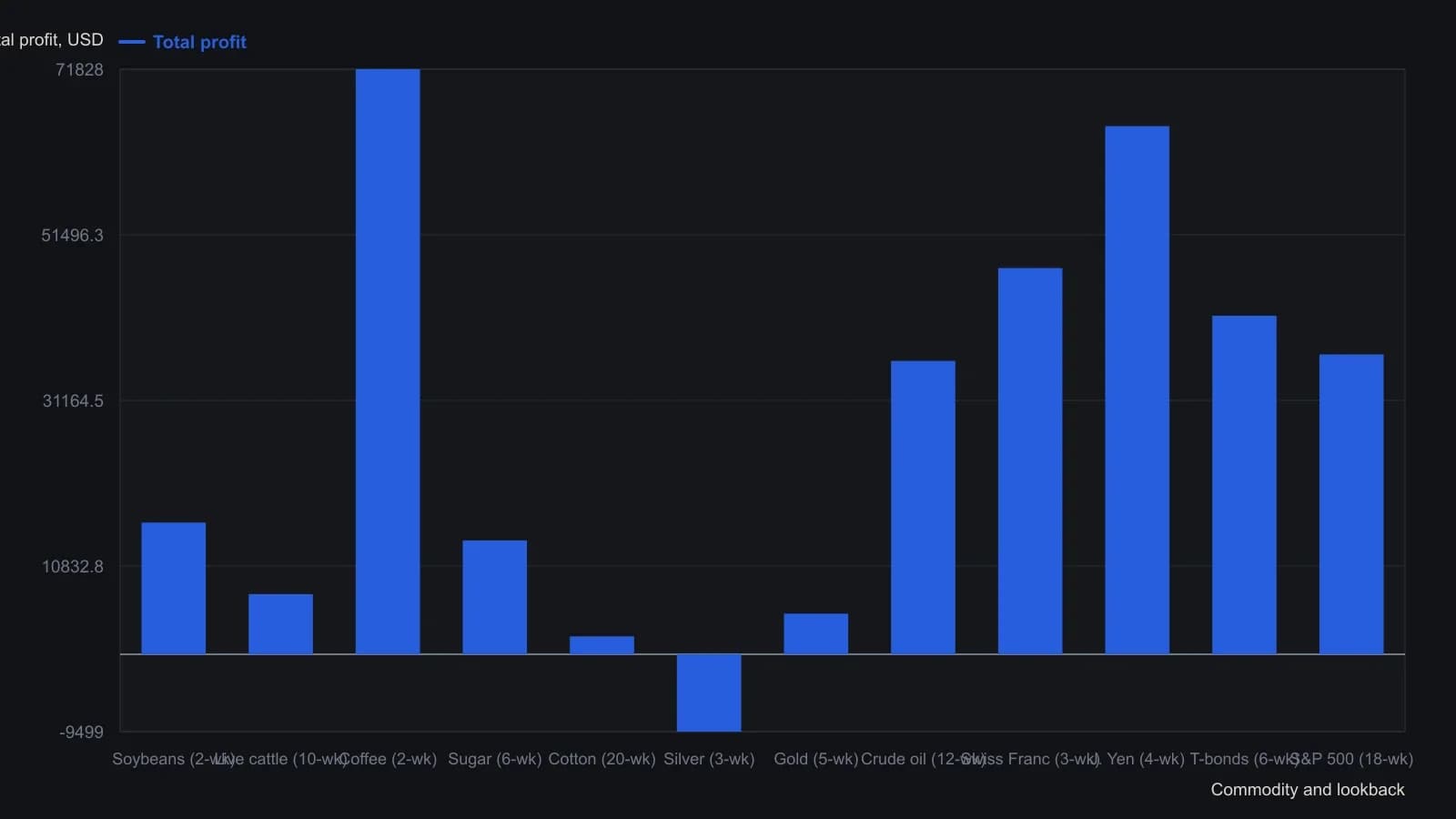
Lookback n was chosen separately for each market from the two-to-twenty-week range the author scanned. Contract windows differ slightly and end in mid-1988. Slippage and commissions were taken as $100 per trade.
All readings on this track · 36 readings
- 1988Half-day bars, a midpoint gate, and a bar-based trail
- 1989Packaging two-bar reversals into testable entry and exit rules
- 1989Weekly high and low averages as stop-and-reverse levels
- 1991Constant false-alarm rate for dominant-cycle stops
- 1992Tick-index extremes as continuation and turn hypotheses
- 1993Constructing layered stops from equity and structure
- 1993Filter crossovers with moving-average slope
- 1993Precommit stop bounds from equity and structure
- 1998Evaluating a trendline barrier that can only tighten a capped stop
- 1999Constructing common-number support and resistance
- 2001Four-step opening-hour bias and trailing stops
- 2004Make the trading system the star
- 2005A beginner stock case: stop, trail, and the pre-trade checklist
- 2006Sell stops that trail support after the buy
- 2006Treat a wave-3 label as unfunded until the stop rails are written
- 2008Test medium-term divergence with a trendline break and a trailing stop
- 2010Rule-based forex entry, stop and trail
- 2012Precommitting stops when one currency range templates another
- 2012Cat-ears as a downtrend continuation hypothesis
- 2013Three-average swing entry and a trailing average exit
- 2014Construct a dual quotient-copy trend filter under a frequency roof
- 2014Stop distance, size, and trailing swing invalidation
- 2014Long-only RSI pullback, reversal-bar-entry, and staged-trail construction
- 2015Dual-average regime, trigger candle, and trail as one daily script
- 2015Three-gate trend system: filter, trigger, and trailing stop
- 2016Construct HHLLS crossover and breakout entry rules
- 2017An appointment-trade around a scheduled political close
- 2017Golden-cross breakout rules for a swing entry
- 2017Breakout confirmation above round numbers, with nines as sell shelves
- 2018Classify diamond geometry before the breakout
- 2019When trails and stops betray the support read
- 2019One-triggers-the-other pairs for preplanned swing entries
- 2019One-triggers-the-other orders for a breakout and its stop
- 2019When the second decision unbounds planned risk
- 2020Last-Hour Breakout With a Same-Session Flatten
- 2020Couple the slow period to stop-loss and trailing-stop settings