2005issue C101-3
A beginner stock case: stop, trail, and the pre-trade checklist
Editorial reading: a first stock system is treated here as a decision-process drill, not a better setup idea. The archive workflow writes a checklist-process that places a stop-loss, defines a trailing-stop, and records an abstention-signal before any live order can go out.
- The archive frames live trading as negative-sum because negative-sum-friction from brokerage and tax costs must be cleared before a net gain appears.
- A stop-loss is mandatory at entry and is later raised under a prior valley, or run as a brokerage trailing-stop, so the exit can fire without a debate.
- New buys come from a momentum-universe of strong industries and prices near yearly highs, while industry-concentration is shown as a shared-shock risk.
- The checklist-process ends on an abstention-signal: stand aside in cash if stops start firing in rapid succession.
A ritual before the first live order
Editorial reading: this beginner stock case is a decision-process drill. The first working system is not a better setup idea. It is a pre-commitment ritual that places the stop-loss, defines the trailing-stop, and writes the stay-in-cash rule before any order can go live.
The archive then binds those pieces in a checklist-process. Entry filters, the protective exit, the trail, and an abstention-signal are one sequence, not a loose pile of tips.
Friction before a net gain
The archive frames live trading as a negative-sum activity. Brokerage charges and tax costs must be cleared before any net gain appears. That negative-sum-friction is why cost control sits inside the process rather than after it.
The preferred setup is a single low-cost broker that does not add advice.
Common stocks and a slower chart
Beginners are directed to common stocks rather than options or futures. A long paper-trading stretch comes first. That stretch showed weak stock selection before any cash was committed.
Shorter holding periods are described as harder for a new trader. The suggested start is a slower buy-and-hold stance that uses weekly charts to limit overtrading.
Cluster risk and a ranked watchlist
A same-industry airline cluster around a multi-day market close, and a later semiconductor cluster, is used as a case of industry-concentration. Names from one group can fall together when the shock is shared.
A large daily watchlist is ranked by six-month results. The momentum-universe that follows restricts new buys to the strongest industries and to stocks already near yearly highs. If price keeps rising, the stop can be raised toward breakeven.
Percent losses in two undiversified industry clusters
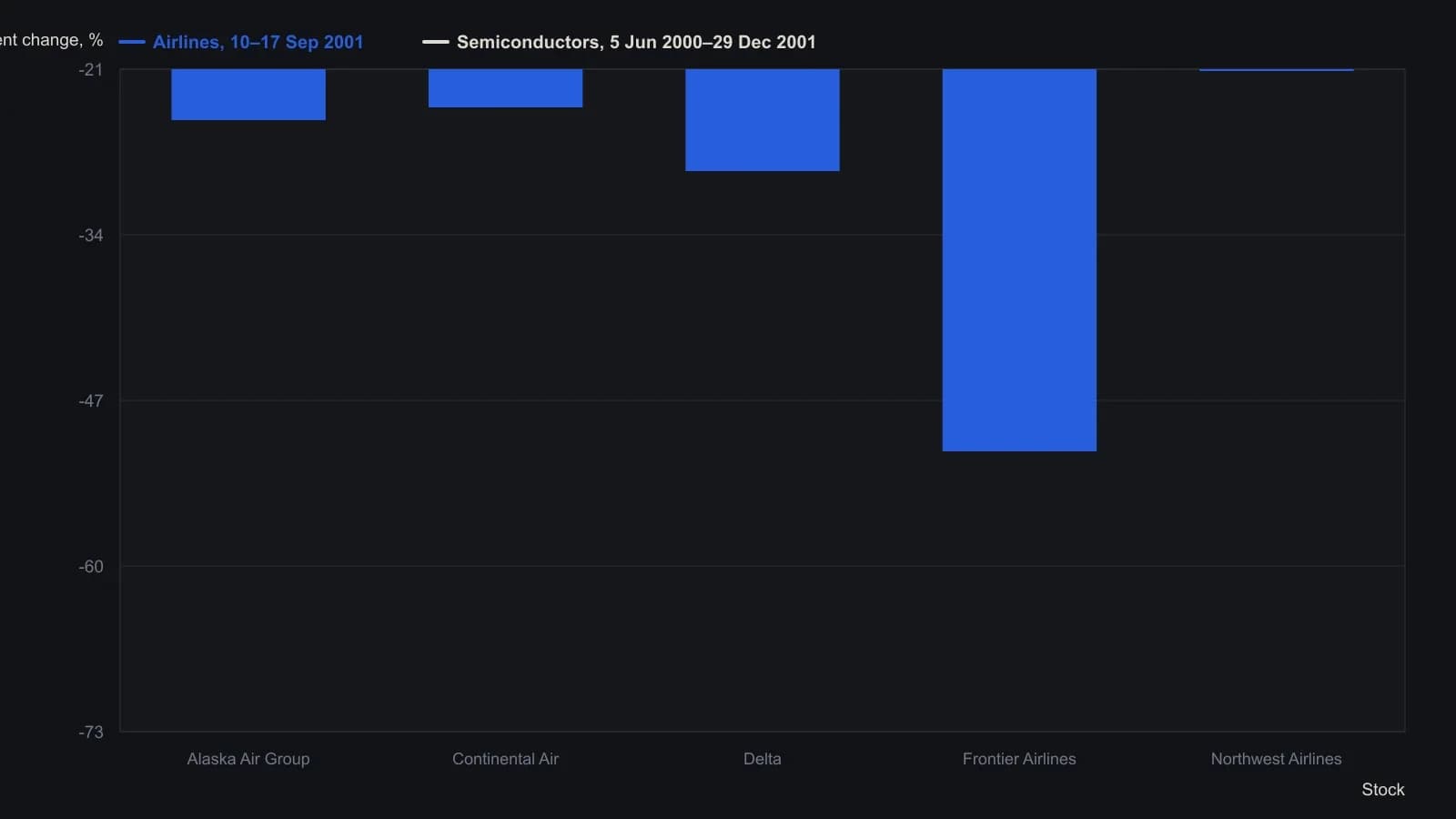
Airline closes are 10 September versus 17 September 2001, spanning the exchange shutdown after 11 September. Semiconductor closes are 5 June 2000 versus 29 December 2001. The source says those printed pairs are not always the true peak-to-trough extremes.
A stop that can fire without debate
A protective stop-loss is treated as mandatory. After new highs it is raised to a level just under the prior valley so the exit can fire without a discretionary debate.
A brokerage trailing-stop specified in points or percent is presented as a way for end-of-day traders to let the exit ratchet with price instead of moving the stop by hand. The remainder of the risk decision stays bounded after price has moved.
The closed checklist
The closing procedure is one checklist-process. The written items are these. Buy only when the broad market and industry are rising. Prefer strong industries and prices near yearly highs. Always attach a stop-loss. Raise it under prior valleys. Exit at once if a stop-out looks imminent.
The same list carries the abstention-signal. If stops start firing in rapid succession, stand aside in cash instead of forcing the next trade.
What the case is for
Editorial note: the archive is recording a historical workflow. TradersWeek is not treating that workflow as a present-day stock method. The case is here as a drill in pre-commitment: stop, trail, and cash are written before the order.
All readings on this track · 36 readings
- 1988Half-day bars, a midpoint gate, and a bar-based trail
- 1989Packaging two-bar reversals into testable entry and exit rules
- 1989Weekly high and low averages as stop-and-reverse levels
- 1991Constant false-alarm rate for dominant-cycle stops
- 1992Tick-index extremes as continuation and turn hypotheses
- 1993Constructing layered stops from equity and structure
- 1993Filter crossovers with moving-average slope
- 1993Precommit stop bounds from equity and structure
- 1998Evaluating a trendline barrier that can only tighten a capped stop
- 1999Constructing common-number support and resistance
- 2001Four-step opening-hour bias and trailing stops
- 2004Make the trading system the star
- 2005A beginner stock case: stop, trail, and the pre-trade checklist
- 2006Sell stops that trail support after the buy
- 2006Treat a wave-3 label as unfunded until the stop rails are written
- 2008Test medium-term divergence with a trendline break and a trailing stop
- 2010Rule-based forex entry, stop and trail
- 2012Precommitting stops when one currency range templates another
- 2012Cat-ears as a downtrend continuation hypothesis
- 2013Three-average swing entry and a trailing average exit
- 2014Construct a dual quotient-copy trend filter under a frequency roof
- 2014Stop distance, size, and trailing swing invalidation
- 2014Long-only RSI pullback, reversal-bar-entry, and staged-trail construction
- 2015Dual-average regime, trigger candle, and trail as one daily script
- 2015Three-gate trend system: filter, trigger, and trailing stop
- 2016Construct HHLLS crossover and breakout entry rules
- 2017An appointment-trade around a scheduled political close
- 2017Golden-cross breakout rules for a swing entry
- 2017Breakout confirmation above round numbers, with nines as sell shelves
- 2018Classify diamond geometry before the breakout
- 2019When trails and stops betray the support read
- 2019One-triggers-the-other pairs for preplanned swing entries
- 2019One-triggers-the-other orders for a breakout and its stop
- 2019When the second decision unbounds planned risk
- 2020Last-Hour Breakout With a Same-Session Flatten
- 2020Couple the slow period to stop-loss and trailing-stop settings