2016issue C0220-26
Construct HHLLS crossover and breakout entry rules
This article organizes the hhlls pair as a construction checklist. Classify the edge-zone first, then require a moving-average-style line cross or a price-structure confirmation-break before acting, and keep the position bounded with a predefined trailing stop.
- Classify the edge-zone before acting: bulls are treated as in control when the higher-high-stochastic is above 50 and the lower-low-stochastic is below 50, and bears when those positions reverse.
- Treat a divergence as a tradeable reversal only after a confirmation-break: a support or resistance break on the price chart, or the opposing line crossing above 50.
- Use a rising high line with a falling low line as an emerging-uptrend construction, and a surging low line with a falling high line as an emerging-downtrend construction, then combine either pattern with support and resistance.
- A complementary swing construction uses a pilot-scale-in on breaks above the 100-day and then the 200-day simple moving averages, a maximum 2-dollar bounded-trail, and a range-fraction-target equal to half of the 90-day range added to the entry.
Build the hhlls pair first
The hhlls system is the paired higher-high and lower-low stochastic used to classify trend, correction, and reversal hypotheses.
The higher-high-stochastic is a high-based, zero-to-100 momentum line that measures how strong recent higher highs are versus the weakest high in the lookback.
The lower-low-stochastic is a low-based, zero-to-100 momentum line that measures how deep recent lower lows are versus the strongest low in the lookback.
Default lookback and smoothing
The default construction uses a 20-period lookback, then smooths the high-based and low-based raw readings with 20-day exponential moving averages so the pair reacts more to recent higher highs or lower lows.
Both smoothed lines are bounded from 0 to 100, and reaching those extremes would require 20 consecutive highest highs or lowest lows for 100, or 20 consecutive non-higher highs or non-lower lows for 0.
Classify the edge-zone
Typical overbought and oversold zones are above 60 and below 10.
A basic edge rule treats bulls as in control when the high line is above 50 and the low line is below 50, and bears as in control when those positions reverse.
The edge-zone is that 50 midline split.
Dow 20-day HHS and LLS, August–September 1998
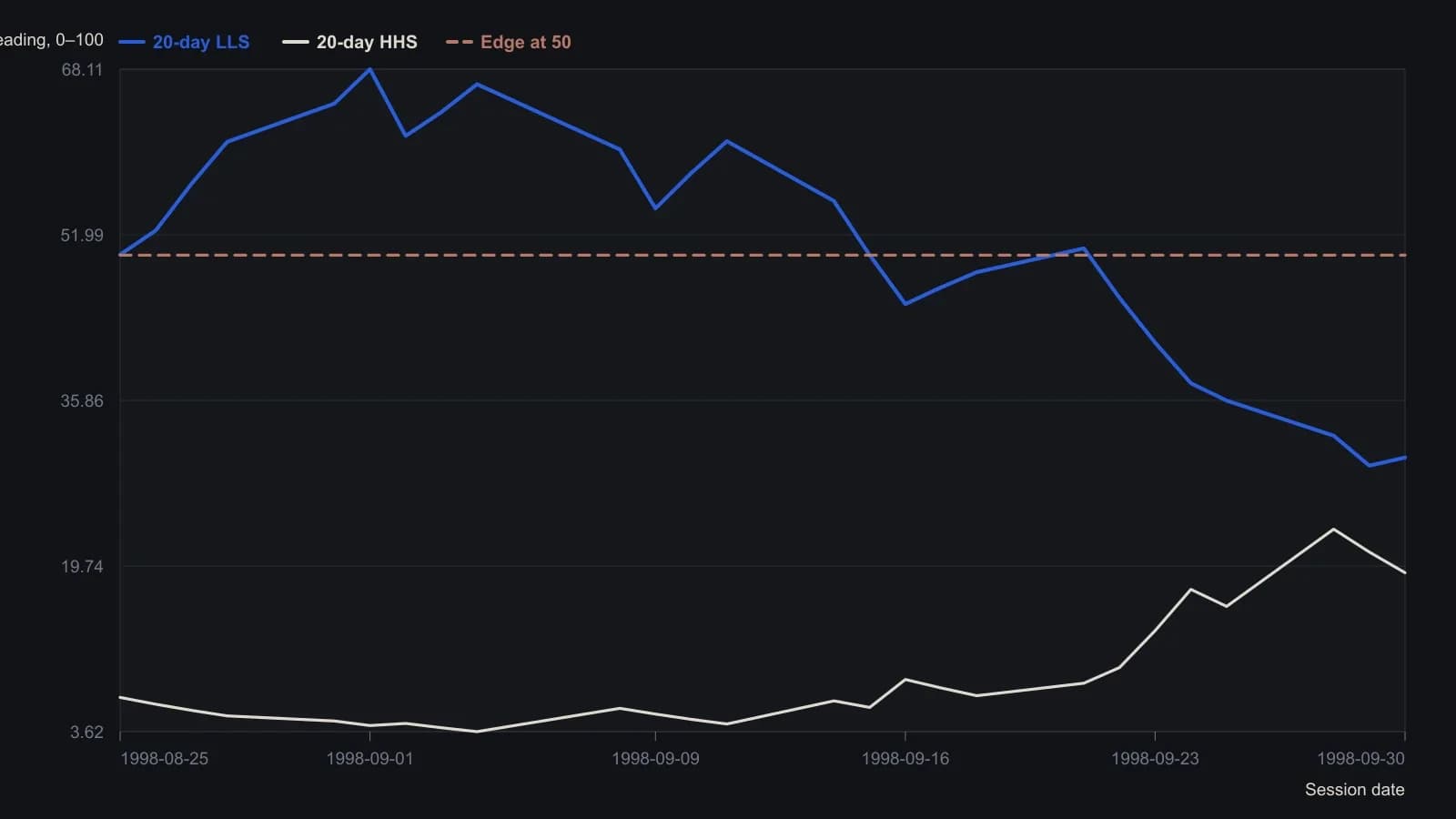
The worksheet seeds the first EMA with the average of the first 20 HS and LS readings; published HHS and LLS begin on 25 August 1998. Default lookback is 20 sessions. The author notes that a short spreadsheet sample can differ slightly from a live chart because of decimal rounding.
Require a line cross or a confirmation-break
A bullish divergence is defined as price making a lower low while the low line makes a higher high. A bearish divergence is price making a higher high while the high line makes a lower high.
Divergences are not treated as completed reversals until confirmed by a support or resistance break on the price chart or by the opposing line crossing above 50. The confirmation-break is that required second event.
Historical confirmation sequences
On the illustrated S&P 500 uptrend, a mid-October 2014 low-line break above 50 was later negated when the high line exceeded 50 at month-end, and an August 20, 2015 support break was followed four days later by the low line moving above 50.
On the illustrated 2011 Dow sequence, a support break plus a low-line cross above 50 marked the start of a correction, and a later trendline breakout plus a high-line cross above 50 marked the end of that correction.
Emerging trend constructions
An emerging-uptrend construction is a rising high line with a falling low line. An emerging-downtrend construction is a surging low line with a falling high line.
Both are meant to be combined with support and resistance for entry and exit confirmation.
Add a complementary swing construction
A complementary swing construction waits for price to break above the 100-day and then the 200-day simple moving averages, starting with a small first position on the nearer breakout and adding only after the later breakout. That two-step sequence is the pilot-scale-in.
That swing construction bounds risk with a maximum 2-dollar initial and trailing stop on stock swing trades. That fixed-dollar initial and trailing stop is the bounded-trail.
It then sets an exit objective at half of the 90-day range added to the entry. That exit objective is the range-fraction-target.
All readings on this track · 36 readings
- 1988Half-day bars, a midpoint gate, and a bar-based trail
- 1989Packaging two-bar reversals into testable entry and exit rules
- 1989Weekly high and low averages as stop-and-reverse levels
- 1991Constant false-alarm rate for dominant-cycle stops
- 1992Tick-index extremes as continuation and turn hypotheses
- 1993Constructing layered stops from equity and structure
- 1993Filter crossovers with moving-average slope
- 1993Precommit stop bounds from equity and structure
- 1998Evaluating a trendline barrier that can only tighten a capped stop
- 1999Constructing common-number support and resistance
- 2001Four-step opening-hour bias and trailing stops
- 2004Make the trading system the star
- 2005A beginner stock case: stop, trail, and the pre-trade checklist
- 2006Sell stops that trail support after the buy
- 2006Treat a wave-3 label as unfunded until the stop rails are written
- 2008Test medium-term divergence with a trendline break and a trailing stop
- 2010Rule-based forex entry, stop and trail
- 2012Precommitting stops when one currency range templates another
- 2012Cat-ears as a downtrend continuation hypothesis
- 2013Three-average swing entry and a trailing average exit
- 2014Construct a dual quotient-copy trend filter under a frequency roof
- 2014Stop distance, size, and trailing swing invalidation
- 2014Long-only RSI pullback, reversal-bar-entry, and staged-trail construction
- 2015Dual-average regime, trigger candle, and trail as one daily script
- 2015Three-gate trend system: filter, trigger, and trailing stop
- 2016Construct HHLLS crossover and breakout entry rules
- 2017An appointment-trade around a scheduled political close
- 2017Golden-cross breakout rules for a swing entry
- 2017Breakout confirmation above round numbers, with nines as sell shelves
- 2018Classify diamond geometry before the breakout
- 2019When trails and stops betray the support read
- 2019One-triggers-the-other pairs for preplanned swing entries
- 2019One-triggers-the-other orders for a breakout and its stop
- 2019When the second decision unbounds planned risk
- 2020Last-Hour Breakout With a Same-Session Flatten
- 2020Couple the slow period to stop-loss and trailing-stop settings