1991issue C041-8
Constant false-alarm rate for dominant-cycle stops
The assumed dominant-cycle length is the knob that sets how fast a trailing reverse order tightens. Scan that setting, treat losing reversals as false alarms, keep a low but nonzero rate, and stand aside when no such setting appears.
- A detection-style yes-or-no decision has four outcomes: correct acceptance, correct rejection, a false alarm, and a missed detection.
- A missed detection is treated as a nearly costless skipped opportunity, while a false alarm is assigned a large negative value.
- If the assumed dominant cycle is too long, the reverse order lags and captured excursion shrinks; if it is too short, the order tightens too fast and produces whipsaw reversals.
- When no clear constant-false-alarm-rate parameter appears, the procedure treats that outcome as a stand-aside signal.
Four outcomes of a yes-or-no decision
A detection-style yes-or-no decision at each step has four outcomes: correct acceptance, correct rejection, a false alarm, and a missed detection. A false alarm is a yes-vote that treats noise as if a usable signal were present. A missed detection is a no-vote that fails to register a signal that was actually present.
Under the value function used here, a missed detection is treated as a nearly costless skipped opportunity, while a false alarm is assigned a large negative value.
A constant false-alarm rate
A sequential observer updates its threshold from experience to hold a roughly constant false-alarm rate. That policy is offered as the basis for an adaptive rule: hold the rate of incorrect yes-votes near a chosen level instead of maximizing detections.
How the trailing reverse order ages
The demonstration entry-exit rule is a stop-and-reverse order whose initial placement is fixed. The trailing-stop then accelerates in proportion to the age of the open trade relative to an assumed dominant cycle. The dominant cycle is the cycle length assumed by the stop-acceleration rule. It scales how quickly the trailing reverse order closes the gap as a trade ages.
The stop update adds a share of the previous gap to the prior stop. That share grows with trade age relative to the assumed dominant cycle.
If the assumed cycle is too long, the reverse order lags and captured excursion shrinks. If it is too short, the order tightens too fast and produces whipsaw reversals.
Scan the parameter or stand aside
With no known cycle period, the stop-acceleration parameter is scanned across candidate dominant-cycle lengths. System optimization is that scan of one rule parameter over a recent window. It selects the value that keeps incorrect yes-votes at an acceptable rate, or refuses the trade if no such value appears. Winners are tallied as detections and losers as false alarms.
The controlled price path is a sine wave. A noisier variant of the same path is used as well. The scan is described as associating the highest plotted results with a low but finite false-alarm count rather than driving false alarms to zero.
When no clear constant-false-alarm-rate parameter appears, the procedure treats that outcome as a stand-aside signal because the span may be too noisy or the rule may not fit.
False alarms and profit versus assumed SAR cycle
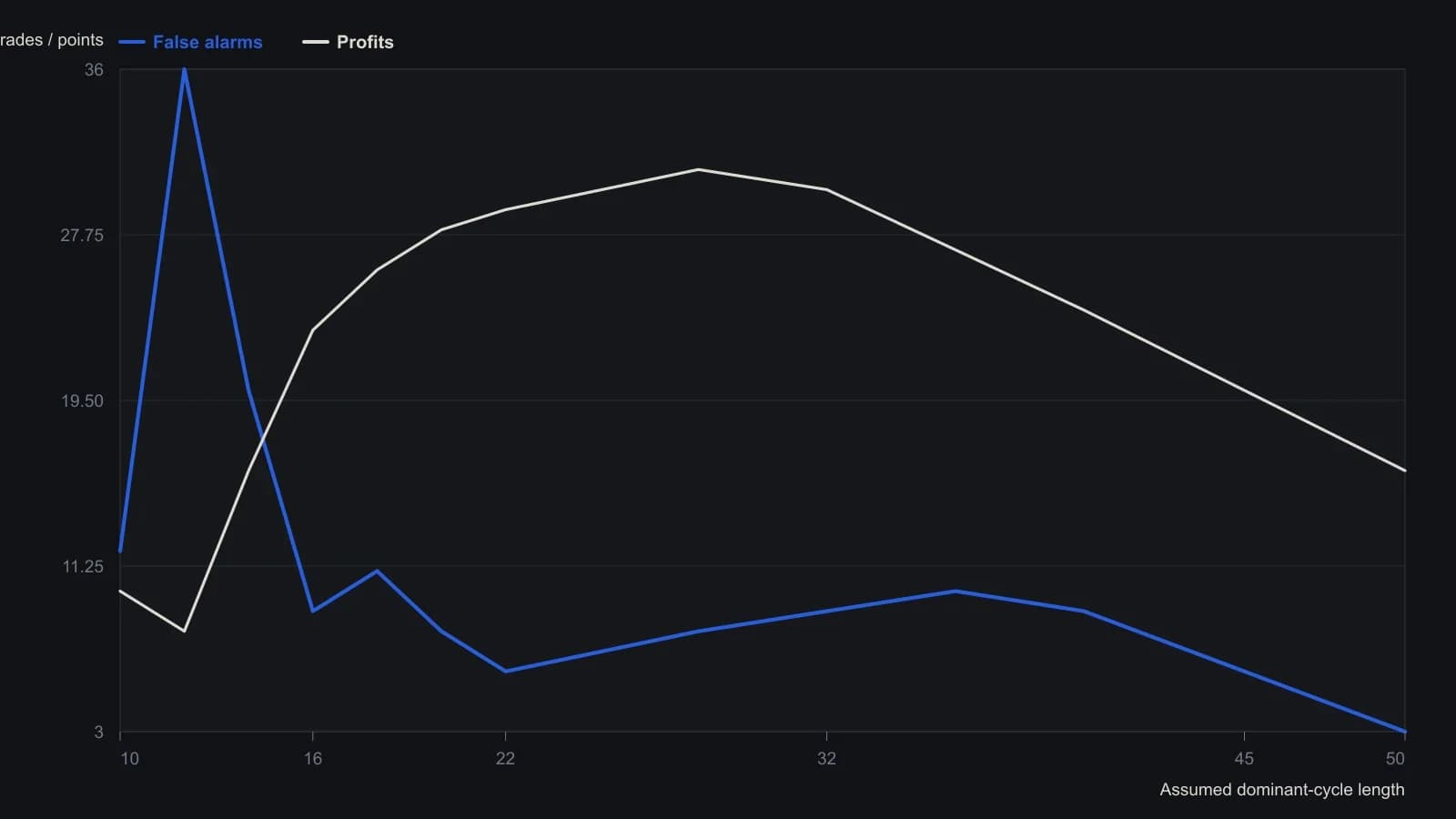
Theoretical 20-day sine price plus noise at about 6 dB SNR; the source scanned assumed cycle length in the SAR acceleration term. Both series share the single printed vertical scale. Digitizing a rotated raster, so counts are approximate.
All readings on this track · 36 readings
- 1988Half-day bars, a midpoint gate, and a bar-based trail
- 1989Packaging two-bar reversals into testable entry and exit rules
- 1989Weekly high and low averages as stop-and-reverse levels
- 1991Constant false-alarm rate for dominant-cycle stops
- 1992Tick-index extremes as continuation and turn hypotheses
- 1993Constructing layered stops from equity and structure
- 1993Filter crossovers with moving-average slope
- 1993Precommit stop bounds from equity and structure
- 1998Evaluating a trendline barrier that can only tighten a capped stop
- 1999Constructing common-number support and resistance
- 2001Four-step opening-hour bias and trailing stops
- 2004Make the trading system the star
- 2005A beginner stock case: stop, trail, and the pre-trade checklist
- 2006Sell stops that trail support after the buy
- 2006Treat a wave-3 label as unfunded until the stop rails are written
- 2008Test medium-term divergence with a trendline break and a trailing stop
- 2010Rule-based forex entry, stop and trail
- 2012Precommitting stops when one currency range templates another
- 2012Cat-ears as a downtrend continuation hypothesis
- 2013Three-average swing entry and a trailing average exit
- 2014Construct a dual quotient-copy trend filter under a frequency roof
- 2014Stop distance, size, and trailing swing invalidation
- 2014Long-only RSI pullback, reversal-bar-entry, and staged-trail construction
- 2015Dual-average regime, trigger candle, and trail as one daily script
- 2015Three-gate trend system: filter, trigger, and trailing stop
- 2016Construct HHLLS crossover and breakout entry rules
- 2017An appointment-trade around a scheduled political close
- 2017Golden-cross breakout rules for a swing entry
- 2017Breakout confirmation above round numbers, with nines as sell shelves
- 2018Classify diamond geometry before the breakout
- 2019When trails and stops betray the support read
- 2019One-triggers-the-other pairs for preplanned swing entries
- 2019One-triggers-the-other orders for a breakout and its stop
- 2019When the second decision unbounds planned risk
- 2020Last-Hour Breakout With a Same-Session Flatten
- 2020Couple the slow period to stop-loss and trailing-stop settings