2004issue C111-3
Make the trading system the star
A retail participant is framed as able to face professional managers and market makers only if the decision process is rebuilt on a statistical record of what actually produced results, not on reputation or appearance. If the system and its edge cannot be stated in one or two sentences, the process is treated as not existing.
- If a trader cannot state the system and its edge in one or two sentences, the process is treated as not existing.
- Jumping among ideas, tips, and hot markets is contrasted with naming who the dollars are expected to come from and why.
- A proposed strategy is to be replayed historically for win-or-loss rate, drawdowns, and related diagnostics before the rules are traded.
- A mechanical procedure is described as reducing emotion by issuing long and short signals, exit points, and trailing stops while a trading-psychology-process discards individual failures and sentiment.
Scout the look or run one procedure
Editorial. TradersWeek reads this archive as an audit of whether the desk is still scouting the look of a trade, the hot tip, the crowded long, the last win, or running one written procedure that can be stated, replayed as a backtest, and exited without argument.
A retail participant is framed as able to face professional managers and market makers only if the decision process is rebuilt on a statistical record of what actually produced results, not on reputation or appearance.
Name the counterpart, then replay the rules
A mechanical-trading-system is a written, statistically checked procedure that turns rule inputs, market state, and execution constraints into entry, exit, and sit-out signals over the system holding period. Abstention is the rule-based choice not to trade when the procedure does not fire, and it is treated as part of the same system as entry and exit.
Jumping among ideas, tips, and hot markets is contrasted with naming who the dollars are expected to come from and why.
A proposed strategy is to be replayed historically for win-or-loss rate, drawdowns, and related diagnostics, and that replay is to become a standing routine before the rules are traded. A backtest, as used here, is that historical replay of the full procedure, used to inspect those diagnostics and whether the rules can be followed with confidence.
Combining a screen for neglected candidates, technical timing of oversold points, and options for leverage or risk control is presented as stacking three independent odds without guaranteeing a win.
Seeing the same public facts differently includes fading what the crowd overvalues, considering neglected names, and allowing short as well as long exposure instead of hunting only one side.
Let the written outcome stand
A trading-psychology-process is a repeatable mental procedure that keeps execution aligned with the written rules instead of with tips, sentiment, or the last success or failure. Process psychology is defined as discarding individual failures, refusing sentiment about a position or story, and placing a stop or protective put so the outcome is allowed to stand.
A trailing-stop is a precommitted, moving exit bound that keeps a loss or exposure decision limited before entry and throughout the position.
A mechanical, statistically based procedure is described as reducing emotion by issuing long and short signals, exit points, and trailing stops while keeping a recorded track of results.
Editorial. TradersWeek treats the system, not the trader's face, as the only star the desk is allowed to keep.
AU Force Model: daily value of a $10,000 account
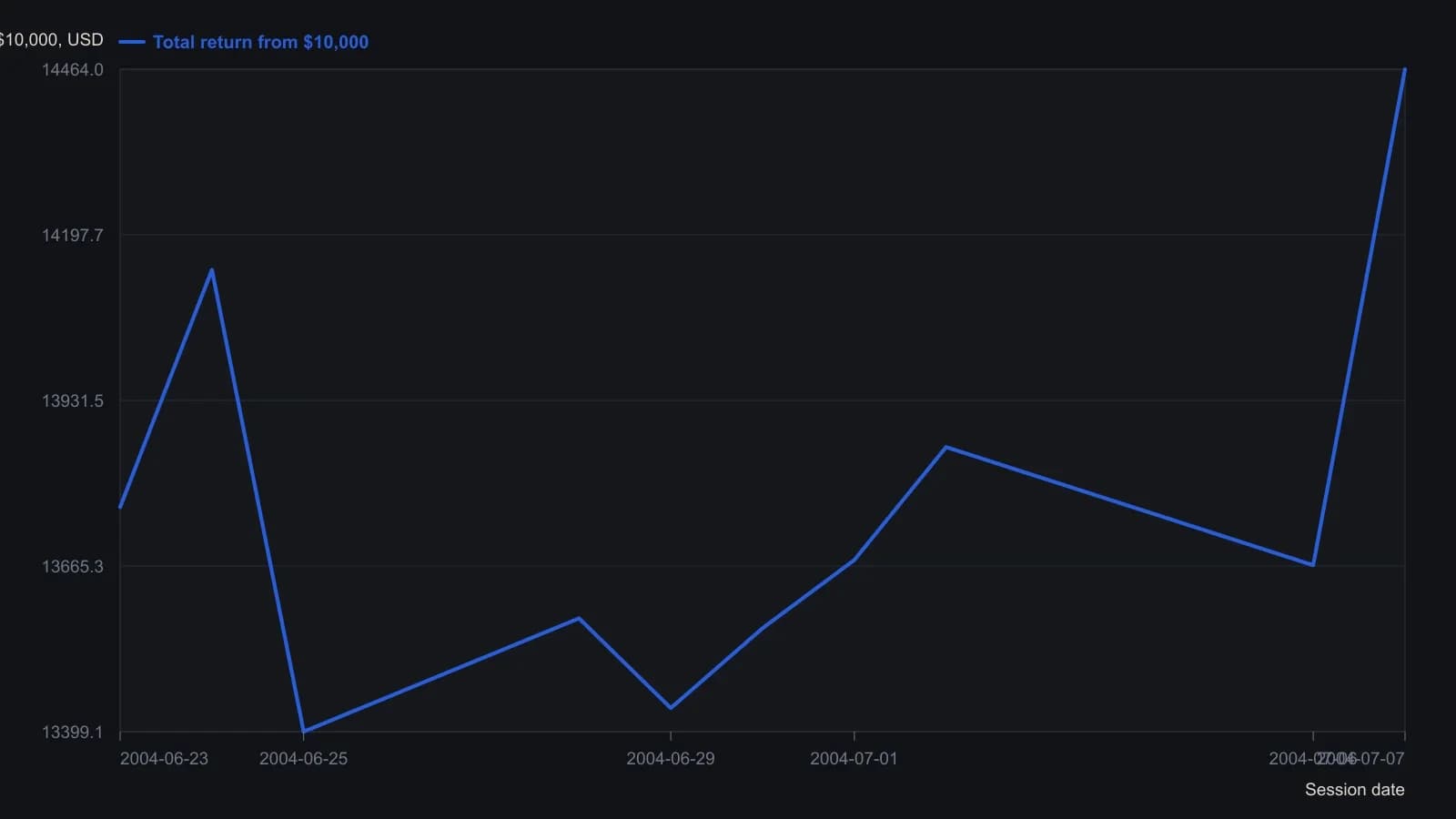
The header on that same screen lists Force smoothing 32, a 2 percent stop, 23 trades, 17.26 points, an ending amount of $14,350.06 and 43.50 percent annualized for the full run. Only the daily rows visible in the grid are plotted.
All readings on this track · 36 readings
- 1988Half-day bars, a midpoint gate, and a bar-based trail
- 1989Packaging two-bar reversals into testable entry and exit rules
- 1989Weekly high and low averages as stop-and-reverse levels
- 1991Constant false-alarm rate for dominant-cycle stops
- 1992Tick-index extremes as continuation and turn hypotheses
- 1993Constructing layered stops from equity and structure
- 1993Filter crossovers with moving-average slope
- 1993Precommit stop bounds from equity and structure
- 1998Evaluating a trendline barrier that can only tighten a capped stop
- 1999Constructing common-number support and resistance
- 2001Four-step opening-hour bias and trailing stops
- 2004Make the trading system the star
- 2005A beginner stock case: stop, trail, and the pre-trade checklist
- 2006Sell stops that trail support after the buy
- 2006Treat a wave-3 label as unfunded until the stop rails are written
- 2008Test medium-term divergence with a trendline break and a trailing stop
- 2010Rule-based forex entry, stop and trail
- 2012Precommitting stops when one currency range templates another
- 2012Cat-ears as a downtrend continuation hypothesis
- 2013Three-average swing entry and a trailing average exit
- 2014Construct a dual quotient-copy trend filter under a frequency roof
- 2014Stop distance, size, and trailing swing invalidation
- 2014Long-only RSI pullback, reversal-bar-entry, and staged-trail construction
- 2015Dual-average regime, trigger candle, and trail as one daily script
- 2015Three-gate trend system: filter, trigger, and trailing stop
- 2016Construct HHLLS crossover and breakout entry rules
- 2017An appointment-trade around a scheduled political close
- 2017Golden-cross breakout rules for a swing entry
- 2017Breakout confirmation above round numbers, with nines as sell shelves
- 2018Classify diamond geometry before the breakout
- 2019When trails and stops betray the support read
- 2019One-triggers-the-other pairs for preplanned swing entries
- 2019One-triggers-the-other orders for a breakout and its stop
- 2019When the second decision unbounds planned risk
- 2020Last-Hour Breakout With a Same-Session Flatten
- 2020Couple the slow period to stop-loss and trailing-stop settings