2017issue C0842-43
Breakout confirmation above round numbers, with nines as sell shelves
This case withholds a long until a breakout-confirmation-offset prints above a whole-number-shelf, treats a nine-shelf as a predetermined sell zone, and keeps the multi-day hold under a 2-point fixed-dollar-trail.
- A long is withheld from a nine through the next whole-dollar print until a 0.50 breakout-confirmation-offset prints above that whole-number-shelf, illustrated as 60.50 rather than any print from 59 to 60.
- A nine-shelf is treated as resistance because it looks costly relative to the next round ten; the one-point band up to that multiple of 10 is an exit or tightening zone, not a place to initiate or add.
- The swing uses a 2-point initial and trailing fixed-dollar-trail and is described as typically lasting five to 15 days.
- After a stall near a nine, re-entry is considered only if price later clears 0.50 above the next whole-ten level, illustrated as 50.50 after a stall at 49.
A three-part entry and exit protocol
This case withholds a long until a breakout-confirmation-offset prints above a whole-number-shelf, treats a nine-shelf as a predetermined sell zone, and keeps the whole hold under a fixed-dollar-trail.
The archive workflow uses the distance from a nine, a whole-dollar print, and the next multiple of 10 to decide when a long is delayed, when it may be taken, and where the sell zone already sits.
GLD average percent move by days held into Labor Day
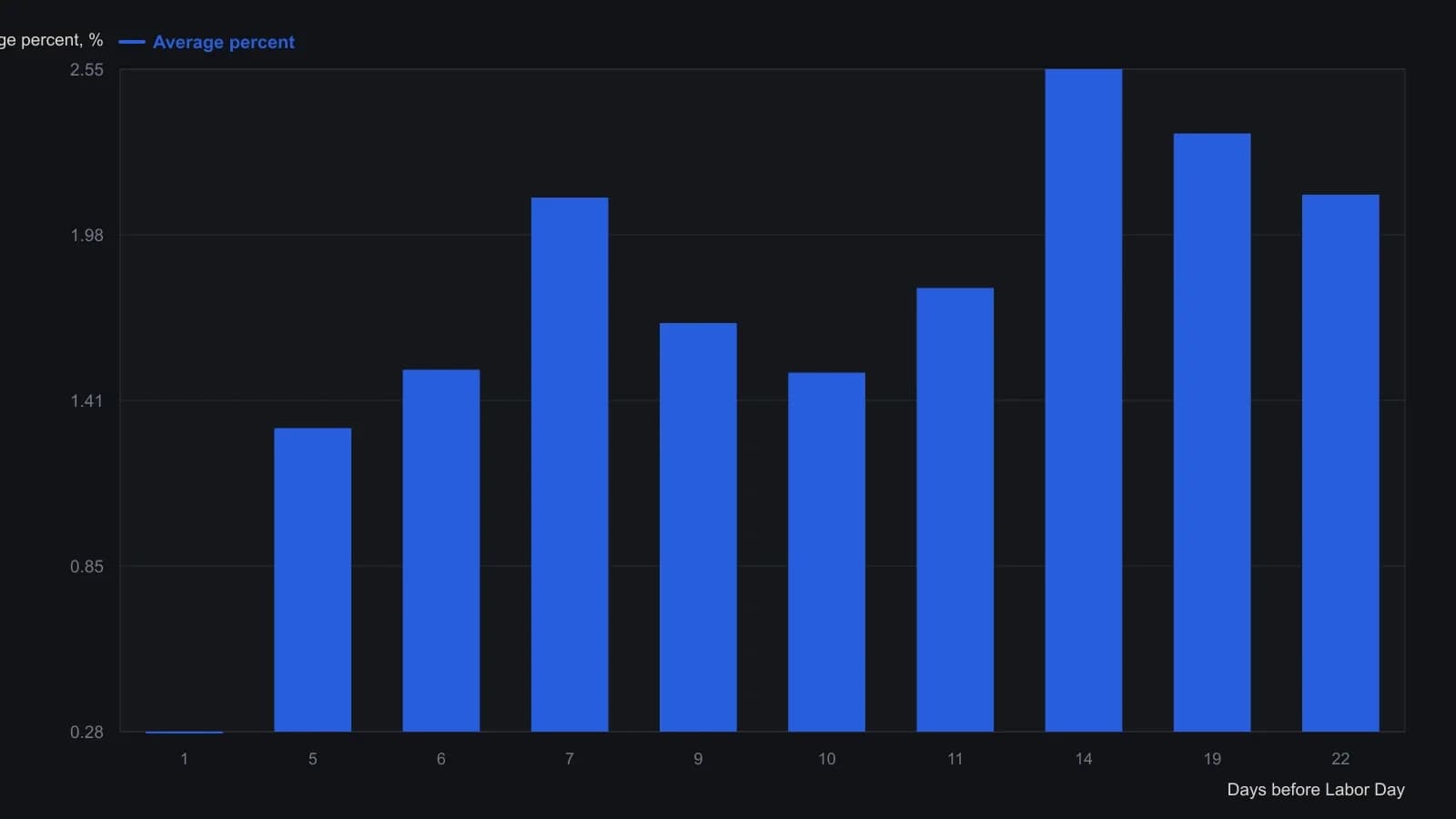
Each row is a 10-year buy-only window that enters N trading days before Labor Day and exits on Labor Day itself (zero days after).
Withhold the long until confirmation
A long is withheld between a nine and the next whole-dollar print. The case waits for a 0.50 confirmation above that whole number, illustrated as 60.50 rather than any print from 59 to 60.
That half-point print is the breakout-confirmation-offset. It delays the long until a probe through the round number is less likely to fail.
A push through a multiple-of-10 shelf is treated as unconfirmed until a prior failed probe at that shelf has been overcome.
Treat nines as sell shelves
Prints that contain a nine are treated as a resistance and selling zone because they are framed as looking costly relative to the next round ten. A nine-shelf is therefore a sell or exit zone, not a buy zone.
The one-point band from a nine up to the next multiple of 10 is used as an exit or trailing-stop tightening zone. It is not used as an area to initiate or add.
Bound the hold with a fixed-dollar trail
The swing is managed with a 2-point initial and trailing stop. That fixed-dollar-trail is set a fixed number of points from price at entry and then trailed so the multi-day swing stays bounded.
The hold is described as typically lasting five to 15 days.
Retry only after the next offset
After a stall near a nine, a later re-entry is considered only if price later clears 0.50 above the next whole-ten level, illustrated as 50.50 after a stall at 49.
Box the intraday range
Intraday ranges are boxed in 10-point increments. That round-ten-box is anchored on multiples of 10, with entries just above the lower ten and targets just under the upper ten.
The illustration is 42 to 49: enter just above a round ten and exit into the nine just below the next ten.
All readings on this track · 36 readings
- 1988Half-day bars, a midpoint gate, and a bar-based trail
- 1989Packaging two-bar reversals into testable entry and exit rules
- 1989Weekly high and low averages as stop-and-reverse levels
- 1991Constant false-alarm rate for dominant-cycle stops
- 1992Tick-index extremes as continuation and turn hypotheses
- 1993Constructing layered stops from equity and structure
- 1993Filter crossovers with moving-average slope
- 1993Precommit stop bounds from equity and structure
- 1998Evaluating a trendline barrier that can only tighten a capped stop
- 1999Constructing common-number support and resistance
- 2001Four-step opening-hour bias and trailing stops
- 2004Make the trading system the star
- 2005A beginner stock case: stop, trail, and the pre-trade checklist
- 2006Sell stops that trail support after the buy
- 2006Treat a wave-3 label as unfunded until the stop rails are written
- 2008Test medium-term divergence with a trendline break and a trailing stop
- 2010Rule-based forex entry, stop and trail
- 2012Precommitting stops when one currency range templates another
- 2012Cat-ears as a downtrend continuation hypothesis
- 2013Three-average swing entry and a trailing average exit
- 2014Construct a dual quotient-copy trend filter under a frequency roof
- 2014Stop distance, size, and trailing swing invalidation
- 2014Long-only RSI pullback, reversal-bar-entry, and staged-trail construction
- 2015Dual-average regime, trigger candle, and trail as one daily script
- 2015Three-gate trend system: filter, trigger, and trailing stop
- 2016Construct HHLLS crossover and breakout entry rules
- 2017An appointment-trade around a scheduled political close
- 2017Golden-cross breakout rules for a swing entry
- 2017Breakout confirmation above round numbers, with nines as sell shelves
- 2018Classify diamond geometry before the breakout
- 2019When trails and stops betray the support read
- 2019One-triggers-the-other pairs for preplanned swing entries
- 2019One-triggers-the-other orders for a breakout and its stop
- 2019When the second decision unbounds planned risk
- 2020Last-Hour Breakout With a Same-Session Flatten
- 2020Couple the slow period to stop-loss and trailing-stop settings