2006issue C091-3
Treat a wave-3 label as unfunded until the stop rails are written
The historical workflow waits for a 1/A upswing and a 38.2% to 50% 2/B retracement before treating wave 3/C as the working hypothesis, then writes the breaking-bar invalidation, first trail, and later Fibonacci rails so the stop plan remains the decision.
- Wait for a 1/A upswing and a 38.2% to 50% 2/B Fibonacci retracement before treating a 3/C continuation as the working hypothesis.
- Choose the initial stop from the breaking-bar ratio or nearby structure so the risk distance is set before the position is left unmanaged.
- Advance a trailing stop only after a stated running distance, then park it one tick under the 1.618, 2.618, or 4.236 rail.
- Beyond 2.618, replace the point step with channel or bar-close rules, and reserve dormant stops at later ratios for an extended third wave.
The setup waits for 1/A and 2/B
After an identified low, the historical setup waits for an initial upswing labeled 1/A and a 38.2% to 50% retracement labeled 2/B before treating a wave 3/C continuation as the working hypothesis.
That measured pullback is a Fibonacci retracement used to time the wave-3 hypothesis. It is not used to assert a guaranteed bounce.
A printed low may end wave B
A printed low is not assumed to start wave 1. It may end wave B of an ABC correction, after which wave C can unfold as a terminal rising triangle, and a failed fifth wave can appear as a double bottom.
Those identity checks keep the Elliott-wave count from treating every low as the start of an impulse.
Swing, average-trend, and extended-wave legs are associated with about 5, 13, and 21-34 bars. Those bar counts are described as often aligning with the Fibonacci sequence.
Choose the risk distance before the trade is left unmanaged
After the breaking bar closes, a typical long uses a 1.5 multiple of that bar as the entry and a -0.5 multiple as the initial stop, each offset by one tick. Shorts reverse the offsets.
The initial stop can remain at the typical -0.5 breaking-bar ratio or be tightened to nearby structure such as a recent bar low or the daily pivot minus one tick. The risk distance is chosen before the position is left unmanaged.
Move the trail after running distance, then park it on the rails
Once price reaches the 1.618 multiple of wave 1 after the wave-2 retracement completes, the 1.618, 2.618, and 4.236 multiples become the target and trail rails, with the trail parked one tick below each ratio.
The first trail is placed after a five-point running distance. The next trail moves one tick under 1.618 after another five-point run. The following trail moves one tick under 2.618 after a 4.5-point run. If the running distance is under three points, the existing stop is left unchanged.
A trailing stop in this workflow is advanced only after a stated running distance or ratio rail is reached, then tightened by structure rules so loss and open exposure stay bounded before and during the trade.
DAX futures wave-3 stop and Fibonacci rails
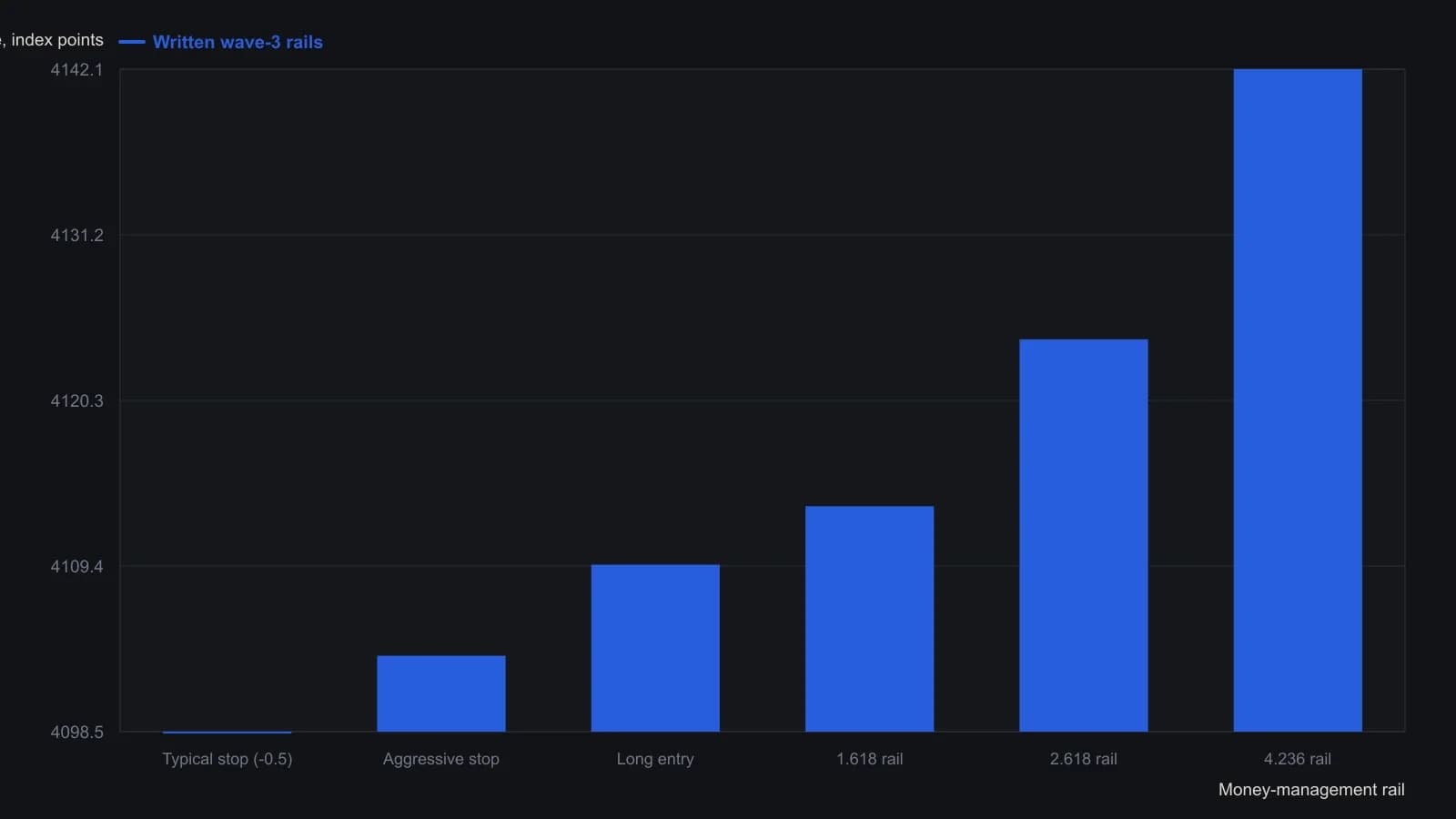
Each trail is placed one tick below the Fibonacci print. The 1.500 breaking-bar ratio is 4109.00; the fill adds one tick to 4109.5. A second aggressive-stop recipe at 4104.5 (daily pivot minus one tick) is mentioned in the text and is not plotted.
Beyond 2.618, abandon the point step
Beyond the 2.618 extension, trailing stops abandon the running-distance step and instead exit on a close through a regression trend channel, under a lower-timeframe reversal bar minus one tick, or after two consecutive bars that close below their opens once a third bar opens beneath those closes.
On an extended third wave, dormant stops at the 4.236 or 6.85 ratios are reserved for a full exit. The 1.618 and 2.618 ratios may be used for partial exits, or 1.618 as the standard full exit when only one unit is held. A dormant stop is a ratio-based exit placed ahead of price, reserved for a full or partial close rather than for chasing the last tick.
All readings on this track · 36 readings
- 1988Half-day bars, a midpoint gate, and a bar-based trail
- 1989Packaging two-bar reversals into testable entry and exit rules
- 1989Weekly high and low averages as stop-and-reverse levels
- 1991Constant false-alarm rate for dominant-cycle stops
- 1992Tick-index extremes as continuation and turn hypotheses
- 1993Constructing layered stops from equity and structure
- 1993Filter crossovers with moving-average slope
- 1993Precommit stop bounds from equity and structure
- 1998Evaluating a trendline barrier that can only tighten a capped stop
- 1999Constructing common-number support and resistance
- 2001Four-step opening-hour bias and trailing stops
- 2004Make the trading system the star
- 2005A beginner stock case: stop, trail, and the pre-trade checklist
- 2006Sell stops that trail support after the buy
- 2006Treat a wave-3 label as unfunded until the stop rails are written
- 2008Test medium-term divergence with a trendline break and a trailing stop
- 2010Rule-based forex entry, stop and trail
- 2012Precommitting stops when one currency range templates another
- 2012Cat-ears as a downtrend continuation hypothesis
- 2013Three-average swing entry and a trailing average exit
- 2014Construct a dual quotient-copy trend filter under a frequency roof
- 2014Stop distance, size, and trailing swing invalidation
- 2014Long-only RSI pullback, reversal-bar-entry, and staged-trail construction
- 2015Dual-average regime, trigger candle, and trail as one daily script
- 2015Three-gate trend system: filter, trigger, and trailing stop
- 2016Construct HHLLS crossover and breakout entry rules
- 2017An appointment-trade around a scheduled political close
- 2017Golden-cross breakout rules for a swing entry
- 2017Breakout confirmation above round numbers, with nines as sell shelves
- 2018Classify diamond geometry before the breakout
- 2019When trails and stops betray the support read
- 2019One-triggers-the-other pairs for preplanned swing entries
- 2019One-triggers-the-other orders for a breakout and its stop
- 2019When the second decision unbounds planned risk
- 2020Last-Hour Breakout With a Same-Session Flatten
- 2020Couple the slow period to stop-loss and trailing-stop settings