2012issue C0924-27
Precommitting stops when one currency range templates another
A finished USD/JPY consolidation is treated as a rehearsal for a still-open EUR/CHF floor, so the live pair is entered only after the stop, trail, and size rules are already written.
- A completed multi-month consolidation can serve as a rehearsal for the next still-open floor, not as proof that the next break will match.
- A stop-loss, pending-limit, and position-size are written while the analog is already finished, so the live pair is entered as a bounded risk script.
- A trailing-stop is advanced only after price has already moved in the position's favor, converting part of an open gain into a hard exit.
- The archive close tied survival to risk control and noted that a winning streak can end as quickly as it began.
A finished range as a rehearsal
USD/JPY spent October 2011 through January 2012 in a multi-month consolidation. Short-horizon participants treated that stretch as the only workable phase, while longer-horizon traders were described as having little room. Consolidation, in the archive's wording, is a long stretch of overlapping prices in which swing-length trades have little room and only short-horizon activity remains viable.
Editorial interpretation: a finished consolidation is useful less as a forecast of the next pair than as a rehearsal. The stop, trail, and size rules can be written while the analog is already complete, so the still-open floor is entered only as a bounded risk script rather than as a prediction that it must break the same way.
How the analog resolved
Daily USD/JPY later left that range with an upward break in February 2012, printed a March 2012 high of 84.17, and then turned lower. Two horizontal lines marked the earlier range and two trendlines framed the later advance. A trendline is a slanted line through successive highs or lows that turns a working advance or decline into a condition that later price can break and thereby reject.
The pair left the upper bound on 14 February 2012, advanced more than 500 pips, then dropped more than 500 pips after 22 March 2012. The archive later treated this finished range-to-trend sequence as a template for waiting on another pair until a later breakout.
USD/JPY daily: range, February breakout, March peak
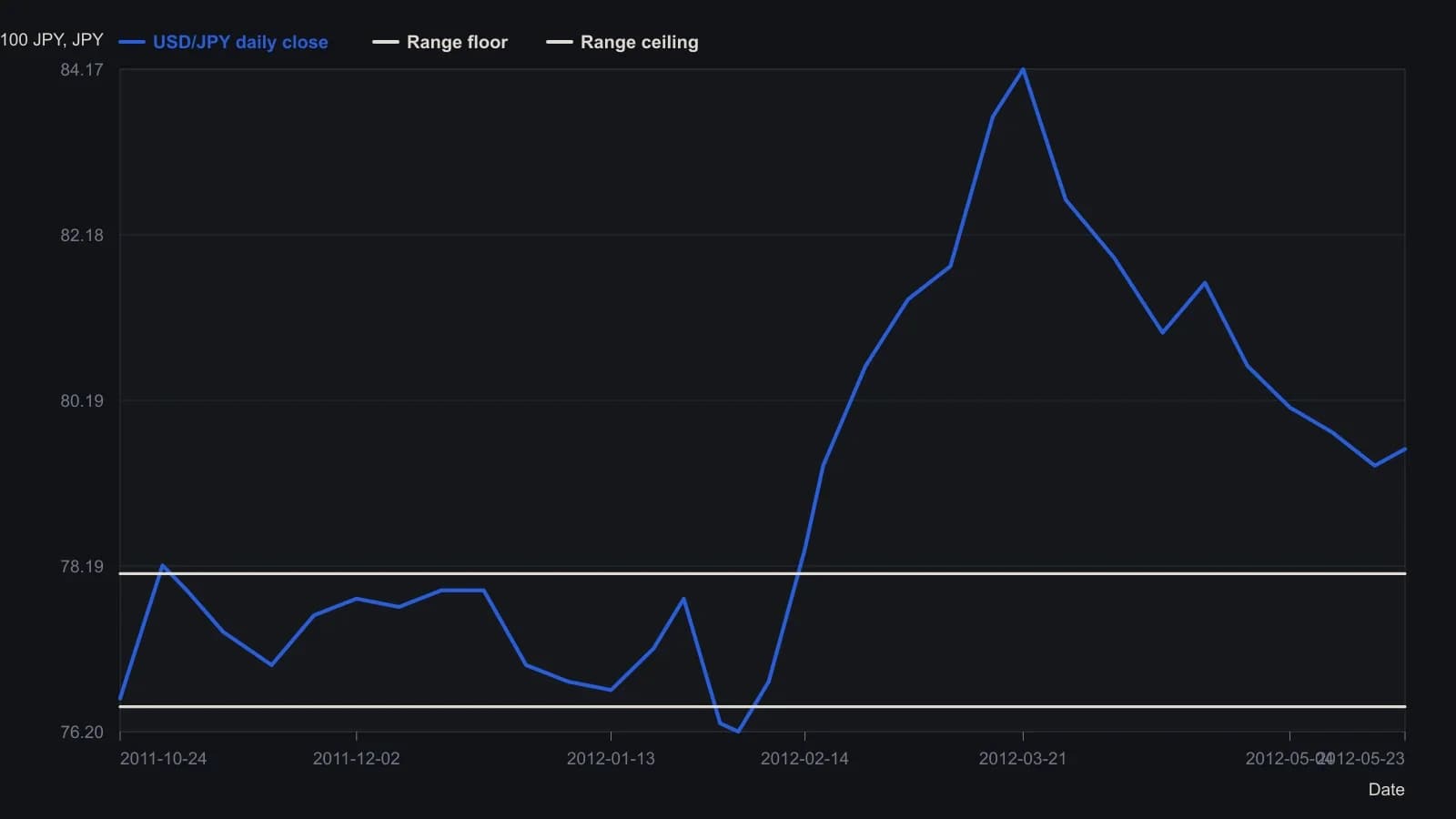
Raster has no printed OHLC table; turning points are the author's stated prices and dates, and the intervening path is an approximate daily close read from Figure 1. Do not treat interior points as tick-accurate.
The still-open floor
EUR/CHF had declined until a 1.2000 floor tied to a Swiss National Bank minimum rate. After that, the pair was described as held in a long sideways phase that was not expected to print lastingly below that level.
Editorial interpretation: the live pair is still inside its floor. The finished USD/JPY sequence is a completed script to copy in structure, not a claim that EUR/CHF must leave 1.2000 the same way.
Stops written before the next fill
A stop-loss is a pre-placed invalidation price that caps the cash loss if the setup fails, chosen from account equity and the distance between entry and the level that would falsify the idea. In the unfilled EUR/CHF plan that invalidation sat at 1.1800. Position-size is the fraction of account equity allocated so that a stop fill remains a bounded loss rather than an open-ended exposure. The plan used a 1 percent portfolio allocation.
Trailing and manually adjusted stops were presented as tools for converting part of an open gain into a hard exit while keeping the stop far enough from spot to reduce an early fill. A trailing-stop is advanced only after price has already moved in the position's favor, remaining far enough from spot to reduce a noise-driven fill.
A short GBP/USD walkthrough showed the same idea after entry. The stop moved from an entry at 1.5803 to 1.5753 after price had fallen to 1.5667, locking 50 pips of the open gain.
Waiting with a script
The archive close treated the finished USD/JPY range-to-trend sequence as a template for waiting on EUR/CHF until a later breakout. It stated that survival depends on risk control and that a winning streak can end as quickly as it began.
Editorial interpretation: the point of the analog is not to require the next floor to break. It is to keep the live pair off the book until the stop-loss, trailing-stop, and position-size are already written as a bounded risk script.
All readings on this track · 36 readings
- 1988Half-day bars, a midpoint gate, and a bar-based trail
- 1989Packaging two-bar reversals into testable entry and exit rules
- 1989Weekly high and low averages as stop-and-reverse levels
- 1991Constant false-alarm rate for dominant-cycle stops
- 1992Tick-index extremes as continuation and turn hypotheses
- 1993Constructing layered stops from equity and structure
- 1993Filter crossovers with moving-average slope
- 1993Precommit stop bounds from equity and structure
- 1998Evaluating a trendline barrier that can only tighten a capped stop
- 1999Constructing common-number support and resistance
- 2001Four-step opening-hour bias and trailing stops
- 2004Make the trading system the star
- 2005A beginner stock case: stop, trail, and the pre-trade checklist
- 2006Sell stops that trail support after the buy
- 2006Treat a wave-3 label as unfunded until the stop rails are written
- 2008Test medium-term divergence with a trendline break and a trailing stop
- 2010Rule-based forex entry, stop and trail
- 2012Precommitting stops when one currency range templates another
- 2012Cat-ears as a downtrend continuation hypothesis
- 2013Three-average swing entry and a trailing average exit
- 2014Construct a dual quotient-copy trend filter under a frequency roof
- 2014Stop distance, size, and trailing swing invalidation
- 2014Long-only RSI pullback, reversal-bar-entry, and staged-trail construction
- 2015Dual-average regime, trigger candle, and trail as one daily script
- 2015Three-gate trend system: filter, trigger, and trailing stop
- 2016Construct HHLLS crossover and breakout entry rules
- 2017An appointment-trade around a scheduled political close
- 2017Golden-cross breakout rules for a swing entry
- 2017Breakout confirmation above round numbers, with nines as sell shelves
- 2018Classify diamond geometry before the breakout
- 2019When trails and stops betray the support read
- 2019One-triggers-the-other pairs for preplanned swing entries
- 2019One-triggers-the-other orders for a breakout and its stop
- 2019When the second decision unbounds planned risk
- 2020Last-Hour Breakout With a Same-Session Flatten
- 2020Couple the slow period to stop-loss and trailing-stop settings