2015issue C0359-61
Dual-average regime, trigger candle, and trail as one daily script
A part-time daily-chart desk can lock bias with a two-speed average stack, then treat the next session as a binary go-or-skip. Entry, abstention, trigger-bar-stop, and breakeven-trail stay inside one closed script.
- Set the dual-average-regime first: the 30-period simple moving average above the 90-period average is bullish, and the reverse is bearish.
- A trigger-candle opens on one side of the 30-period average and closes on the other; the wick-cross-filter keeps crossing bars with shadows and discards shadowless bars of the same direction.
- Place the order on the following session, park a trigger-bar-stop at the signal candle’s opposite extreme, and do not widen that stop.
- Manage the open trade with an initial objective and a breakeven-trail, and treat a zone-retest as context only after at least three visits.
A part-time daily script
The write-up frames the script for part-time use on daily charts. It accepts fewer signals instead of continuous lower-timeframe scanning.
Editorial: TradersWeek reads that choice as a way for a daily desk to lock bias with a two-speed average stack first, then treat the next session as a binary go-or-skip so entry, abstention, stop, and trail can be tested as one closed script.
Set the dual-average-regime first
A dual-average-regime is a bullish or bearish market-state label taken from whether a shorter simple moving average sits above or below a longer one.
A bullish regime is defined as the 30-period simple moving average sitting above the 90-period average. A bearish regime is the reverse.
A long is considered only in a bullish regime. A short is considered only after the matching close in a bearish regime.
Read the trigger-candle through the wick-cross-filter
A trigger-candle is the daily bar whose open and close straddle the shorter average and authorize a next-session order.
A long is considered after a daily candle opens below the 30-period average and closes above it. A short waits for the opposite close in a bearish regime. In both cases the order is placed on the following session.
The wick-cross-filter is a selection rule that accepts a crossing bar with shadows and discards a shadowless crossing bar of the same direction.
Place the trigger-bar-stop and the breakeven-trail
A trigger-bar-stop is an initial loss bound parked at the signal candle’s opposite extreme and left unwidened. The initial stop is placed at the trigger candle’s low for a long and at its high for a short. The write-up instructs not to widen that stop after entry.
After entry, an initial objective is paired with breakeven and trailing-stop adjustments rather than a single static exit. A breakeven-trail is a post-entry adjustment that first removes residual risk and then follows price so an adverse turn forces the exit.
Use a zone-retest only as context
Supply and demand zones used as context are described as price areas that have been tested at least three times. A zone-retest is a prior reaction band treated as context only after price has visited it at least three times.
What the case charts walk through
Four 2011 daily foreign-exchange case charts walk through the same script, including one long that reversed into the initial stop.
Editorial: TradersWeek treats that reversed long as part of the closed script, not as a reason to widen the trigger-bar-stop.
EURUSD daily SMA(30) versus SMA(90), September 2011–March 2012
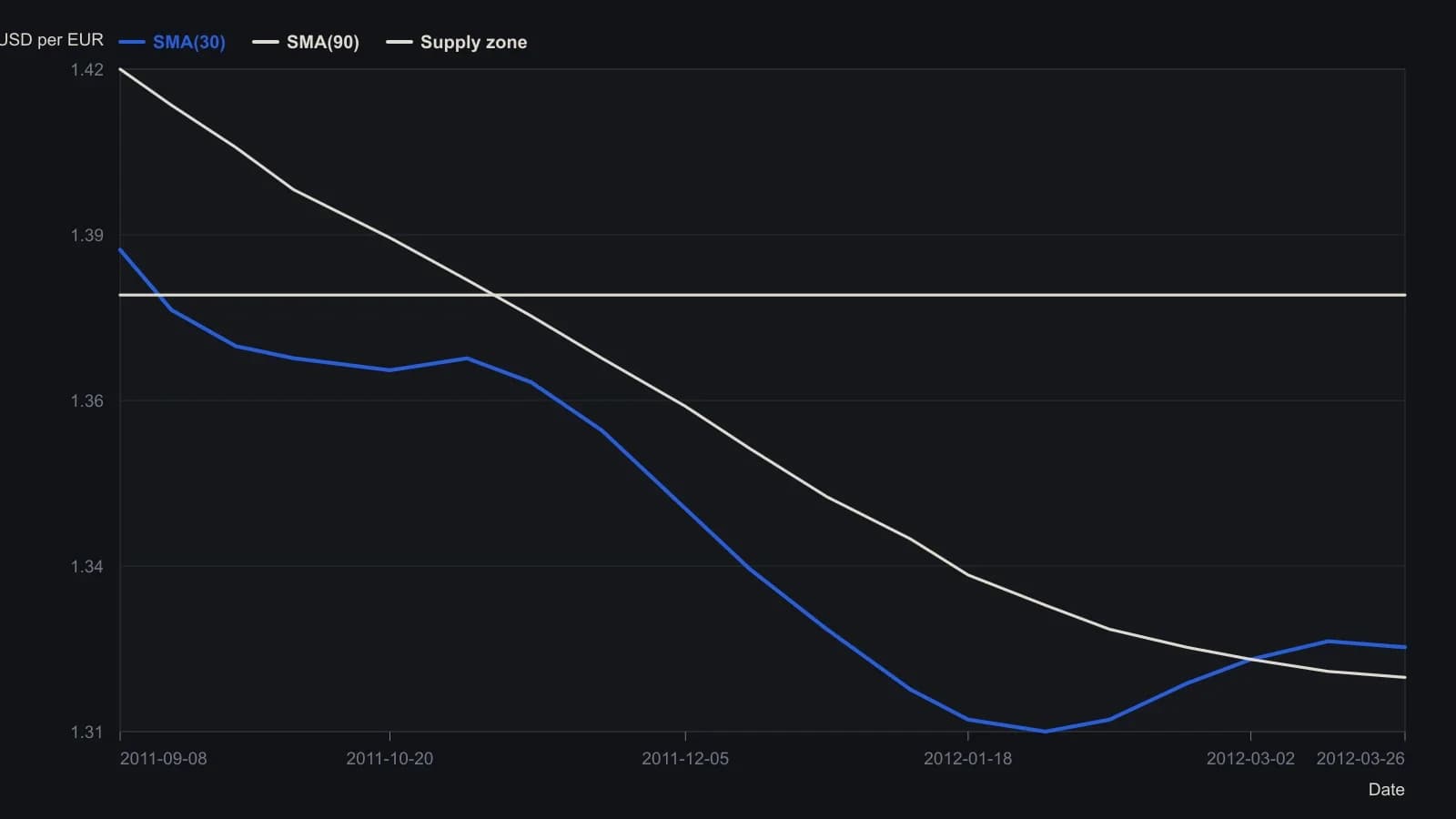
Digitized from the printed daily pane. Expect about 20–40 pip uncertainty on the averages. The source draws SMA(30) in blue and SMA(90) in green and ignores spreads.
All readings on this track · 36 readings
- 1988Half-day bars, a midpoint gate, and a bar-based trail
- 1989Packaging two-bar reversals into testable entry and exit rules
- 1989Weekly high and low averages as stop-and-reverse levels
- 1991Constant false-alarm rate for dominant-cycle stops
- 1992Tick-index extremes as continuation and turn hypotheses
- 1993Constructing layered stops from equity and structure
- 1993Filter crossovers with moving-average slope
- 1993Precommit stop bounds from equity and structure
- 1998Evaluating a trendline barrier that can only tighten a capped stop
- 1999Constructing common-number support and resistance
- 2001Four-step opening-hour bias and trailing stops
- 2004Make the trading system the star
- 2005A beginner stock case: stop, trail, and the pre-trade checklist
- 2006Sell stops that trail support after the buy
- 2006Treat a wave-3 label as unfunded until the stop rails are written
- 2008Test medium-term divergence with a trendline break and a trailing stop
- 2010Rule-based forex entry, stop and trail
- 2012Precommitting stops when one currency range templates another
- 2012Cat-ears as a downtrend continuation hypothesis
- 2013Three-average swing entry and a trailing average exit
- 2014Construct a dual quotient-copy trend filter under a frequency roof
- 2014Stop distance, size, and trailing swing invalidation
- 2014Long-only RSI pullback, reversal-bar-entry, and staged-trail construction
- 2015Dual-average regime, trigger candle, and trail as one daily script
- 2015Three-gate trend system: filter, trigger, and trailing stop
- 2016Construct HHLLS crossover and breakout entry rules
- 2017An appointment-trade around a scheduled political close
- 2017Golden-cross breakout rules for a swing entry
- 2017Breakout confirmation above round numbers, with nines as sell shelves
- 2018Classify diamond geometry before the breakout
- 2019When trails and stops betray the support read
- 2019One-triggers-the-other pairs for preplanned swing entries
- 2019One-triggers-the-other orders for a breakout and its stop
- 2019When the second decision unbounds planned risk
- 2020Last-Hour Breakout With a Same-Session Flatten
- 2020Couple the slow period to stop-loss and trailing-stop settings