2017issue C0350-56
Golden-cross breakout rules for a swing entry
A historical swing workflow treats a daily 50-over-200 golden-cross as an entry condition, not a forecast. The long is held only while the averages stay uncrossed and is closed by a trailing-stop after a chart-quality-filter has already required a wide, clean range.
- A golden-cross here is a 50-period simple moving average crossing above a 200-period simple moving average on a daily chart, and entry may come any time after that cross is observed.
- The long stays open as a trend-following hold while the averages remain uncrossed, then ends when a trailing-stop of two points or more is taken out, or when a longer hold uses the 50-period average as the trail.
- A chart-quality-filter prefers wide, clean ranges and stocks or ETFs priced about 20 to 70, and the crossover is meant to sit with swing-breakout clues rather than stand alone.
- A symbol may print at most one golden-cross in a year, and some years none, so the workflow needs a broad scan.
A daily golden-cross as a swing rule
The archive procedure defines a golden-cross as a 50-period simple moving average crossing above a 200-period simple moving average on a daily chart. That moving-average-crossover is treated as a bullish swing-entry condition rather than a standalone forecast. Entry is allowed any time after the crossover is observed, not only on the exact cross bar.
How the long is held and closed
Trend-following in this workflow keeps the long open while the two averages remain uncrossed in an uptrend. The position is closed when a trailing-stop of two points or more is taken out. An alternative trailing-stop uses the 50-period average, especially for longer swing or position holds.
Clues that sit with the cross
The crossover is presented as more useful when combined with other swing-breakout clues such as bullish cups, ascending triangles, or rising volume. It is not to be used in isolation.
What the chart-quality-filter keeps
Candidates are screened for wide ranges and clean, non-choppy trends. One example chart spans nearly 20 points from 43 to 61 on a 90-day window. The write-up prefers stocks and ETFs priced about 20 to 70 per share and rejects names under 10 because those charts are described as choppier and harder to trade.
Why the scan has to be broad
A later implementation note states that a given symbol may produce at most one golden-cross in a year, and some years none, so a broad scan is required.
How the pieces work as one procedure
Editorial: the moving-average-crossover names the entry condition, trend-following is the hold while the averages stay uncrossed, and the trailing-stop is the bound that ends the trade. None of those pieces is presented here as a standalone forecast.
NAS100 golden-cross longs with a two-point trailing stop
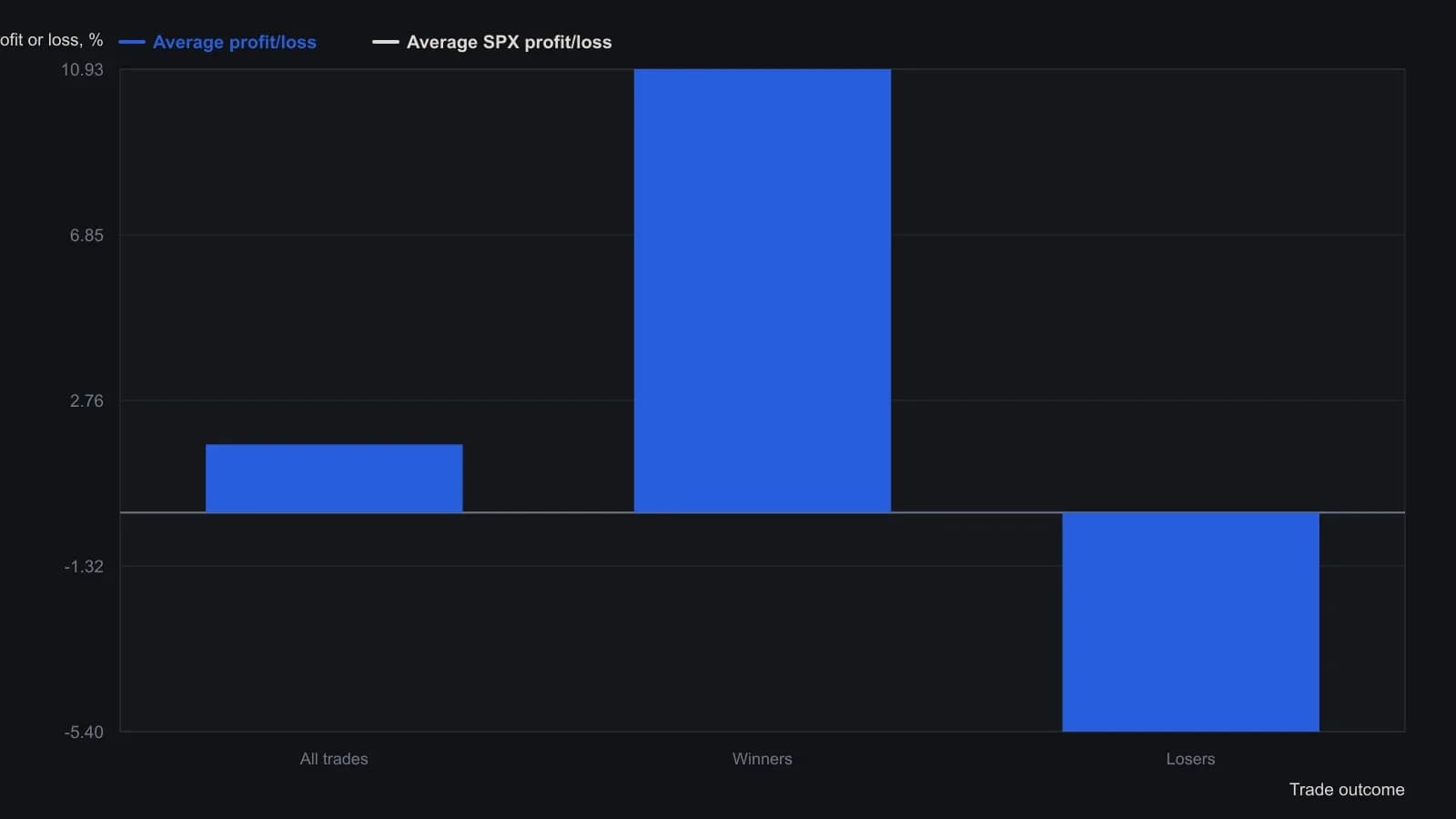
Daily bars, fills at the open, open trades included. The coded filter kept names whose 10-day average sat between 5 and 70 dollars, wider than the article’s 20-to-70 visual band. The 32-day typical hold is the two-point trail, not a 15 percent profit lock.
All readings on this track · 36 readings
- 1988Half-day bars, a midpoint gate, and a bar-based trail
- 1989Packaging two-bar reversals into testable entry and exit rules
- 1989Weekly high and low averages as stop-and-reverse levels
- 1991Constant false-alarm rate for dominant-cycle stops
- 1992Tick-index extremes as continuation and turn hypotheses
- 1993Constructing layered stops from equity and structure
- 1993Filter crossovers with moving-average slope
- 1993Precommit stop bounds from equity and structure
- 1998Evaluating a trendline barrier that can only tighten a capped stop
- 1999Constructing common-number support and resistance
- 2001Four-step opening-hour bias and trailing stops
- 2004Make the trading system the star
- 2005A beginner stock case: stop, trail, and the pre-trade checklist
- 2006Sell stops that trail support after the buy
- 2006Treat a wave-3 label as unfunded until the stop rails are written
- 2008Test medium-term divergence with a trendline break and a trailing stop
- 2010Rule-based forex entry, stop and trail
- 2012Precommitting stops when one currency range templates another
- 2012Cat-ears as a downtrend continuation hypothesis
- 2013Three-average swing entry and a trailing average exit
- 2014Construct a dual quotient-copy trend filter under a frequency roof
- 2014Stop distance, size, and trailing swing invalidation
- 2014Long-only RSI pullback, reversal-bar-entry, and staged-trail construction
- 2015Dual-average regime, trigger candle, and trail as one daily script
- 2015Three-gate trend system: filter, trigger, and trailing stop
- 2016Construct HHLLS crossover and breakout entry rules
- 2017An appointment-trade around a scheduled political close
- 2017Golden-cross breakout rules for a swing entry
- 2017Breakout confirmation above round numbers, with nines as sell shelves
- 2018Classify diamond geometry before the breakout
- 2019When trails and stops betray the support read
- 2019One-triggers-the-other pairs for preplanned swing entries
- 2019One-triggers-the-other orders for a breakout and its stop
- 2019When the second decision unbounds planned risk
- 2020Last-Hour Breakout With a Same-Session Flatten
- 2020Couple the slow period to stop-loss and trailing-stop settings