2017issue C0112-15
An appointment-trade around a scheduled political close
A United Kingdom referendum scheduled for 23 June 2016 at 5:00 pm EST was treated as an appointment-trade whose entry, management, and exit could be written before the polls closed. After first results pointed to leave, the case used entry-confluence to define a short rule-based-entry-region, selected the whole-number-level 1.5000, and kept a Fibonacci exit and a trailing-stop in the same written procedure.
- A known decision time makes the setup an appointment-trade, so entry, management, and exit can be written before the event prints.
- Entry-confluence is the filter: several independent chart methods must overlap in one rule-based-entry-region instead of a single tick.
- A fibonacci-turning-point can name a testable exit in advance, separate from how the position is kept alive.
- After entry, a trailing-stop decides whether the position is still allowed to exist when a fixed line or a tight volatility stop is not usable.
The appointment-trade
A United Kingdom referendum scheduled for 23 June 2016 at 5:00 pm EST was treated as an appointment-trade. The decision time was known in advance, so entry, management, and exit could be written before the polls closed.
The directional hypothesis was binary: sterling weaker on a leave outcome and stronger on a remain outcome. Yen and Swiss franc were named as destinations if leave passed.
After the polls closed
After the polls closed, first reported results pointed to leave and GBPUSD began rising from 1.4520. The case studied short-sale entries on that bounce rather than a sideways path.
Entry-confluence and the short band
Independent chart methods produced overlapping short candidates on the day: a channel return at 1.4740, an upper-band pierce at 1.4829, and a 127.2 Fibonacci extension at 1.4934. That overlap is the entry-confluence used as the filter for taking a signal.
A previously untested sell zone at 1.4960 to 1.5100 and the whole-number-level 1.5000 sat inside a combined rule-based-entry-region from 1.4776 to 1.5100. The band measured 324 pips on the daily chart.
Of the five named entry styles, channel, volatility bands, Fibonacci, unfilled sell orders, and whole numbers, the case selected 1.5000 because price left that level with a sharp imbalance.
Weekly GBPUSD descending channel into the Brexit week
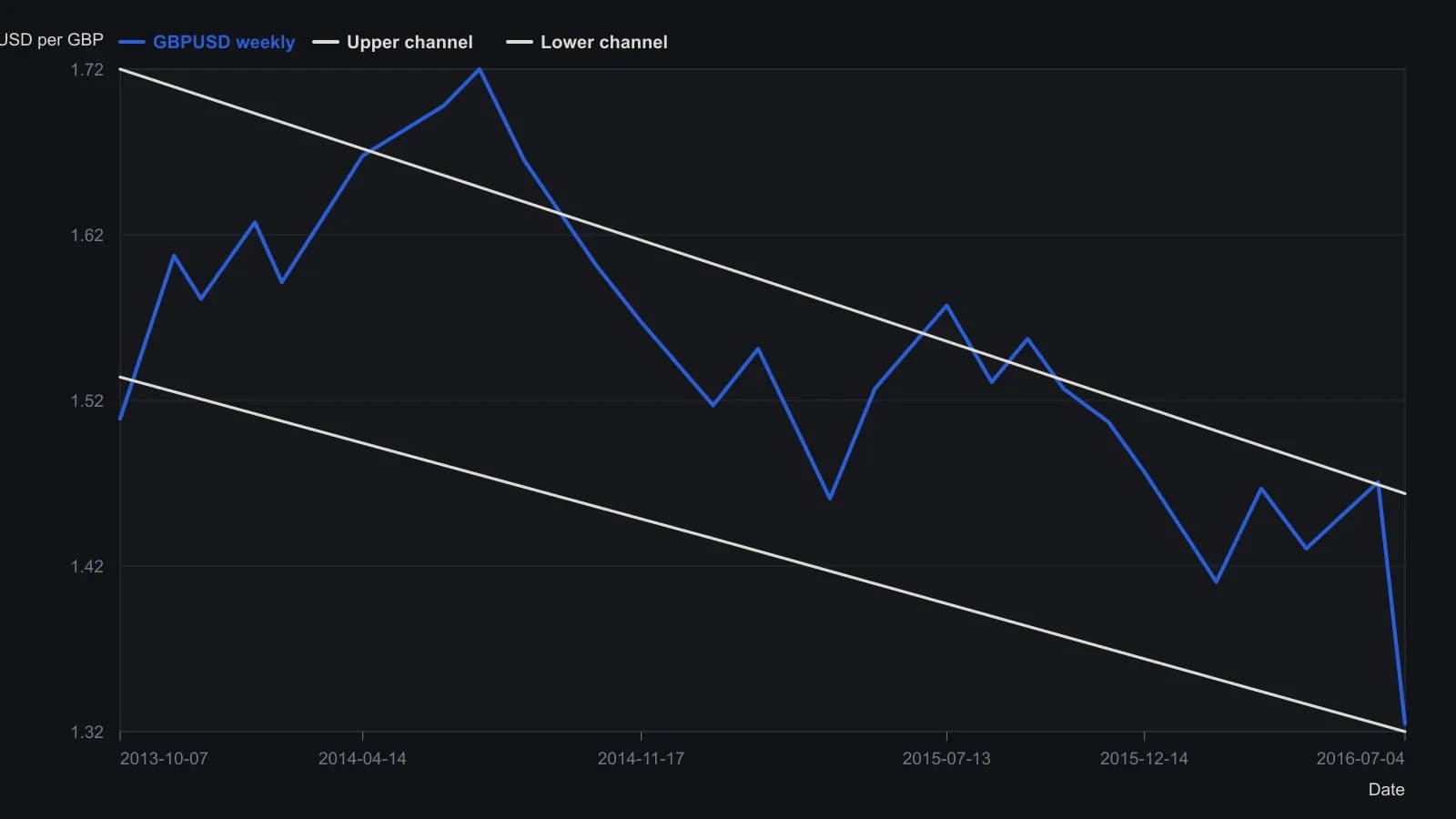
Turning points are visual reads from weekly bars, reliable to about 0.005. The close 1.32671 is the figure printed on the price axis, not an estimate. Channel lines follow the two boundaries drawn on the same panel.
Management and the trailing-stop
After entry, named management options were a downtrend line, an average-true-range stop, a moving average, and a stop advanced under successive lower highs.
In this path a steep downtrend line was judged unusable and an ATR stop was too tight after a 250-pip reaction on the first 30-minute bar. A nine-period simple moving average and a lower-high trailing-stop were described as ways to remain in the position.
Editorial interpretation: TradersWeek reads the trailing-stop as the post-entry test of whether remaining loss stays bounded and whether the short is still allowed to exist.
A Fibonacci exit written in advance
Fibonacci structure also supplied an exit hypothesis at 1.3351 on the 261.8 extension. That price is a fibonacci-turning-point taken from a stated ratio of a prior swing and used as a falsifiable exit. Other preset exits sat at the daily-channel floor, the whole-number-level 1.3000, and the 1985 low.
All readings on this track · 36 readings
- 1988Half-day bars, a midpoint gate, and a bar-based trail
- 1989Packaging two-bar reversals into testable entry and exit rules
- 1989Weekly high and low averages as stop-and-reverse levels
- 1991Constant false-alarm rate for dominant-cycle stops
- 1992Tick-index extremes as continuation and turn hypotheses
- 1993Constructing layered stops from equity and structure
- 1993Filter crossovers with moving-average slope
- 1993Precommit stop bounds from equity and structure
- 1998Evaluating a trendline barrier that can only tighten a capped stop
- 1999Constructing common-number support and resistance
- 2001Four-step opening-hour bias and trailing stops
- 2004Make the trading system the star
- 2005A beginner stock case: stop, trail, and the pre-trade checklist
- 2006Sell stops that trail support after the buy
- 2006Treat a wave-3 label as unfunded until the stop rails are written
- 2008Test medium-term divergence with a trendline break and a trailing stop
- 2010Rule-based forex entry, stop and trail
- 2012Precommitting stops when one currency range templates another
- 2012Cat-ears as a downtrend continuation hypothesis
- 2013Three-average swing entry and a trailing average exit
- 2014Construct a dual quotient-copy trend filter under a frequency roof
- 2014Stop distance, size, and trailing swing invalidation
- 2014Long-only RSI pullback, reversal-bar-entry, and staged-trail construction
- 2015Dual-average regime, trigger candle, and trail as one daily script
- 2015Three-gate trend system: filter, trigger, and trailing stop
- 2016Construct HHLLS crossover and breakout entry rules
- 2017An appointment-trade around a scheduled political close
- 2017Golden-cross breakout rules for a swing entry
- 2017Breakout confirmation above round numbers, with nines as sell shelves
- 2018Classify diamond geometry before the breakout
- 2019When trails and stops betray the support read
- 2019One-triggers-the-other pairs for preplanned swing entries
- 2019One-triggers-the-other orders for a breakout and its stop
- 2019When the second decision unbounds planned risk
- 2020Last-Hour Breakout With a Same-Session Flatten
- 2020Couple the slow period to stop-loss and trailing-stop settings