1988issue C081-10
Opening-range brackets, a two-bar trend filter, and bounded stops
The historical workflow treats the opening print as a measurable reference. It ranks open-to-high and open-to-low distances into frequency brackets, labels direction with a two-bar swing comparison, and places a stop only at a bracket the same sample supported.
- Sort historical distances from the open to the session high and from the open to the session low into ranked brackets so later stop and re-entry distances come from observed frequencies rather than a single average.
- A two-bar comparison of consecutive highs, lows, and closes labels the market bullish or bearish before any opening-range trade is taken.
- A pre-set exit below a bullish open or above a bearish open is chosen from a historical bracket so the loss is bounded before the position is opened.
- After an opening rally of nine cents, the same table can frame a later four-cent pullback as a re-entry rather than a failed breakout.
Ranking distances from the open
The historical workflow treats the first print of the session as a measurable reference. From that open it records how far price later travels to the session high and how far it travels to the session low.
Price-change categorization sorts those historical distances into ranked brackets so later stop and re-entry distances come from observed frequencies rather than a single average.
The opening-range construction records one hundred open-to-high and open-to-low distances, ranks each series from smallest to largest, and groups the values into ten brackets of ten observations to form a table of historical move frequencies.
Cycle language beside the table
A four-phase price-cycle framing treats accumulation as a narrow, sideways base, the upmove as expansion above that base, distribution as wide and volatile topping action, and the downmove as a decline toward the next accumulation zone.
Island reversals are presented as a V-shaped exception in which a session is isolated by gaps on both sides and is treated as a candidate for a major or intermediate trend change.
A 10 percent drop in open interest inside ten trading days or fewer, occurring at the low of a sell-off, is described as a condition that often precedes higher prices because participants are leaving the market.
Stops taken from the same brackets
A stop-loss in this workflow is a pre-set exit distance below a bullish open or above a bearish open, chosen from a historical bracket so the loss is bounded before the position is opened.
In the soybean opening-range example, a two-cent stop under a bullish open is treated as about a 50 percent chance of being stopped, a five-cent stop as about a 90 percent chance of surviving, and a seven-cent stop as full coverage of the historical sample.
In the corresponding bearish soybean example, a six-cent stop is treated as about a 90 percent historical survival rate and a nine-cent stop as full coverage of that sample.
A pullback read as re-entry
After an opening rally of nine cents, the same table is used as a certainty that the open was nearer the low, so a later four-cent pullback is framed as a re-entry rather than a failed breakout.
A two-bar label before the trade
The trend filter is a two-bar comparison of consecutive highs, lows, and closes that labels the market bullish or bearish before any opening-range trade is taken.
The two-bar trend filter labels week two bullish, and recommends a Monday open buy, when the rise from week-one low to week-two high exceeds the fall from week-one high to week-two low and week two closes above week one.
The same two-bar comparison can be applied to daily bars, but the source restricts daily use to a two- or three-day sell-off inside a bullish trend or a two- or three-day rally inside a bearish trend.
Soybean open-to-low stop coverage
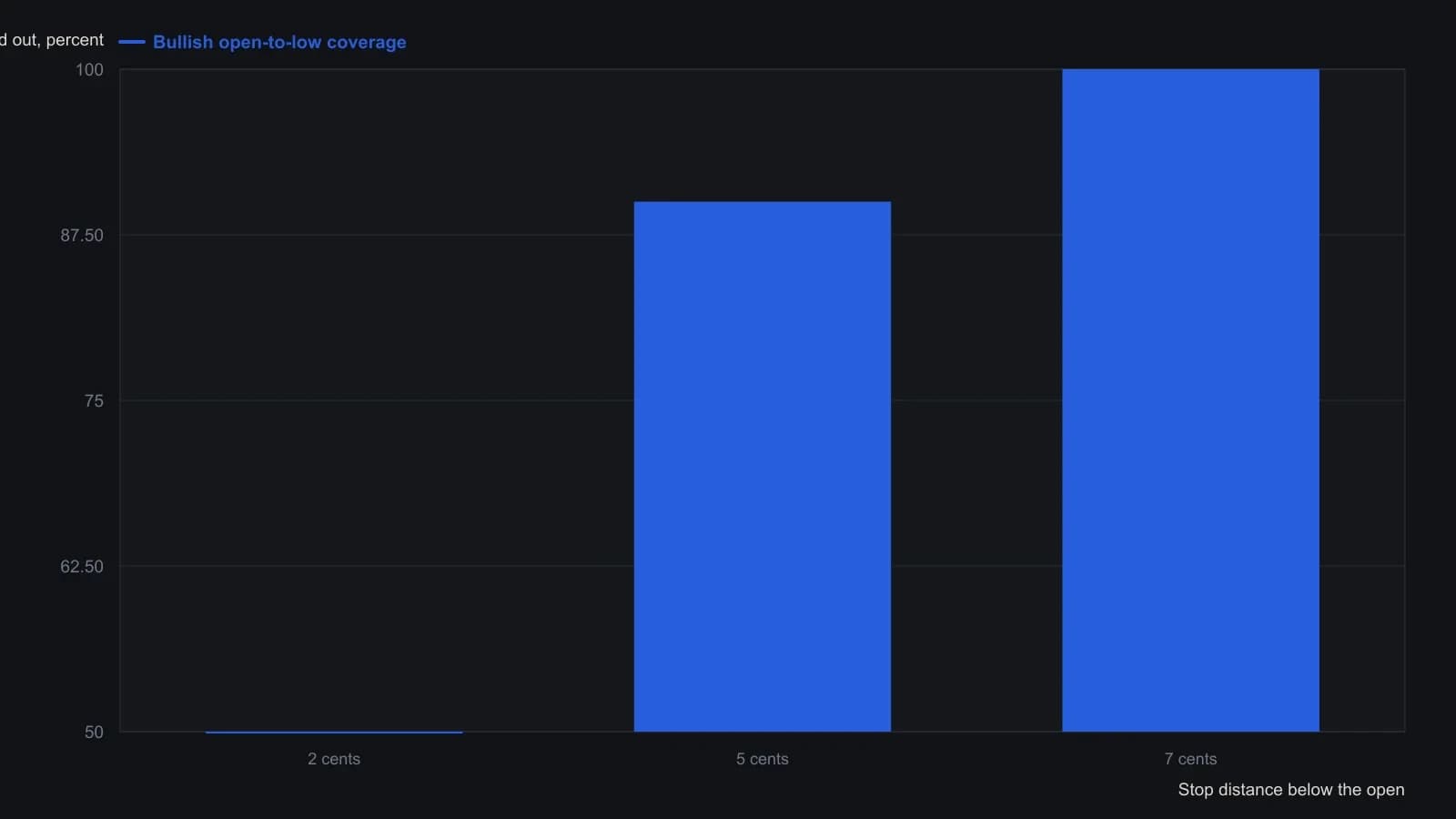
One hundred soybean sessions were ranked into ten brackets of ten. The article quotes only the 50th, 90th and 100th percentiles for a bullish day when the open sits nearer the low; the matching bearish open-to-high pair is given only at six and nine cents, so it is omitted.
All readings on this track · 33 readings
- 1988Opening-range brackets, a two-bar trend filter, and bounded stops
- 1990Bezier-curve price trend filter
- 1992Constructing a damping-index trend filter
- 1992Building a random walk index trend filter
- 1992Phase diagrams for moving-average trend filters
- 1993Volume-weighted change smoothing and trend ranking
- 1993Concurrent highest-low filter with a largest-low-fall trigger
- 1994Unit-invariant trend filters and the c-test
- 1995Constructing cup and cap entries with a three-bar net line
- 1997Why a daily timing evaluation depends on interval, lookbacks, and the fitting objective
- 2001A volume budget clock for trend-segment construction
- 2001Keep three jobs separate when you test a composite score
- 2002Evaluating the weekly four-percent close filter as a market-state procedure
- 2003Constructing a confirmed zigzag trend filter
- 2004Decompose high, low, and close into separate forecast streams
- 2005Three-state moving-average breakout bar coloring
- 2005Constructing a volume and move-adjusted trend filter
- 2005A fifty-day average breakout as a trend permission filter
- 2005Current-bar inclusion can mute a stochastic channel break
- 2006A stochastic oscillator gated by a long-term exponential average
- 2010A construction test for a modified volume-price trend filter
- 2011Constructing a Spearman rank trend filter
- 2013Constructing a repeated-median slope as a resistant trend filter
- 2014Combining a relative-strength index and trend filters for oversold setups
- 2014Price-rooted lookbacks for a relative strength index, a moving average, and a trend filter
- 2015Evaluating next-session intermarket range forecasts
- 2018Read the intermarket weight matrix first, then the predicted moving-average filter
- 2018Constructing the stiffness trend filter from moving-average holds
- 2018The averaging kernel and the lagged trend gate are separate specifications
- 2019A trend filter is not ready to compare until portfolio constraints are written down
- 2019Lookback, threshold, and position-capacity for a stiffness trend-filter
- 2020Combining a trend filter with a moving average and a stochastic oscillator
- 2020Constructing a relative-strength oscillator with a rank-agreement trend filter