1995issue C071-3
Constructing cup and cap entries with a three-bar net line
Trend direction is classified with a three-bar net line before any cup or cap is treated as a setup. A cup short is accepted only at the high of the current advance, and a cap long only at the low of the current decline, each written with a three-tick protective stop and a two-close exit.
- Classify trend with a three-bar net line before treating any cup or cap as a trading setup.
- Accept a cup short only at the high of the current advance, and a cap long only at the low of the current decline, while the net line still holds.
- Keep the rule-based entry inside a three-session window, choosing a three-tick stop from the pattern extreme or a close through the extreme close.
- Set the protective stop three ticks beyond the opposite extreme with the entry, and leave on the two-close exit.
Classify the trend with a three-bar net line
Trend direction is classified with a three-bar net line before any cup or cap is treated as a trading setup. The three-bar net line is a horizontal reference taken from the third qualifying swing extreme. A close through the far side of the line ends the classified trend, and a new extreme requires a fresh line.
In a rising market the net line is drawn from the third successively equal-or-lower low counted left from the high-day low. The uptrend holds until a close occurs below that line, and a new high forces a recalculation.
In a falling market the net line is drawn from the third successively equal-or-higher high counted left from the low-day high. The downtrend holds until a close occurs above that line, and a new low forces a recalculation.
Define a cup and a cap
A cup is a three-session sequence in which the middle session prints the lowest low or the lowest close. A cap is a three-session sequence in which the middle session prints the highest high or the highest close. In both shapes the first and third sessions may match or differ.
Accept the shape only at the current extreme
A cup is eligible as a short setup only when the net line still classifies an uptrend, the cup sits at the high of the current advance, and the entry arrives within three sessions of completion.
A cap is eligible as a long setup only when the net line still classifies a downtrend, the cap low is the low of the current decline, and the entry arrives within three sessions of completion. A high-based cap that marks the low of the current decline can still produce a buy on the third session after the three-session shape completes.
The trend filter is the gate on those choices. It licenses a cup short only while the net line still classifies an uptrend, and a cap long only while the net line still classifies a downtrend.
Write the entry, the protective stop, and the two-close exit
The rule-based entry is a timed choice, valid only inside a three-session window, between a stop offset by three ticks from the pattern extreme and a close through the extreme close of the pattern.
For a cup short, entry may be a sell-stop three ticks under the cup low or a short on a close under the lowest close of the cup. The protective stop sits three ticks above the cup high and is set with the entry. The two-close exit waits for the second close under the cup low rather than exiting on the first breach.
For a cap long, entry may be a buy-stop three ticks above the cap high or a long on a close above the highest close of the cap. The protective stop sits three ticks below the cap low and is set with the entry. The two-close exit waits for the second close above the cap high rather than exiting on the first breach.
September T-bonds: cap at the decline low, then a buy
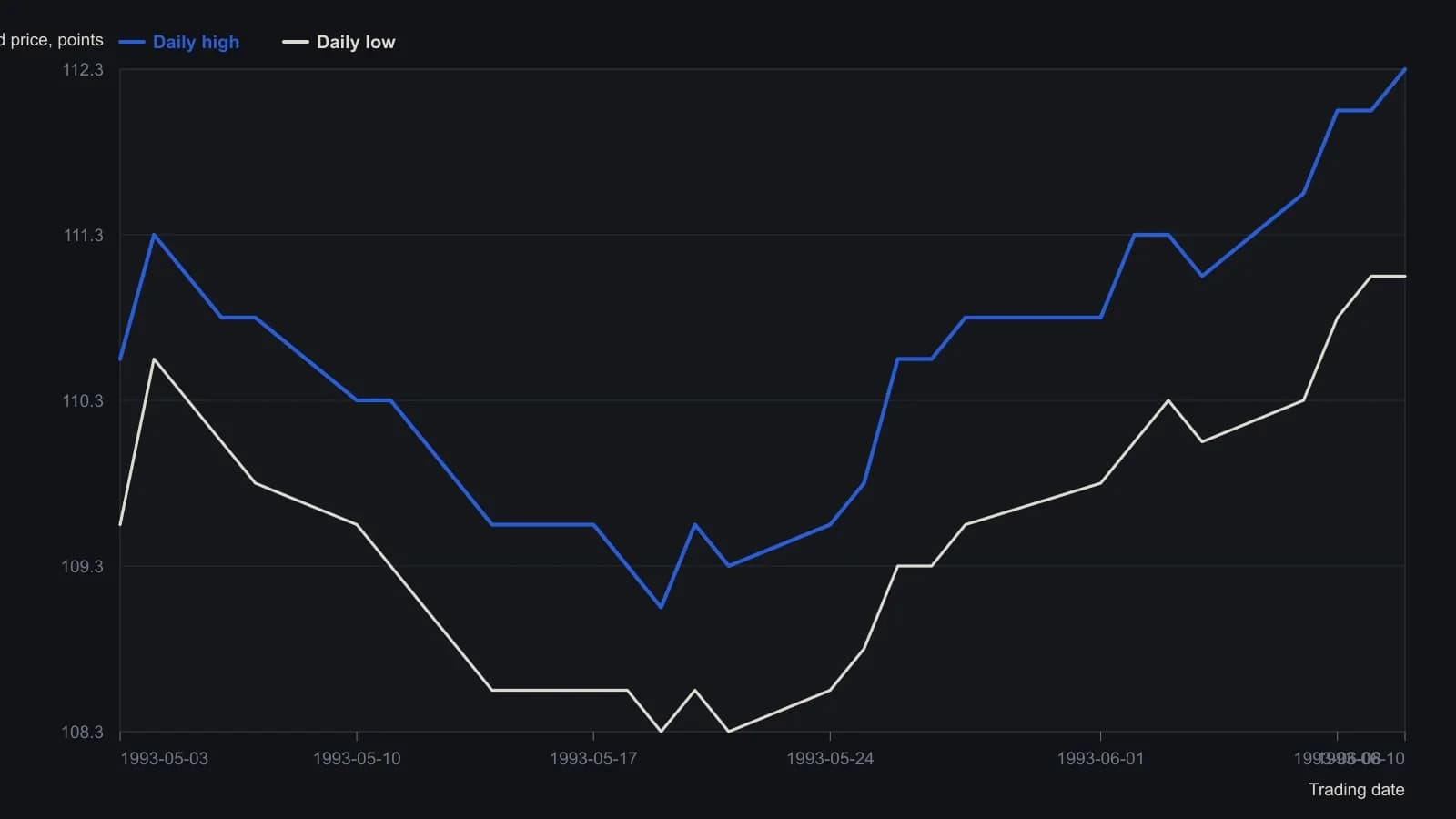
Digitized from a small magazine scan. Open and close ticks are not readable, so the series are the high and low of each daily bar, rounded to a quarter-point. Printed date labels step every five sessions (930503–930608); 31 May 1993 (Memorial Day) is omitted to match that spacing.
All readings on this track · 33 readings
- 1988Opening-range brackets, a two-bar trend filter, and bounded stops
- 1990Bezier-curve price trend filter
- 1992Constructing a damping-index trend filter
- 1992Building a random walk index trend filter
- 1992Phase diagrams for moving-average trend filters
- 1993Volume-weighted change smoothing and trend ranking
- 1993Concurrent highest-low filter with a largest-low-fall trigger
- 1994Unit-invariant trend filters and the c-test
- 1995Constructing cup and cap entries with a three-bar net line
- 1997Why a daily timing evaluation depends on interval, lookbacks, and the fitting objective
- 2001A volume budget clock for trend-segment construction
- 2001Keep three jobs separate when you test a composite score
- 2002Evaluating the weekly four-percent close filter as a market-state procedure
- 2003Constructing a confirmed zigzag trend filter
- 2004Decompose high, low, and close into separate forecast streams
- 2005Three-state moving-average breakout bar coloring
- 2005Constructing a volume and move-adjusted trend filter
- 2005A fifty-day average breakout as a trend permission filter
- 2005Current-bar inclusion can mute a stochastic channel break
- 2006A stochastic oscillator gated by a long-term exponential average
- 2010A construction test for a modified volume-price trend filter
- 2011Constructing a Spearman rank trend filter
- 2013Constructing a repeated-median slope as a resistant trend filter
- 2014Combining a relative-strength index and trend filters for oversold setups
- 2014Price-rooted lookbacks for a relative strength index, a moving average, and a trend filter
- 2015Evaluating next-session intermarket range forecasts
- 2018Read the intermarket weight matrix first, then the predicted moving-average filter
- 2018Constructing the stiffness trend filter from moving-average holds
- 2018The averaging kernel and the lagged trend gate are separate specifications
- 2019A trend filter is not ready to compare until portfolio constraints are written down
- 2019Lookback, threshold, and position-capacity for a stiffness trend-filter
- 2020Combining a trend filter with a moving average and a stochastic oscillator
- 2020Constructing a relative-strength oscillator with a rank-agreement trend filter