1989issue C081-3
Evaluating weekday close direction with a counted baseline
Monday’s close always receives a continuation-label. Later weekday closes are split into a continuation-label or a reversal-label of the Friday-to-Monday move, then scored against the counted baseline at each sequence-fork.
- Monday’s close always receives a continuation-label, whether that close is higher or lower than Friday’s close.
- Each later weekday close receives a continuation-label if it matches the Friday-to-Monday direction and a reversal-label if it does not.
- Weekday close strings are arranged on a branching grid so each new close is read as a sequence-fork from the preceding sequence.
- Replication tallies closes under each sequence label as a share of the observations that remain after the previous sequence-fork.
Direction labels for each weekday close
Ordered daily closes are first categorized by direction and then treated as weekday strings so a later close can be compared with the counted baseline at that sequence-fork.
Monday’s close is always coded as a continuation-label, whether that close is higher or lower than Friday’s close. Price-change-categorization maps each later daily close to a same-direction or opposite-direction label relative to the Friday-to-Monday move.
Each later weekday close receives a continuation-label if it matches the Friday-to-Monday direction. It receives a reversal-label if it moves opposite the Friday-to-Monday direction.
A branching grid of weekday strings
Weekday close strings are arranged on a branching grid so each new close is read as a sequence-fork from the preceding sequence. Pattern-recognition enumerates those weekday close strings and compares a later close with the count accumulated at that sequence-fork.
One illustrated grid summarized weekly cattle close sequences. At each sequence-fork, remaining observations are split by the next close.
A counted baseline after each sequence-fork
A runs-test partitions ordered closes into continuation stretches and reversal breaks so a later session can be scored against the sequence already observed.
Replication is a tally of closes under each sequence label, expressed as a share of the observations that remain after the previous sequence-fork.
The same encoding in another market
A related study asked whether the session after any five-day close sequence finished lower and allowed sequences to begin with a down close.
The same close-direction encoding can be rebuilt for another market by counting sequence members rather than by fitting a priced rule set.
Friday close rates after each Thursday cattle sequence
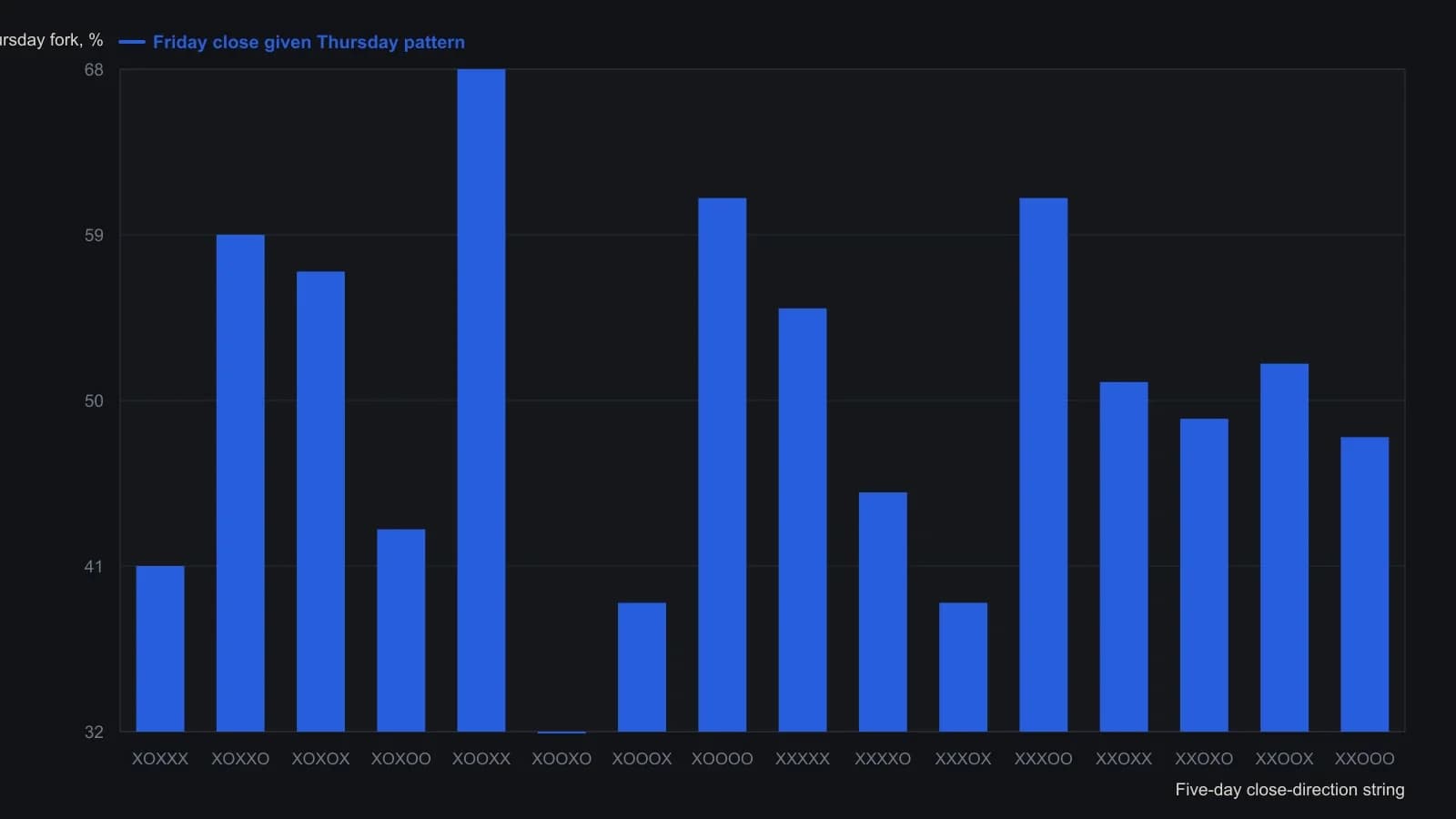
Monday is always coded X. Each percentage is the proportion of cases from the previous fork, so the two Friday outcomes that share a Thursday pattern sum to 100.
All readings on this track · 15 readings
- 1986Constructing runs and persistence tests from labeled prices
- 1986Evaluating daily price and volume serial independence windows
- 1986Evaluating advance-decline plus-day runs against chance baselines
- 1986Weekly resamples as a diagnostic filter for statistical windows
- 1988Runs test as a critique of price-series memory
- 1989Evaluating weekday close direction with a counted baseline
- 1989Statistical windows for indicator time parameters
- 1992Channel-height ratios for equity trend evaluation
- 2001A runs test before volatility and expected-value sizing
- 2005Constructing runs-test z-scores for signed return persistence
- 2005Evaluating persistence with runs and autocorrelation
- 2005Weekday FX turning points and close run tests
- 2013Constructing a runs-test turn forecast
- 2017Star rating from slope and swing runs
- 2018Regime-dependent odds after directional price runs