2020issue C0134-41
Combining a trend filter with a moving average and a stochastic oscillator
A long-term moving average can serve as a trend filter so mean-reversion trades stay aligned with the larger price direction. A stochastic oscillator then times entries and exits inside that filtered trend by marking short-term overbought and oversold stretches.
- A long-term moving average can serve as a trend filter that keeps mean-reversion trades aligned with the larger price direction rather than fighting it.
- Moving-average slope or position relative to price can define whether the market is in a bullish or bearish regime before any oscillator signal is taken.
- A stochastic oscillator can time entries and exits inside a filtered trend by marking short-term overbought and oversold stretches.
- Combining a slow trend filter with a faster oscillator accepts lag at major turns in exchange for fewer countertrend trades during persistent moves.
How the three tools work together
A long-term moving average can serve as a trend filter that keeps mean-reversion trades aligned with the larger price direction rather than fighting it.
Moving-average slope or position relative to price can define whether the market is in a bullish or bearish regime before any oscillator signal is taken.
A stochastic oscillator can be used to time entries and exits inside a filtered trend by marking short-term overbought and oversold stretches.
Dividend-adjusted SPY and trailing filter, 1995–2019
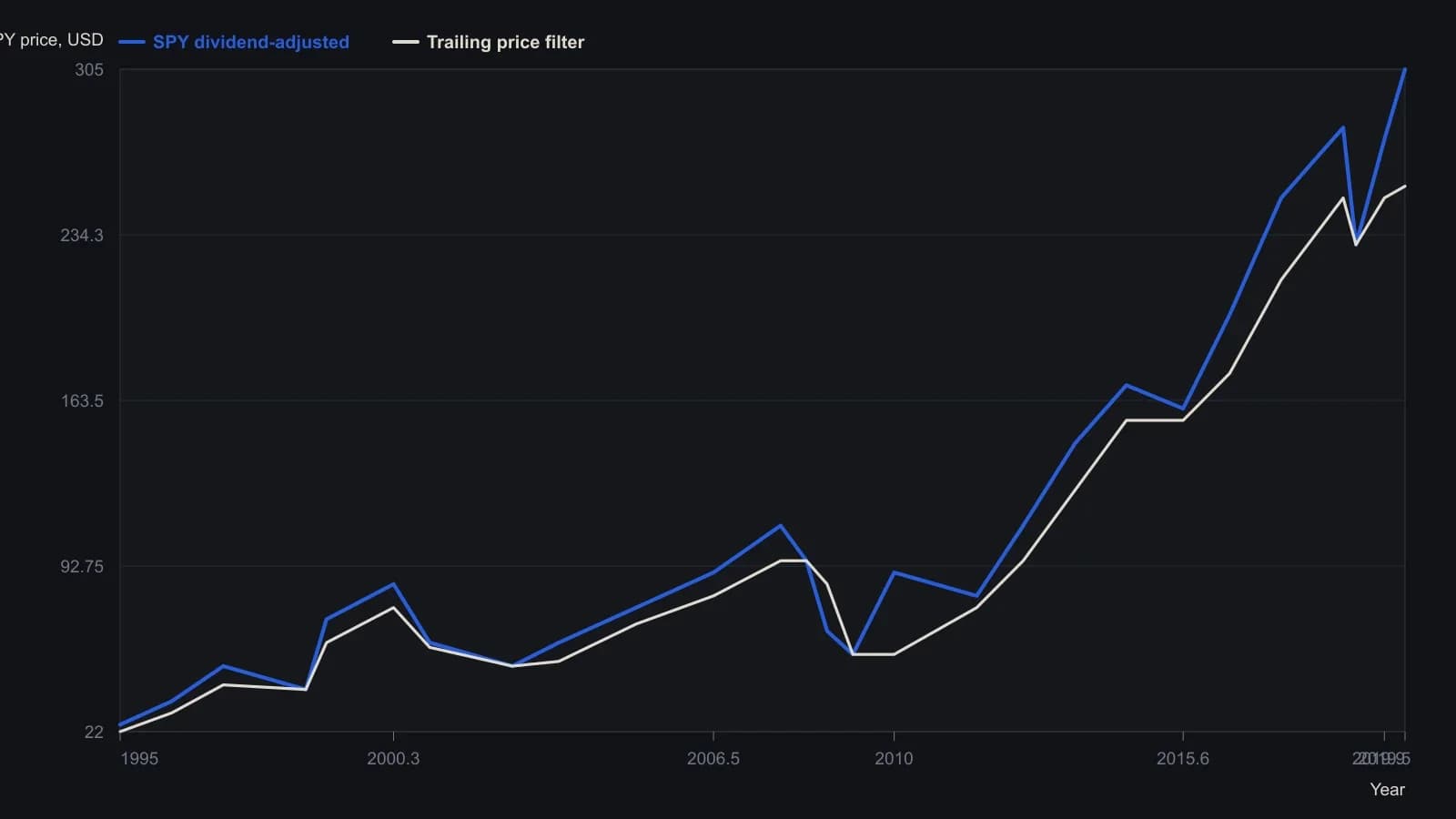
Upper-pane PPO traces sit on a separate vertical scale whose tick labels are not readable on this raster, so those oscillators are omitted. Readings are approximate to the nearest five dollars.
Lag, persistence, and market-specific settings
Combining a slow trend filter with a faster oscillator accepts lag at major turns in exchange for fewer countertrend trades during persistent moves.
Parameter settings for the filter, average, and oscillator are market-specific and should be checked with walk-forward testing rather than treated as universal defaults.
All readings on this track · 33 readings
- 1988Opening-range brackets, a two-bar trend filter, and bounded stops
- 1990Bezier-curve price trend filter
- 1992Constructing a damping-index trend filter
- 1992Building a random walk index trend filter
- 1992Phase diagrams for moving-average trend filters
- 1993Volume-weighted change smoothing and trend ranking
- 1993Concurrent highest-low filter with a largest-low-fall trigger
- 1994Unit-invariant trend filters and the c-test
- 1995Constructing cup and cap entries with a three-bar net line
- 1997Why a daily timing evaluation depends on interval, lookbacks, and the fitting objective
- 2001A volume budget clock for trend-segment construction
- 2001Keep three jobs separate when you test a composite score
- 2002Evaluating the weekly four-percent close filter as a market-state procedure
- 2003Constructing a confirmed zigzag trend filter
- 2004Decompose high, low, and close into separate forecast streams
- 2005Three-state moving-average breakout bar coloring
- 2005Constructing a volume and move-adjusted trend filter
- 2005A fifty-day average breakout as a trend permission filter
- 2005Current-bar inclusion can mute a stochastic channel break
- 2006A stochastic oscillator gated by a long-term exponential average
- 2010A construction test for a modified volume-price trend filter
- 2011Constructing a Spearman rank trend filter
- 2013Constructing a repeated-median slope as a resistant trend filter
- 2014Combining a relative-strength index and trend filters for oversold setups
- 2014Price-rooted lookbacks for a relative strength index, a moving average, and a trend filter
- 2015Evaluating next-session intermarket range forecasts
- 2018Read the intermarket weight matrix first, then the predicted moving-average filter
- 2018Constructing the stiffness trend filter from moving-average holds
- 2018The averaging kernel and the lagged trend gate are separate specifications
- 2019A trend filter is not ready to compare until portfolio constraints are written down
- 2019Lookback, threshold, and position-capacity for a stiffness trend-filter
- 2020Combining a trend filter with a moving average and a stochastic oscillator
- 2020Constructing a relative-strength oscillator with a rank-agreement trend filter