2016issue C0359-60
From nonconfirmation to a bearish primary trend change
In this 2015 case, a nonconfirmation between the industrial and transportation averages was later completed when both closed through dated secondary lows. Orthodox practice then treated the bearish primary trend as in force until an opposing change reversed it.
- Orthodox Dow Theory does not define buy or sell signals. Historical practice placed positions at anticipated-turn spots and treated a later primary trend change as confirmation of those positions.
- A bearish primary trend change requires both the industrial and transportation averages to close below the closes of their previous secondary low points.
- Naming those secondary highs and lows is required, and the theory itself supplies no quantification rule for the points.
- Once a primary trend change is recognized, it is assumed to remain in force until an opposing change authoritatively reverses it.
How the two averages confirm a primary change
Dow Theory is a two-average price-structure method. It reads the primary trend from joint confirmation or disagreement between the Dow Jones Industrial Average and the Dow Jones Transportation Average, using secondary highs and lows as the reference points.
Orthodox Dow Theory does not define buy or sell signals. Historical practice placed positions at buy-spot-sell-spot locations, the anticipated-turn spots, and treated a later primary trend change as confirmation of those positions.
A bearish-primary-trend-change requires both averages to close below the closes of their previous secondary lows. Those secondary-high-low extremes are the reference closes for the later primary-trend test. The joint-close rule requires that both averages, not one alone, close beyond those points before the change is recognized.
The 2015 nonconfirmation sequence
A nonconfirmation between the two averages began forming in February 2015. Nonconfirmation is a stretch in which the two averages fail to agree, including one average not bettering a prior secondary high while the other does, or one violating a secondary low while the other does not.
The previous secondary low points used for the 2015 bearish test were identified at the July 8, 2015 closing lows. Naming those secondary highs and lows is an inherent practical difficulty because the theory itself supplies no quantification rule for those points.
The August 21, 2015 close completed an orthodox bearish primary trend change under the joint-close rule. The case chart marks a primary nonconfirmation, a secondary nonconfirmation with failure to better the prior secondary high, and joint violation of the prior secondary lows on both averages.
Dow industrials and transports through the 2015 breakdown
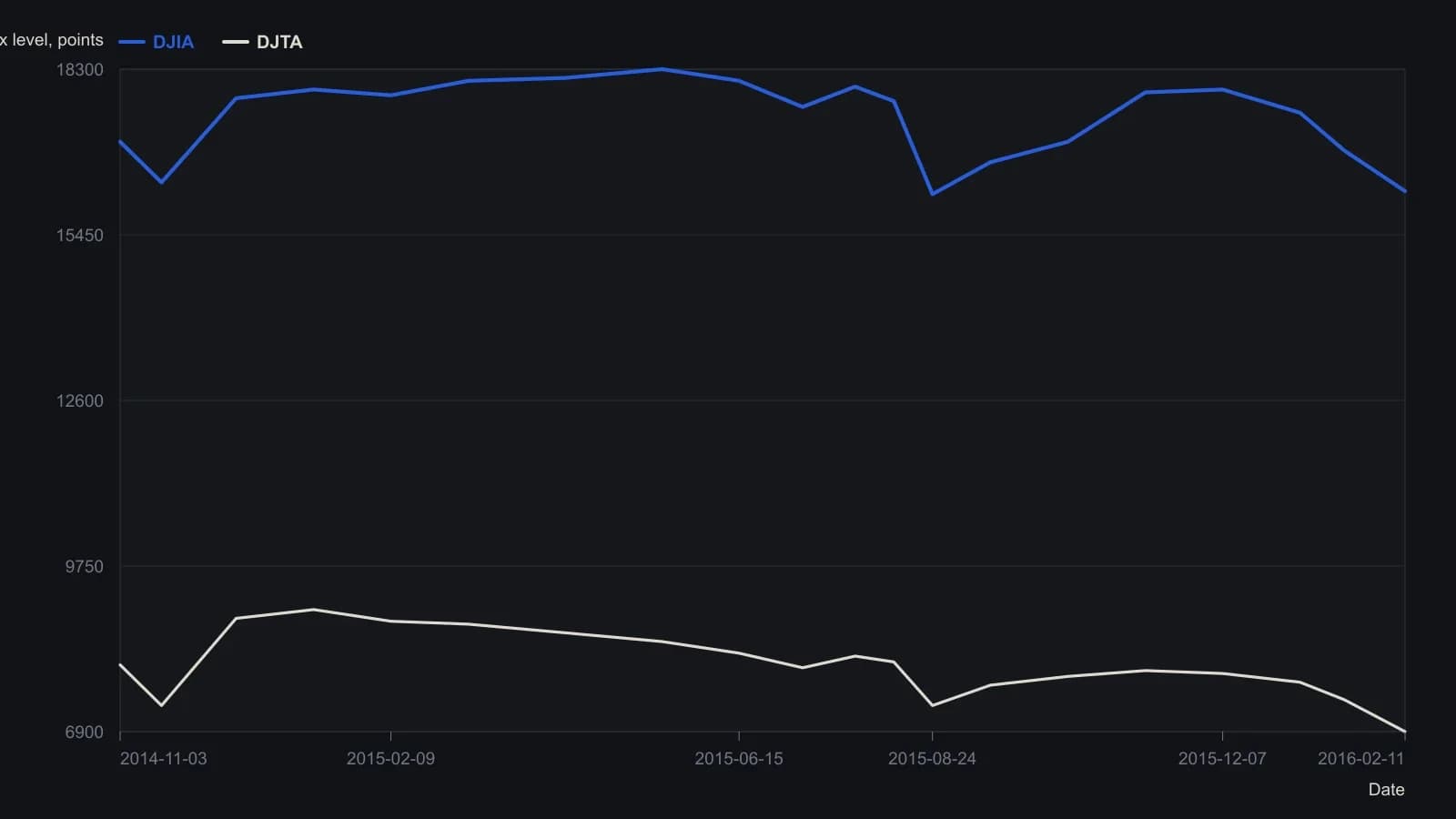
Secondary-low dating follows the article (8 July 2015 closes; 21 August 2015 as the completing close). The path is a hand reading of the magazine raster, so levels are only approximate to the nearest fifty points. Industrials use the figure’s 15,500–18,500 scale; transports use 6,500–9,500.
What remains in force after the change
Once a primary trend change is recognized, that primary trend is assumed to remain in force until an opposing trend change authoritatively reverses it. That opposing change is the authoritative-reversal required before the currently recognized primary trend is considered no longer in force.
After the bearish primary change, the case describes a deceptive interval of sharp rallies and sharp declines in which each new low can be read as a return to health.
All readings on this track · 29 readings
- 1982A bounded-risk entry separates a forecast from a trend
- 1984Critiquing reward bias, single-scale charts, and exact-turn forecasts
- 1990Constructing dual-average primary-trend confirmation
- 1991Two-average confirmation before a primary reversal call
- 1991Delayed confirmation is not Dow Theory divergence
- 1991Confirmation delay and breadth divergence in a two-average case
- 1992Utilities as a rate-regime lead for equities
- 1992Critiquing unconfirmed Dow rallies with volume
- 1993When Dow Theory signals fail after the decision-makers change
- 1994Market life expectancy as a risk filter
- 1994Score industrial and transport sync before calling an intermediate-trend signal
- 1997A 1995 industrial-average breakout mapped from component trends
- 1998Confirm Dow trends with Market breadth and Head and shoulders
- 1999Confirming an equity idea with rate, commodity, and index spreads
- 2001Why trend, range, and Dow rules need separate tests
- 2001Bear-market confirmation via prior correction troughs
- 2002Constructing a Dow line before breakout confirmation
- 2002Two-average confirmation as a swing-by-swing classroom drill
- 2002Withhold the hypothesis until the second average confirms: a 2001 case
- 2002A primary-bear case study in cycle speed, Dow theory, and pattern legs
- 2003Four index proxies as a bear-regime dashboard
- 2004Dual-average confirmation at shared prior highs
- 2004Confirmation as the second clock on a trend break
- 2004The confirmation-reaction planning window after a joint break
- 2005Dow confirmation as a two-average trend test
- 2008Related-average confirmation lag after a correction
- 2008Intermediate confirmation outranks secular phasing
- 2012Align swings to nested energy regimes
- 2016From nonconfirmation to a bearish primary trend change