1991issue C071-9
Delayed confirmation is not Dow Theory divergence
After a secondary reaction, confirmation is a two-average question you can falsify on the chart: are both independent measures still moving the same way? A lead-and-lag split is delayed confirmation or nonconfirmation, not automatic bearish divergence.
- A Dow Theory inference is treated as reliable only when two independent averages move together. A reading from one unconfirmed average is regarded as likely to mislead.
- Confirmation is directional sync. After a secondary reaction, a lead-and-lag split is delayed confirmation or nonconfirmation if both averages are still advancing, not bearish divergence.
- Reserve divergence for a failed follow-through after an extended primary advance. The working inference is possible turbulence or a correction, not a completed bear market.
- Key highs and lows come from the current primary-swing and secondary-reaction sequence. Distant peaks lose force, and a primary bull label can rest on nearby swing highs even if an older record is still above one average.
Two independent averages must agree
A Dow Theory inference is treated as reliable only when two independent price averages move together. A conclusion drawn from one unconfirmed average is regarded as likely to mislead.
Pairing an industrials average with a transportation average is often criticized as an obsolete production-versus-shipment model. The opposing view is that the two series were built to measure separate market sectors and function as a breadth check that other independent indices can replace.
Editorial note: the practical point of pairing two averages is two-index breadth. Independent market sectors are juxtaposed so a one-average reading can be confirmed or rejected.
Confirmation is directional sync
Confirmation is usefully read as whether the two averages are moving in the same direction, not only as a same-day break of a prior high or low.
Simultaneous new highs are the exception. After a secondary reaction, one average often leads while the other lags. That lag is delayed confirmation rather than bearish divergence.
Delayed confirmation means one average leads to new ground while the other is still advancing but has not yet cleared its nearby swing high. This is a timing lag, not a reversal label.
A split can be nonconfirmation
In December 1988 the transportation average exceeded its October high while the industrials average remained about 60 points below its October high. With both averages still advancing after a completed secondary reaction, that pattern is labeled nonconfirmation, not divergence.
Nonconfirmation is a temporary split in which one average has printed a new swing extreme and the other has not. It is not automatically a bearish divergence.
DJTA holds new highs after the 1988 secondary reaction
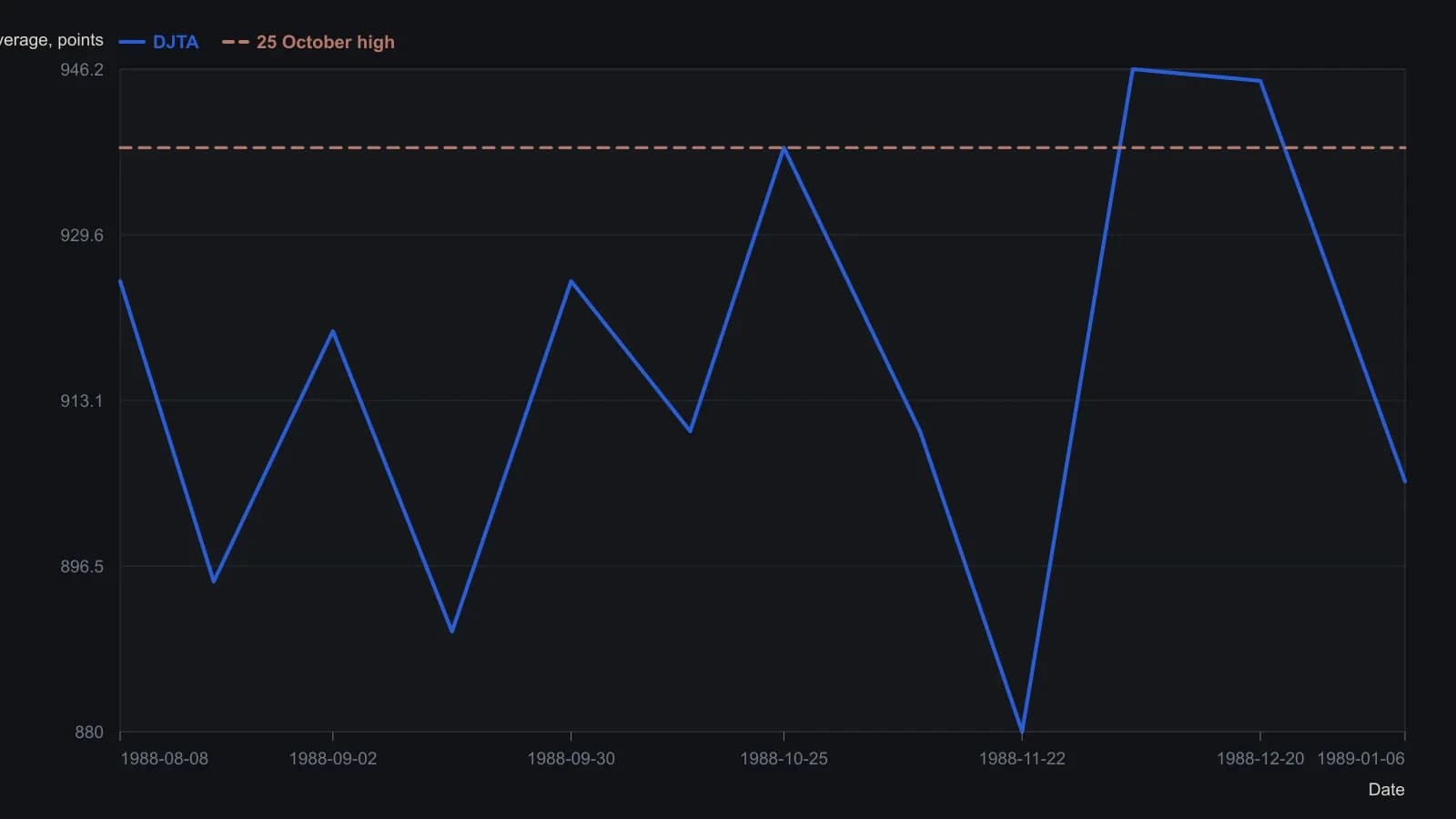
Window is the magazine daily-bar chart labeled 8-88/1-89. Other than the two printed prints, swing points are read off the bars and rounded to 5 points.
Divergence after an extended advance
Divergence applies when, after an extended advance, one average continues into new highs and the other fails to follow soon. The reading is that some turbulence or correction is more likely, not that a bear market has begun or that the next decline's size is known.
Not every correction is preceded by a divergence, but after an extensive advance such two-average splits often come before a decline of some degree.
Use the current swing sequence
Key highs and lows should be classified from the current primary-swing, secondary-reaction, and next-swing sequence. Distant historical peaks lose force when too much time or too many points have elapsed.
In the advance that followed the 1987 crash lows, both averages eventually cleared the prior-cycle highs only after about 24 months, showing why remote peaks delay primary-trend classification.
A primary bull classification can be made once both averages clear nearby swing highs even if one average is still below a much older record. Direction and which highs are key matter more than any single distant ceiling.
All readings on this track · 29 readings
- 1982A bounded-risk entry separates a forecast from a trend
- 1984Critiquing reward bias, single-scale charts, and exact-turn forecasts
- 1990Constructing dual-average primary-trend confirmation
- 1991Two-average confirmation before a primary reversal call
- 1991Delayed confirmation is not Dow Theory divergence
- 1991Confirmation delay and breadth divergence in a two-average case
- 1992Utilities as a rate-regime lead for equities
- 1992Critiquing unconfirmed Dow rallies with volume
- 1993When Dow Theory signals fail after the decision-makers change
- 1994Market life expectancy as a risk filter
- 1994Score industrial and transport sync before calling an intermediate-trend signal
- 1997A 1995 industrial-average breakout mapped from component trends
- 1998Confirm Dow trends with Market breadth and Head and shoulders
- 1999Confirming an equity idea with rate, commodity, and index spreads
- 2001Why trend, range, and Dow rules need separate tests
- 2001Bear-market confirmation via prior correction troughs
- 2002Constructing a Dow line before breakout confirmation
- 2002Two-average confirmation as a swing-by-swing classroom drill
- 2002Withhold the hypothesis until the second average confirms: a 2001 case
- 2002A primary-bear case study in cycle speed, Dow theory, and pattern legs
- 2003Four index proxies as a bear-regime dashboard
- 2004Dual-average confirmation at shared prior highs
- 2004Confirmation as the second clock on a trend break
- 2004The confirmation-reaction planning window after a joint break
- 2005Dow confirmation as a two-average trend test
- 2008Related-average confirmation lag after a correction
- 2008Intermediate confirmation outranks secular phasing
- 2012Align swings to nested energy regimes
- 2016From nonconfirmation to a bearish primary trend change