1991issue C121-8
Confirmation delay and breadth divergence in a two-average case
A two-average confirmation workflow names the swing first, then asks whether the second average confirmed, confirmed late, or diverged. Market-breadth lag is treated as a participation warning, not as a claim about how far or how long price will travel.
- A move is forecast-relevant only when the industrial average and the transportation average confirm each other; a signal from one average alone is treated as potentially deceptive.
- Joint-confirmation is uncommon, but delayed-confirmation can still classify the trend when direction, intensity, and the most recent confirmed signal are taken together.
- An unmatched new high is a warning of possible weakening; the method does not estimate how far or how long any decline will run.
- After a primary-trend warning, split market-breadth can leave large-capitalization industrials in a wide range while transports and more speculative listings deteriorate.
What makes a swing forecast-relevant
Dow Theory treats a move as forecast-relevant only when the industrial average and the transportation average confirm each other. Confirmation is the same directional message from both averages before a swing is treated as forecast-relevant. A nonconfirmation is a signal printed by one average and not repeated by the other, so the isolated reading is treated as incomplete and potentially deceptive.
Divergence is the sharper split: one average makes a new extreme while the other fails to follow or makes an opposing extreme. After prices have advanced for several months, especially into new high ground, a new high in one average that the other fails to match is a warning of possible weakening. The method does not estimate how far or how long any decline will run.
Delayed confirmation is still a classification
Joint-confirmation, when both averages confirm at roughly the same time, is uncommon. Delayed-confirmation can still classify the trend when direction, intensity, and the most recent confirmed signal are taken together. Delay alone does not cancel trend classification.
A rule that only names the trend after both averages cross a predetermined prior point is statistical-trend-classification. That rule is a hindsight classification. Directional-trend-classification can support earlier directional inferences from volume and from where prices sit relative to the length and size of the primary-trend and secondary-reaction structure.
A long advance can still be read as a confirmed primary bull market when the two averages repeatedly reconfirm, even if a casual reading keeps finding apparent nonconfirmations.
A historical confirmation failure
In the September to October 1989 case, both averages advanced together into early September. Industrials then made a new October high while transports failed to exceed their early-September peak. That split is a divergence at the intermediate-swing scale: confirmation and divergence at this scale flag strain without stating how large the next move will be.
Breaking recent reaction lows is not automatically a primary-trend reversal. The prior lows must first be judged important enough to count as a secondary-reaction or an intermediate-swing. After an unconfirmed industrial high in early January 1990, the later break of the October 1989 intermediate lows was read as the industrials confirming the already-weak transportation average and as a primary-trend warning. The primary-trend is reclassified only after intermediate or secondary-reaction points are taken out and confirmed.
Unconfirmed industrials highs versus lagging transports, 1989–90
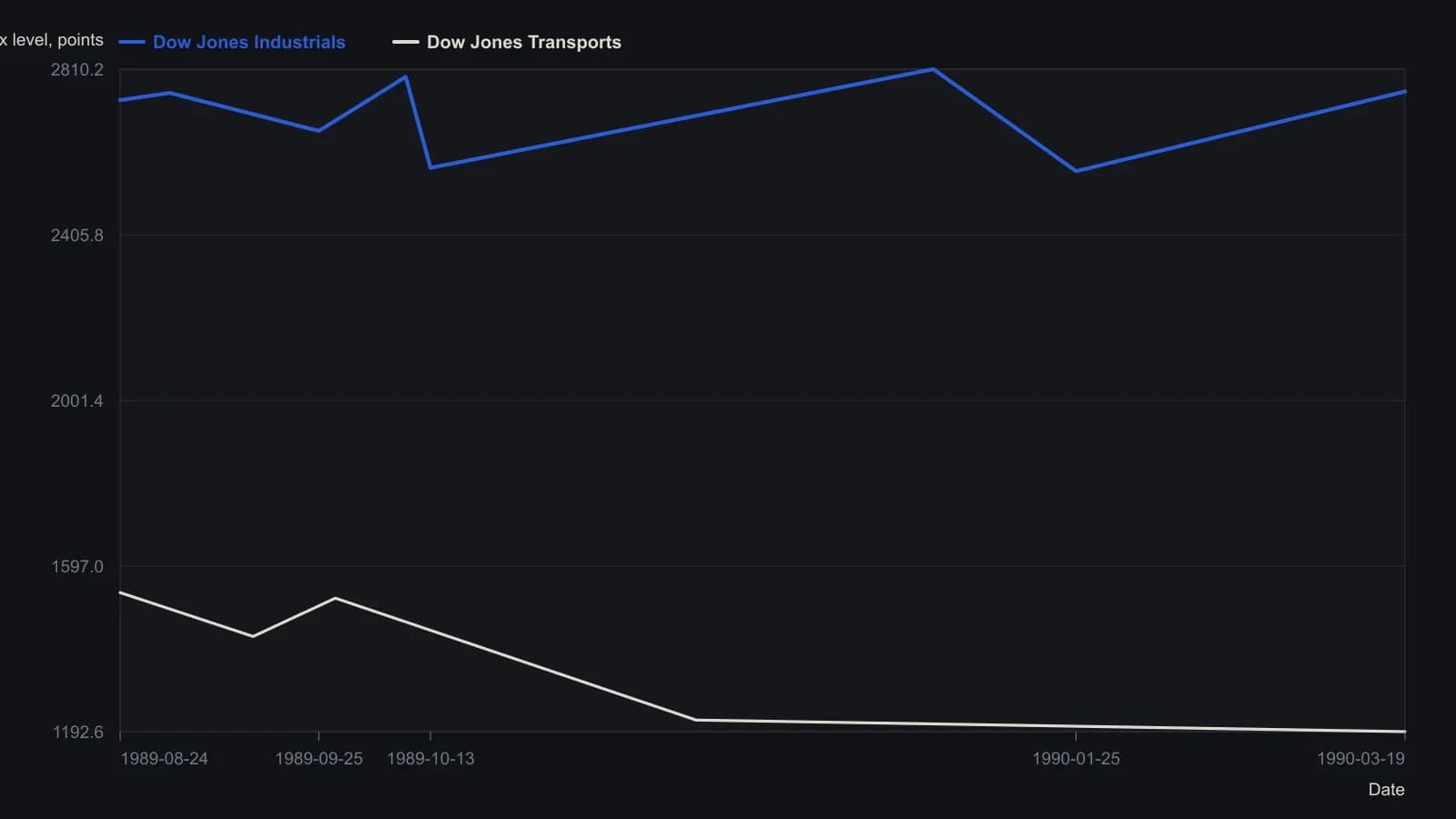
Only dated turning points stated in the text are plotted; segments between them are not a daily sample. January 1990 lows of 2543.24 (industrials) and 1031.83 (transports) are omitted because no calendar day is given.
Split breadth after the warning
After that primary-trend warning, large-capitalization industrials could still occupy a wide trading range and print later highs, while the transportation average and more speculative over-the-counter prices deteriorated. That pattern is split market-breadth rather than a single-index verdict. Participation across the industrial average, the transportation average, and more speculative listings had come out-of-gear.
After the last jointly confirmed high, a sequence of higher industrial highs against lower transportation highs is another nonconfirmation inside a still-classified bull phase. It is treated as a caution about strain, not as a completed trend change.
All readings on this track · 29 readings
- 1982A bounded-risk entry separates a forecast from a trend
- 1984Critiquing reward bias, single-scale charts, and exact-turn forecasts
- 1990Constructing dual-average primary-trend confirmation
- 1991Two-average confirmation before a primary reversal call
- 1991Delayed confirmation is not Dow Theory divergence
- 1991Confirmation delay and breadth divergence in a two-average case
- 1992Utilities as a rate-regime lead for equities
- 1992Critiquing unconfirmed Dow rallies with volume
- 1993When Dow Theory signals fail after the decision-makers change
- 1994Market life expectancy as a risk filter
- 1994Score industrial and transport sync before calling an intermediate-trend signal
- 1997A 1995 industrial-average breakout mapped from component trends
- 1998Confirm Dow trends with Market breadth and Head and shoulders
- 1999Confirming an equity idea with rate, commodity, and index spreads
- 2001Why trend, range, and Dow rules need separate tests
- 2001Bear-market confirmation via prior correction troughs
- 2002Constructing a Dow line before breakout confirmation
- 2002Two-average confirmation as a swing-by-swing classroom drill
- 2002Withhold the hypothesis until the second average confirms: a 2001 case
- 2002A primary-bear case study in cycle speed, Dow theory, and pattern legs
- 2003Four index proxies as a bear-regime dashboard
- 2004Dual-average confirmation at shared prior highs
- 2004Confirmation as the second clock on a trend break
- 2004The confirmation-reaction planning window after a joint break
- 2005Dow confirmation as a two-average trend test
- 2008Related-average confirmation lag after a correction
- 2008Intermediate confirmation outranks secular phasing
- 2012Align swings to nested energy regimes
- 2016From nonconfirmation to a bearish primary trend change