1994issue C111-6
Score industrial and transport sync before calling an intermediate-trend signal
Confirmation treats a market swing as more reliable when a production-sector average and a goods-movement average move together in direction and intensity. This archive article turns that two-average chart into a classroom checklist: score the sync first, then read a delayed transport high trapped in a line-formation as resistance-capped nonconfirmation rather than a finished intermediate-trend signal.
- Confirmation is a two-average breadth test: an important swing is treated as more reliable when the industrial and transportation averages advance or decline together in both direction and intensity.
- A lasting move is described as needing primary-secondary-participation, with blue-chip industrials and secondary transports both joining the swing.
- Divergence is applied most usefully to the intermediate-trend, as a warning about the next month or two, not as an automatic major-trend label.
- A late transport high that only returns to the top of a line-formation is a support-resistance check for nonconfirmation, not proof that the intermediate-trend signal is complete.
What confirmation measures
Dow Theory confirmation treats an important market swing as more reliable when a production-sector average and a goods-movement average advance or decline together.
The industrial average is assigned to production of goods and services, and the transportation average to the movement of those goods.
A confirmation reading is meant to ask whether the two averages match in direction and intensity, not only whether they jointly break a prior high or low.
When the averages split
When the averages are out of sync, the split is treated as a possible sign of economic deterioration and a precursor to a change in trend.
The industrials are treated as primary blue-chip issues and the transports as secondary issues. A lasting market move is described as requiring participation from both.
Two 1992 confirmation checks
In spring 1992 the industrial average reached new bull-market highs while the transportation average lost ground, and the industrials later declined sharply.
In October 1992 the industrials made new lows while the transports held. A turn stronger in the previously weaker average after a long decline is treated as a sign that a reaction is ending.
Divergence on the intermediate-trend
Divergence is applied most usefully to the intermediate-trend: an industrial advance without transport confirmation implies a possible shakeout over the following month or two.
Other price patterns are required before calling more than a severe intermediate correction.
A delayed high inside a line-formation
From the April 1994 lows through summer, the industrials rose while the transports lagged. A June 16 transport closing high arrived after nearly three months of industrial strength and only returned to the top of a 1540-1660 line.
After a mid-June 1994 shakeout the industrials later moved above 3800, while the transports formed a 1570-1630 line and again met resistance near 1660.
Dow Jones Transports weekly, early 1994: delayed high trapped in a line
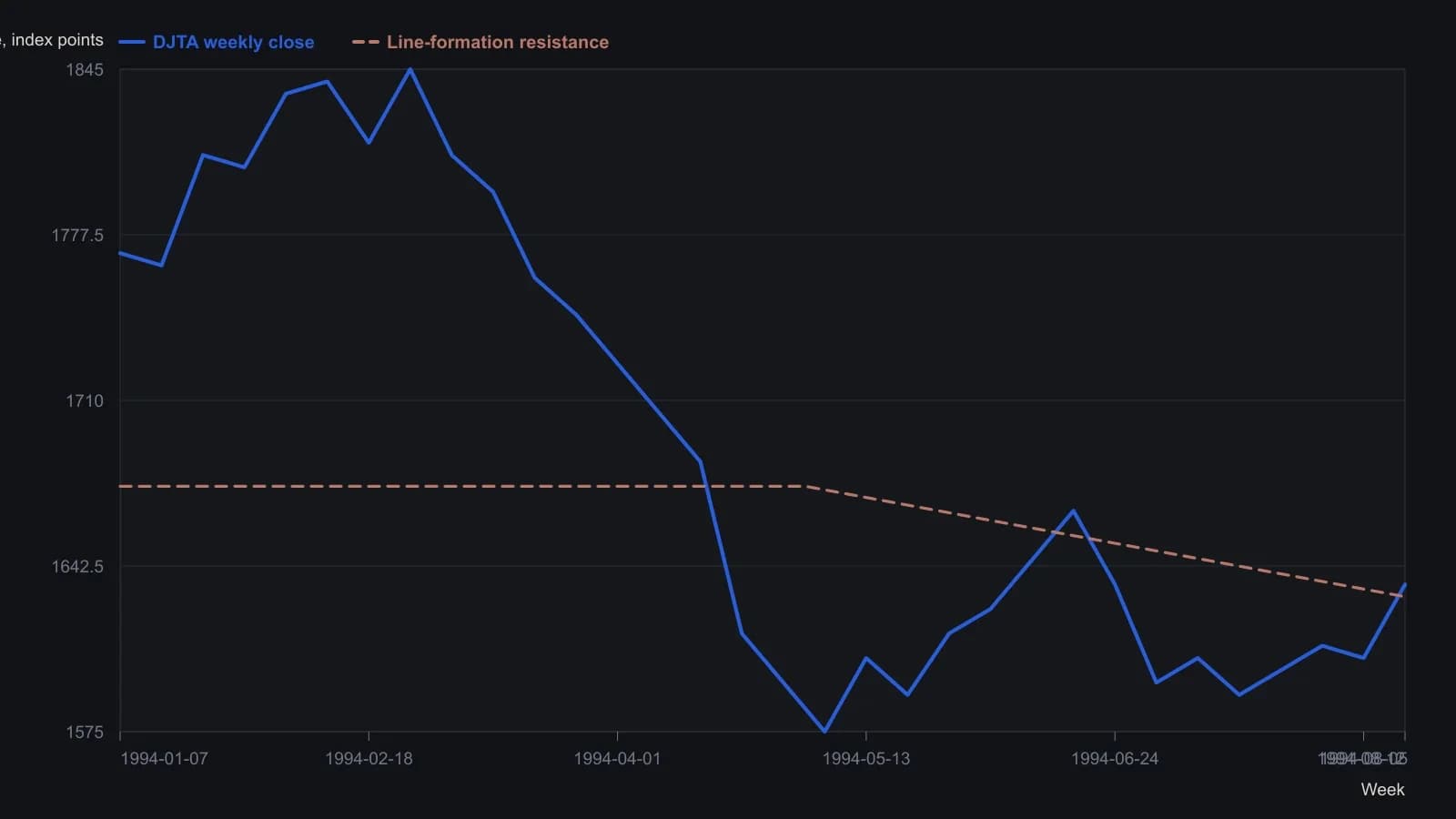
Digitized from weekly high-low bars on the 1993 ChartBook raster; closes are approximate to the nearest 5–10 index points. Horizontal lines on the source mark the line-formation band, not extra plotted series.
Editorial scoring order
Editorial reading: treat that delayed transport high as a support-resistance event at the top of a line-formation, not as confirmation that an intermediate-trend signal is complete.
Editorial sequence: first score whether the two averages share direction and intensity. Then ask whether the new print is a genuine breakout or only a return to a known cap. Failure of the transports to match in intensity or timely participation is nonconfirmation.
All readings on this track · 29 readings
- 1982A bounded-risk entry separates a forecast from a trend
- 1984Critiquing reward bias, single-scale charts, and exact-turn forecasts
- 1990Constructing dual-average primary-trend confirmation
- 1991Two-average confirmation before a primary reversal call
- 1991Delayed confirmation is not Dow Theory divergence
- 1991Confirmation delay and breadth divergence in a two-average case
- 1992Utilities as a rate-regime lead for equities
- 1992Critiquing unconfirmed Dow rallies with volume
- 1993When Dow Theory signals fail after the decision-makers change
- 1994Market life expectancy as a risk filter
- 1994Score industrial and transport sync before calling an intermediate-trend signal
- 1997A 1995 industrial-average breakout mapped from component trends
- 1998Confirm Dow trends with Market breadth and Head and shoulders
- 1999Confirming an equity idea with rate, commodity, and index spreads
- 2001Why trend, range, and Dow rules need separate tests
- 2001Bear-market confirmation via prior correction troughs
- 2002Constructing a Dow line before breakout confirmation
- 2002Two-average confirmation as a swing-by-swing classroom drill
- 2002Withhold the hypothesis until the second average confirms: a 2001 case
- 2002A primary-bear case study in cycle speed, Dow theory, and pattern legs
- 2003Four index proxies as a bear-regime dashboard
- 2004Dual-average confirmation at shared prior highs
- 2004Confirmation as the second clock on a trend break
- 2004The confirmation-reaction planning window after a joint break
- 2005Dow confirmation as a two-average trend test
- 2008Related-average confirmation lag after a correction
- 2008Intermediate confirmation outranks secular phasing
- 2012Align swings to nested energy regimes
- 2016From nonconfirmation to a bearish primary trend change