1990issue C091-8
Constructing dual-average primary-trend confirmation
A primary-trend reading is built from closing prices on an industrial composite and a confirming transportation composite. This editorial sequence locks successive highs and lows first, treats range lines as support-resistance that both averages must clear, and uses volume-price-analysis only as a veto.
- Build the primary-trend from successive highs and lows on two closing-price averages. The construction names direction only, not distance or duration.
- Treat constructed lines as support-resistance, and credit confirmation only when both averages break the same side of those ranges.
- Keep a contrary swing in the secondary-trend class while turning points still hold and the retrace stays between 33% and 66% of the current primary move.
- Add volume-price-analysis as a strength check after the price structure is set. Expanding activity should support the prevailing move and the test of a line.
What the construction produces
A primary-trend reading is built from closing prices on two averages. An industrial composite proposes direction. A transportation composite must confirm or reject that proposal.
The construction identifies the long-term direction only. It does not estimate how far prices will travel or how long that direction will last. The primary-trend is the long-horizon direction built from successive highs and lows and treated as the least easily manipulated layer.
Lock successive highs and lows first
Three trends are constructed as simultaneous layers: a long primary-trend, a contrary intermediate secondary-trend, and a short minor-trend. All three are read from successive highs and lows.
The minor-trend is the short, day-to-day swing. It can be mapped, but it is not required to define the primary reading. Triangular swings are not treated as valid trend structure.
DJIA primary-trend construction, January–November 1988
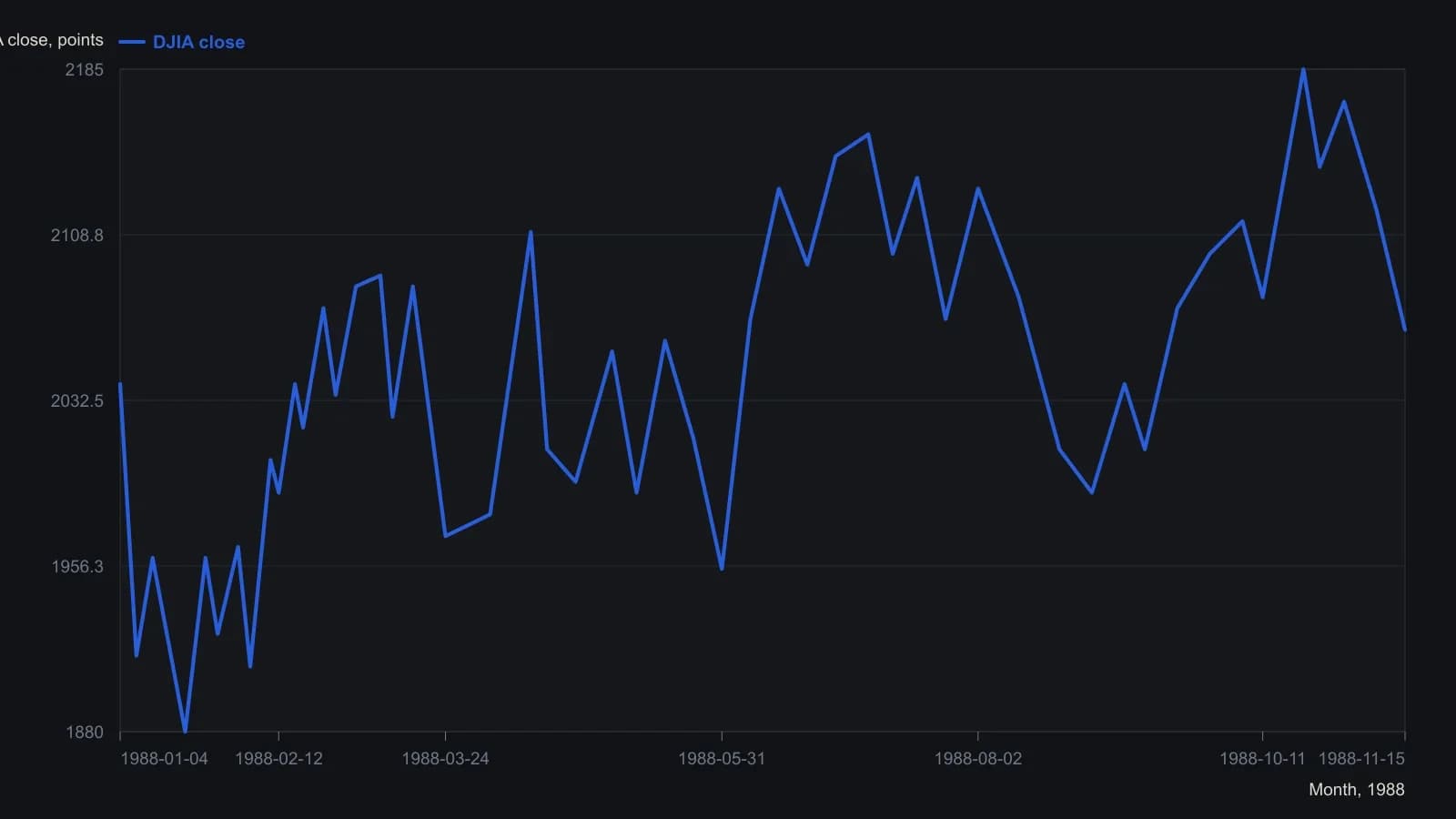
Closes are approximate to the 20-point grid. Calendar days are placed from monthly tick marks, so turning-point dates are reliable only to about a week.
Classify a contrary swing
A contrary swing is classified as a secondary-trend rather than a primary reversal by checking whether support-resistance turning points still hold and whether the move retraces between 33% and 66% of the current primary advance or decline. Support-resistance means prior highs, lows, and range boundaries that mark candidate turning points.
Amplitude and duration of the current swing are then compared with recent history. That comparison is used to judge whether the contrary move is still a secondary correction or a candidate primary reversal.
Require both averages to clear the same lines
Lines are a narrow sideways band of closings used as constructed support and resistance while holdings are accumulated or distributed. Confirmation is complete only when both averages form horizontal ranges and both break the same side of those lines. A one-average breakout is treated as incomplete.
A non-confirmed new high or new low is a warning, not a finished reversal, until both averages later break the prior range in the same direction. Non-confirmation is a split reading in which one average makes a new extreme or leaves a range while the other does not.
Use volume only as a veto
Volume-price-analysis is added as a strength check. Expanding activity on the prevailing move and shrinking activity on pullbacks supports continuation. The opposite mix implies the move is weakening. When price nears a range boundary or a prior high or low used as resistance or support, expanding volume is treated as stronger evidence that the penetration is valid.
Editorial interpretation: do not let volume-price-analysis invent the primary-trend. Use it only as a veto after the dual-average structure is in place. If activity disagrees with the prevailing move, or fails to expand as price tests a line, treat the hypothesis as able to fail even if one average has already broken out.
All readings on this track · 29 readings
- 1982A bounded-risk entry separates a forecast from a trend
- 1984Critiquing reward bias, single-scale charts, and exact-turn forecasts
- 1990Constructing dual-average primary-trend confirmation
- 1991Two-average confirmation before a primary reversal call
- 1991Delayed confirmation is not Dow Theory divergence
- 1991Confirmation delay and breadth divergence in a two-average case
- 1992Utilities as a rate-regime lead for equities
- 1992Critiquing unconfirmed Dow rallies with volume
- 1993When Dow Theory signals fail after the decision-makers change
- 1994Market life expectancy as a risk filter
- 1994Score industrial and transport sync before calling an intermediate-trend signal
- 1997A 1995 industrial-average breakout mapped from component trends
- 1998Confirm Dow trends with Market breadth and Head and shoulders
- 1999Confirming an equity idea with rate, commodity, and index spreads
- 2001Why trend, range, and Dow rules need separate tests
- 2001Bear-market confirmation via prior correction troughs
- 2002Constructing a Dow line before breakout confirmation
- 2002Two-average confirmation as a swing-by-swing classroom drill
- 2002Withhold the hypothesis until the second average confirms: a 2001 case
- 2002A primary-bear case study in cycle speed, Dow theory, and pattern legs
- 2003Four index proxies as a bear-regime dashboard
- 2004Dual-average confirmation at shared prior highs
- 2004Confirmation as the second clock on a trend break
- 2004The confirmation-reaction planning window after a joint break
- 2005Dow confirmation as a two-average trend test
- 2008Related-average confirmation lag after a correction
- 2008Intermediate confirmation outranks secular phasing
- 2012Align swings to nested energy regimes
- 2016From nonconfirmation to a bearish primary trend change