1998issue C031-7
Testable cycle rules instead of fear and greed
The archive treats cycle timing, oscillator confirmation, and a pre-trade checklist as one mechanical decision procedure. Entries, exits, and abstention stay the same written rules when fear and greed would otherwise reopen the plan.
- Shorter market cycles were meant to forecast price and time, not to justify untested discretionary systems.
- Counted low-to-low, low-to-high, and high-to-low intervals stayed too wide to trade until a central timing band projected the next top and bottom.
- Written notes failed as a control because a later sense of invincibility led traders to abandon them mid-trade.
- Oscillator turns were not signals by themselves. A complete pre-trade sequence required cycle location, confirmation, trend alignment, and a fixed risk budget.
Cycles as a forecast, not a license to trade
Cycle work began from the premise that if long-term rhythms exist, shorter market cycles can be used to forecast price and time rather than to churn accounts with untested systems.
The dominant cycle is the market rhythm whose measured low-to-low, low-to-high, and high-to-low intervals define the timing band and oscillator lookback used for the current holding period.
Counted intervals needed a timing band
Hand-counted low-to-low, low-to-high, and high-to-low intervals produced timing windows too wide to trade until the central portion of those observations was kept as a timing band. The next top and the next bottom were then projected from that band.
Fear and greed as the source of losses
Judgment under fear and greed was treated as the source of losses, so cycle counts and oscillators were quantified specifically to remove discretionary overrides from the decision process.
The mechanical decision procedure converts cycle timing, oscillator confirmation, and risk limits into the same entry, exit, and abstention rules a trader must follow when emotion would otherwise override judgment.
Notes did not survive a later winning stretch
Written notes about what worked after large givebacks failed as a control method, because a later sense of invincibility returned and the notes were abandoned mid-trade.
Unexplained early success was treated as a hazard because the same unexamined rules remain in force after the market regime turns and then destroy the account.
Oscillator turns were not enough
A usable cycle oscillator had to turn with price rather than wiggle. A stochastic whose lookback was taken from the traded cycle length was preferred for that reason, and remaining wiggle was treated as a false-entry risk.
Buying bottoms and selling tops was defined as valid only when the trade aligned with the prevailing trend, so oscillator turns were not sufficient signals by themselves.
S&P 500 daily RSI-M3 against the 30 buy line
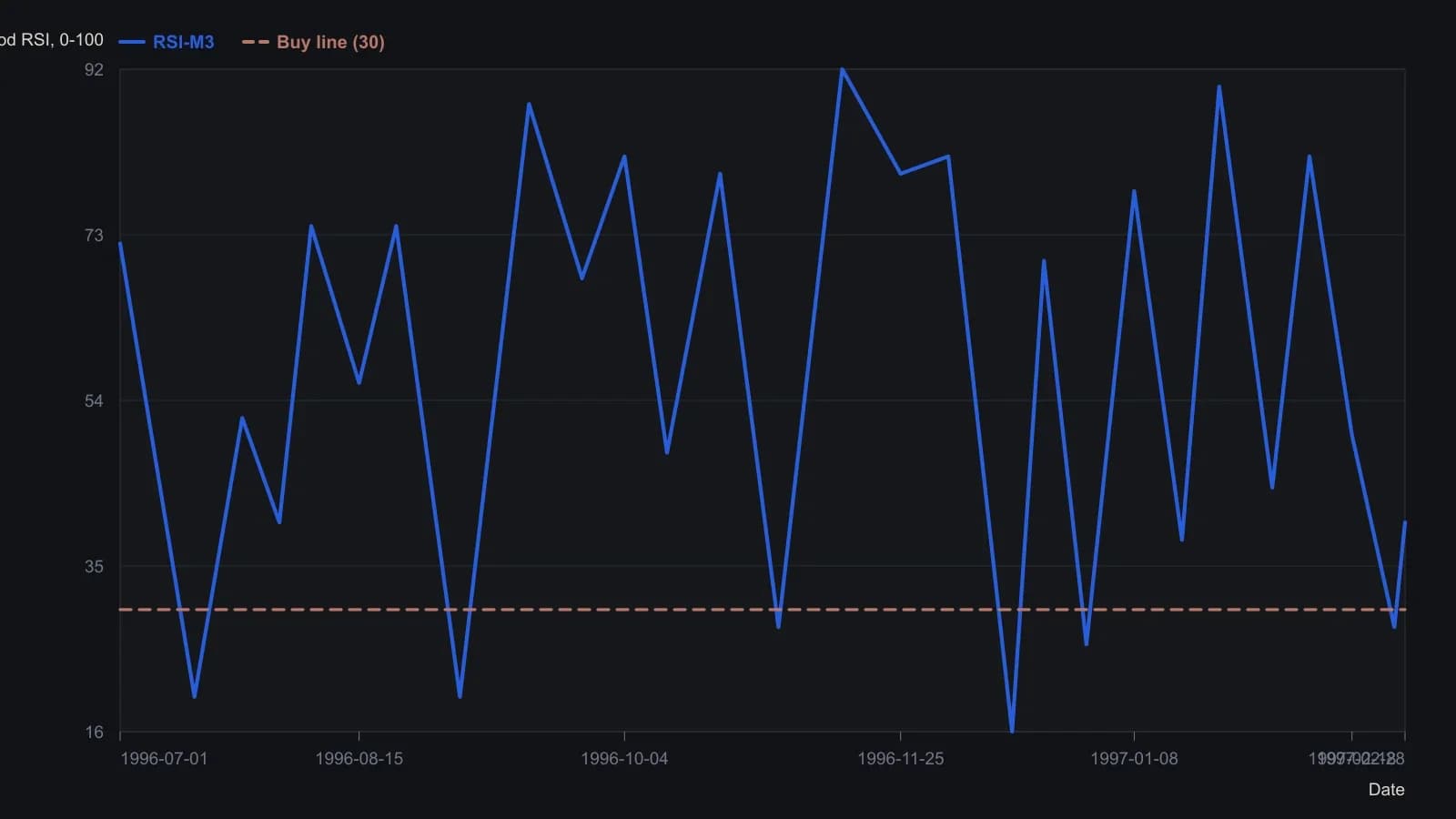
RSI-M3 is Bressert’s 3-period RSI smoothed with a 3-bar average. Digitized from the raster, so troughs and peaks are only good to a few oscillator points; dates are aligned to the chart’s month marks, not to a printed table.
A checklist before any order
The pre-trade sequence had to be complete before an order was placed: cycle location, oscillator confirmation, trend alignment, and a fixed risk budget.
Intraday strategy changes and trading for excitement rather than for a planned outcome were listed among the cardinal process failures that break a mechanical plan during market hours.
Lasting control was attributed to a structured game plan unique to the trader's temperament. That plan required a comfortable risk size, an explicit market path, and extended chart practice, rather than any single shared market technique.
All readings on this track · 31 readings
- 1982Cycle phase windows for chart signal filters
- 1987Constructing a cycle-scaled trend oscillator
- 1987Constructing a dominant-cycle grid from marked lows
- 1988Cycle lead from staggered exponential averages
- 1988Auditing the forty-month stock-price cycle
- 1989When long-wave dominant cycles cannot be disproved
- 1991Half-cycle average plot shift versus cycle attenuation
- 1991Half-cycle average contact as an amplitude-ratio test
- 1993Building a restoring-pull indicator from cycle frequency and volume
- 1995Regime filters for a dominant long wave
- 1995A cycle-tuned lead filter from bounded oscillators
- 1998Testable cycle rules instead of fear and greed
- 1999Nested Euro cycle timing as one checkable procedure
- 2002Constructing an instantaneous trendline from a dominant cycle
- 2002Half-cycle center of gravity oscillator from moving-average balance
- 2004Testing a locked forty-week cycle with a hold-or-sit-out rule
- 2005Nested timing bands for dominant-cycle confirmation
- 2005Dominant-cycle baselines versus policy-news narratives
- 2006Pairing a dominant-cycle horizon with trend and oscillators
- 2006A dominant-cycle split into a trend filter and residual Relative Strength Index
- 2007Construct a momentum difference from the dominant cycle
- 2007Naive dominant-cycle rules fail without crowd tests
- 2012Constructing a dominant-cycle forecast as a timing window
- 2012Open-parameter construction of dominant-cycle baselines
- 2013Using a second-term election to check a predeclared dominant-cycle forecast
- 2014Constructing a dominant-cycle forecast baseline
- 2014Quotient transform as an early-onset trend filter
- 2014Construct a trough-to-trough cycle map with the Detrended Price Oscillator
- 2015Dominant-cycle alignment before an earnings catalyst
- 2017Causal reverse exponential average for cycle and trend
- 2020Constructing a cycle-plus-trend oscillator from a one-wavelength chord