2007issue C041-2
Construct a momentum difference from the dominant cycle
Differencing subtracts an earlier observation from the latest one and yields a signed series that regularly crosses through zero. On a teaching sine wave, a half-cycle interval keeps full amplitude and coincident turns, while shorter or longer lookbacks trade amplitude for lead or lag.
- Differencing subtracts an earlier observation from the latest observation over a fixed interval and yields a signed series that regularly crosses through zero.
- On a teaching 20-period sine wave, a 10-step half-cycle interval keeps full amplitude and coincident highs and lows.
- A 5-step interval turns early with half the amplitude, a 15-step interval turns late with half the amplitude, and a full-period interval returns zeros.
- A shorter lookback is more exposed to random false turns, a longer lookback can miss much of an extended move, and a packaged default used without inspecting cycles is a construction risk.
Differencing as a signed series
Differencing subtracts an observation from a fixed number of steps earlier from the latest observation and yields a signed series that regularly crosses through zero.
A single sine wave is only a teaching model for the differencing operation. Actual series combine several cycles, trend, and irregular fluctuation.
The teaching sine wave
The worked cyclical model is a sine wave with a period of 20 sampling steps, an amplitude of 10, and a central value of 100.
On that 20-period wave, a 10-step difference reproduces the original series with no amplitude loss and coincident highs and lows.
A 5-step difference on the same wave keeps a similar shape, halves the amplitude, and turns before the original series, which is also where a split between the indicator and the source path can appear.
A 15-step difference on the same wave halves the amplitude and turns after the original series.
The half-cycle interval
The interval that maximizes difference amplitude and aligns turns with the modeled cycle is one-half the cycle period. That half-cycle interval is the differencing lookback equal to one-half the period of the cycle under study.
Size the lookback from the dominant cycle, the repeating up-and-down component whose measured period sets the interval. Count period in sampling steps from any point to the next equivalent point, often between successive highs or lows.
Amplitude is the distance from a cycle's central value to an extreme high or low. Moving away from that half-period in either direction shrinks amplitude, and an interval equal to the full period returns zeros.
Leading and lagging differences
An interval shorter than half the cycle can turn early but, with reduced amplitude, is more exposed to random false turns. That earlier series is a leading difference.
An interval longer than half the cycle yet shorter than the full period lags and can miss much of an extended move. That later series is a lagging difference.
A packaged default interval used without inspecting the data for cycles is treated as a construction risk.
Teaching sine wave with a 20-day period
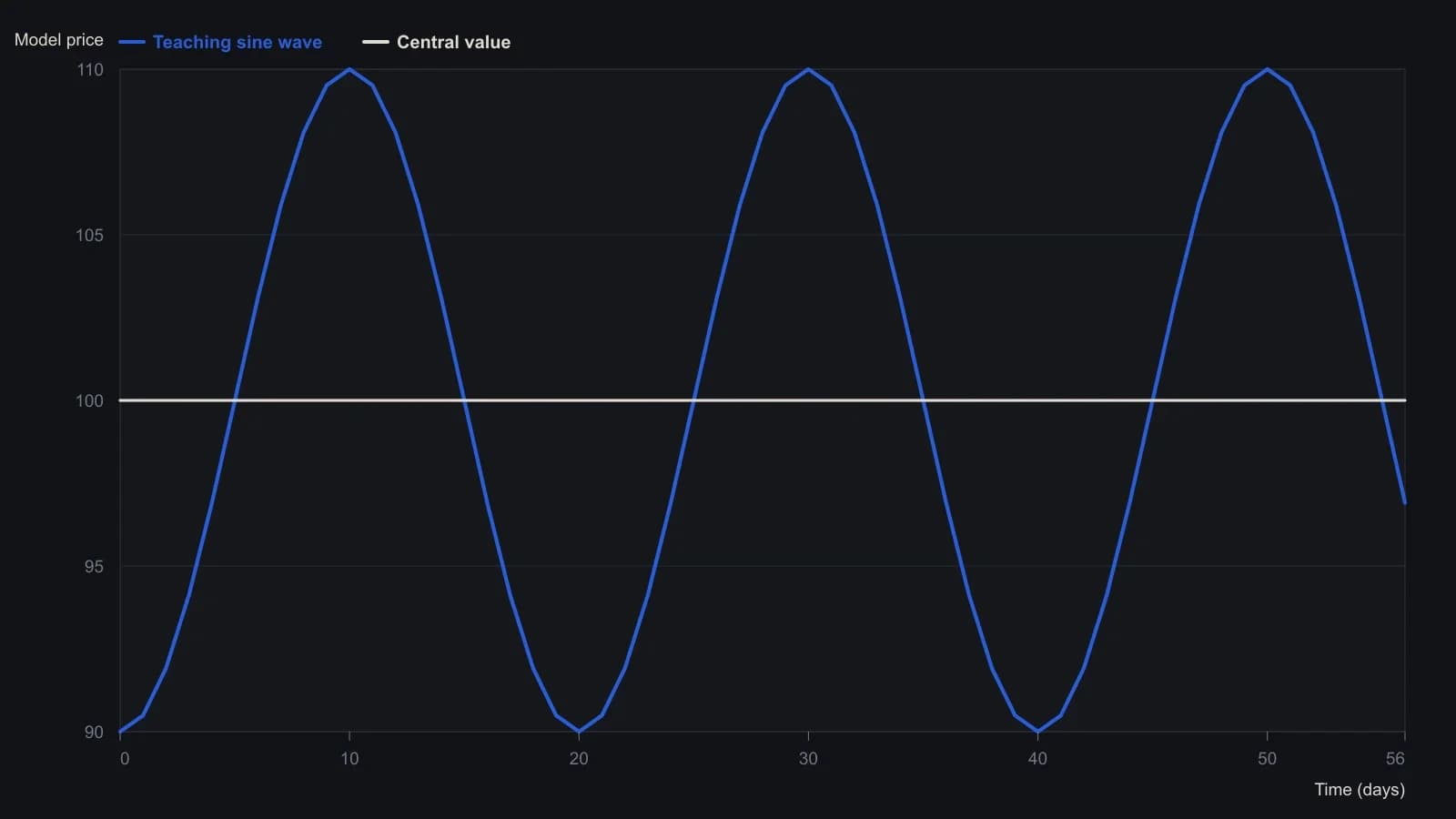
The source uses this sine only to show how a differencing interval relates to cycle length, and warns that real prices also contain trend, other cycles, and noise.
All readings on this track · 31 readings
- 1982Cycle phase windows for chart signal filters
- 1987Constructing a cycle-scaled trend oscillator
- 1987Constructing a dominant-cycle grid from marked lows
- 1988Cycle lead from staggered exponential averages
- 1988Auditing the forty-month stock-price cycle
- 1989When long-wave dominant cycles cannot be disproved
- 1991Half-cycle average plot shift versus cycle attenuation
- 1991Half-cycle average contact as an amplitude-ratio test
- 1993Building a restoring-pull indicator from cycle frequency and volume
- 1995Regime filters for a dominant long wave
- 1995A cycle-tuned lead filter from bounded oscillators
- 1998Testable cycle rules instead of fear and greed
- 1999Nested Euro cycle timing as one checkable procedure
- 2002Constructing an instantaneous trendline from a dominant cycle
- 2002Half-cycle center of gravity oscillator from moving-average balance
- 2004Testing a locked forty-week cycle with a hold-or-sit-out rule
- 2005Nested timing bands for dominant-cycle confirmation
- 2005Dominant-cycle baselines versus policy-news narratives
- 2006Pairing a dominant-cycle horizon with trend and oscillators
- 2006A dominant-cycle split into a trend filter and residual Relative Strength Index
- 2007Construct a momentum difference from the dominant cycle
- 2007Naive dominant-cycle rules fail without crowd tests
- 2012Constructing a dominant-cycle forecast as a timing window
- 2012Open-parameter construction of dominant-cycle baselines
- 2013Using a second-term election to check a predeclared dominant-cycle forecast
- 2014Constructing a dominant-cycle forecast baseline
- 2014Quotient transform as an early-onset trend filter
- 2014Construct a trough-to-trough cycle map with the Detrended Price Oscillator
- 2015Dominant-cycle alignment before an earnings catalyst
- 2017Causal reverse exponential average for cycle and trend
- 2020Constructing a cycle-plus-trend oscillator from a one-wavelength chord